
Quick Answer
The most defensible precious-metals forecast for 2026 through 2051 is not a single line aimed at a single number. It is a set of conditional paths. Gold is primarily a monetary and reserve asset with jewelry and technology demand around the edges. Silver is both an investment metal and a high-volume industrial input. Platinum is a supply-concentrated industrial metal with meaningful jewelry and investment markets. Palladium remains unusually dependent on gasoline-vehicle catalysts. A forecast that treats the four as interchangeable will almost certainly fail for the wrong reasons.
All Metal Prices' central scenario uses rounded annual-average equivalents, not intraday targets. It begins with 2026 planning anchors of about $4,700 per ounce for gold, $70 for silver, $1,950 for platinum, and $1,450 for palladium. Those anchors are consistent with the 2025 LBMA averages, the World Bank's mid-2026 projections for gold, silver, and platinum, and the 2026 palladium market described by Johnson Matthey and the World Platinum Investment Council. From there, the central path reaches approximately $12,300 gold, $175 silver, $4,400 platinum, and $1,400 palladium in 2051. These figures are not promises. They are the midpoint of a transparent scenario exercise intended to make assumptions testable.
The wide ranges matter more than the midpoint. By 2051, a relatively stable monetary regime could leave gold near $6,000, while repeated fiscal, currency, or geopolitical shocks could carry it above $25,000. Silver could plausibly finish near $50 if industrial thrifting and abundant recycling dominate, or around $500 in a combined monetary and industrial squeeze. Platinum could range from roughly $1,400 to $10,000 depending on mine supply, substitution, hydrogen deployment, and recycling. Palladium has the widest structural disagreement: a battery-electric transition could push it toward $450, while hybrid-heavy transport, mine closures, or Russian supply disruption could still produce periods above $4,500.
Forecast horizon: publication on August 24, 2026 through December 31, 2051. Prices are nominal US dollars per troy ounce unless otherwise stated. This report is research, not personalized investment, legal, accounting, or tax advice.
Key findings
- Gold has the clearest long-run monetary case. Central-bank diversification, reserve management, fiscal risk, and the slow response of mine supply give gold the strongest probability of preserving a durable monetary premium. Its greatest threat is not technological obsolescence but a long period of high real yields, credible fiscal repair, and reduced official-sector demand.
- Silver has the strongest combination of monetary optionality and industrial volume, but that combination cuts both ways. Solar, electronics, vehicles, grids, and data infrastructure support demand; thrifting, substitution, and price-sensitive recycling can cap it. Silver is likely to remain the most volatile of the four major precious metals.
- Platinum begins the forecast in a genuine deficit regime. Its long-run outcome depends on whether automotive substitution, chemical and glass uses, jewelry, investment, and hydrogen applications replace the demand eventually lost as internal-combustion vehicles decline.
- Palladium faces the clearest secular demand headwind because most demand is automotive. It can still rally violently when supply is interrupted, hybrids gain share, recycling disappoints, or low prices close mines. A weak long-run central case does not imply a smooth decline.
- For physical buyers, the quoted metal price is only the first number. The relevant economics are benchmark price, retail ask, dealer repurchase bid, total carrying cost, and inflation-adjusted value. A metal can rise while a poorly chosen product still underperforms because the initial premium is never recovered.
- For sellers, provenance will become more valuable. Serial numbers, assay records, chain-of-custody data, vault statements, invoices, and digitally verifiable bar histories should reduce friction and widen the number of buyers willing to quote aggressively.
- Tokenisation will change how claims on metal are moved, but it will not eliminate old questions. The decisive issues will remain legal title, bankruptcy treatment, custody, audits, redemption, settlement finality, and the ability to verify that the promised metal exists.
- The forecast should be revised, not worshipped. A useful monitoring schedule compares actual prices and balances with the assumptions in this report at least once a year, and immediately after a structural break in monetary policy, mine supply, automotive technology, or market regulation.
Scope, Definitions, and Forecast Discipline
This paper forecasts the market for buying and selling four metals - gold, silver, platinum, and palladium - rather than forecasting mine equities, jewelry brands, numismatic rarities, or leveraged derivatives. It includes physical coins and bars, wholesale bullion, exchange-traded products, futures, allocated accounts, unallocated claims, recycling, and emerging tokenised forms of ownership. It treats 2051 as a horizon for scenario analysis, not as a date for false precision.
The forecast starts from complete 2025 annual averages published by the London Bullion Market Association: $3,431.54 for gold, $40.03 for silver, $1,274.73 for platinum, and $1,150.29 for palladium. The first forecast year is already partly observed. The World Bank reported in June 2026 that gold, silver, and platinum had reached record nominal levels earlier in the year, then retreated sharply in the second quarter. It nevertheless projected 2026 annual-average gains of about 37% for gold, 76% for silver, and 53% for platinum, followed by declines in 2027. This unusual starting point is crucial: a 25-year forecast launched after a large revaluation should not simply extend the first-year slope (LBMA 2026a; World Bank 2026b).
An annual average is not a year-end close, a guaranteed transaction price, or the highest print within a year. A metal can average $5,000 while trading hundreds of dollars above and below that figure. Physical buyers may pay a premium above the benchmark, and sellers may receive a bid below it. A quoted retail price can also include fabrication, distribution, card fees, tax, shipping, insurance, or a dealer's inventory risk. The benchmark is therefore a reference point, not a receipt.
The paper uses three scenarios. The stability scenario assumes credible monetary institutions, moderate inflation, positive real interest rates, broad access to mine capital, faster substitution, and effective recycling. The central scenario assumes periodic inflation and geopolitical shocks, moderate global growth, incomplete fiscal repair, continued central-bank gold demand, persistent but manageable supply constraints, and uneven adoption of clean technologies. The stress scenario assumes repeated currency and fiscal strain, severe supply interruptions, slower mine response, strategic stockpiling, or a monetary revaluation that raises investment demand beyond ordinary industrial fundamentals. No probability weights are assigned because the data do not justify them over twenty-five years.
The report's numbers are nominal US dollars. They therefore combine changes in the metal's real value with changes in the purchasing power of the dollar. To keep that distinction visible, the central 2051 prices are also translated into 2026-dollar equivalents using a 2.5% annual inflation assumption. That is not an inflation forecast. It is a measuring stick. At 2.5% inflation, one 2051 dollar would buy only about 54 cents of 2026 purchasing power.
Five prices in every long-term physical-metal decision
The history of precious-metal retailing is full of analyses that stop at spot price. A useful long-horizon forecast must track five different values:
- Benchmark price: the wholesale reference, usually expressed per troy ounce for a specified metal and delivery convention.
- Retail ask: the amount required to acquire a particular coin, bar, round, or account position after premiums and fees.
- Immediate bid: the amount a dealer, refiner, market maker, or platform would pay for the same asset now.
- Carrying and exit cost: storage, insurance, financing, custody, shipping, assay, platform charges, tax, and the expected spread at sale.
- Real value: the proceeds measured in purchasing power rather than nominal dollars.
These five values explain why a correct direction can still produce a disappointing investment. A buyer who pays a 25% premium for an illiquid product may need a substantial benchmark rally before breaking even. A seller who ignores collectible, brand, or provenance value may accept a melt-based quote for an object worth more intact. A token holder may track spot perfectly but discover that redemption is expensive or legally restricted. Price direction matters; transaction architecture determines how much of that direction reaches the owner.
The 2026 Starting Point
A record year followed by a meaningful pullback
The forecast begins in a market that has already experienced the kind of dislocation normally reserved for a stress scenario. The World Bank's precious-metals index rose 24% in the first quarter of 2026 after fourteen consecutive monthly gains through February. By June, gold was about 15% below its February peak, while silver and platinum were roughly 25% below their January records. The same institution still expected its precious-metals index to average 42% higher in 2026 and then fall 8% in 2027. The combination - record annual averages and large drawdowns inside the same year - is a warning against treating a bullish long-term thesis as a promise of a smooth path (World Bank 2026a, 2026b).
The macroeconomic setting is equally unstable. The IMF's July 2026 update projected global growth of 3.0% in 2026 and 3.4% in 2027, with headline inflation rising from 4.1% in 2025 to 4.7% in 2026 before easing. It described a world split between a negative energy and geopolitical shock and a positive technology-investment cycle. That mixture can support gold through uncertainty while simultaneously damaging industrial-metal demand if energy costs and trade fragmentation weaken manufacturing (IMF 2026).
Gold: official demand remains structural, not automatic
Gold entered the forecast with unusually broad institutional support. In the World Gold Council's 2026 survey, 89% of responding reserve managers expected global central-bank gold reserves to increase during the next twelve months, and a record 45% expected their own institutions to add gold. Actual buying remained uneven: the Council reported 289 tonnes of net purchases in the second quarter, but first-half demand was the lowest since 2022. This distinction matters. The official sector can remain a structural buyer while changing the pace of buying from quarter to quarter (World Gold Council 2026b, 2026c).
High prices also redistribute demand. Jewelry volume tends to weaken as affordability falls, while recycling rises and investment may become more sensitive to real yields, currencies, and momentum. The World Gold Council's second-half 2026 outlook expected investment to remain the primary source of demand growth, central banks to remain significant buyers, jewelry volumes to stay under pressure, and mine and recycling supply to respond only modestly. The long-run forecast therefore assumes continued official and private demand, not unlimited demand at every price (World Gold Council 2026d).
Silver: deficit does not mean shortage at any price
The Silver Institute expected a sixth consecutive annual market deficit in 2026, estimated at 67 million ounces. It projected total supply of roughly 1.05 billion ounces, mine production near 820 million, and physical investment of about 227 million. Industrial fabrication was expected to slip about 2% to roughly 650 million ounces as photovoltaic manufacturers continued to thrift and substitute silver. The market can therefore be both structurally tight and responsive: above-ground bullion can bridge deficits, price can suppress use, and recycling can rise (Silver Institute 2026a).
Silver's dual identity creates a feedback loop. Investment demand can absorb metal when gold rises or confidence weakens. At the same time, higher silver prices encourage manufacturers to redesign contacts, reduce paste loadings, substitute copper where feasible, and recover more scrap. Persistent deficits support the central case, but the scale of the long-run price response depends on how quickly technology and recycling alter the ounces required per unit of output.
Platinum and palladium: the divergence is already visible
Platinum began the period with a tighter balance than palladium. The World Platinum Investment Council expected platinum deficits to average about 331,000 ounces from 2026 through 2030, while palladium deficits were expected to turn into surpluses from 2027. Johnson Matthey's 2026 report likewise expected platinum to remain in deficit and palladium to move into a small surplus. Its forecast put palladium demand down 9% in 2026, largely because automotive use was expected to decline with internal-combustion production, while recycling recovered (WPIC 2026a; Johnson Matthey 2026).
The near-term data do not settle the next twenty-five years. Platinum demand is more diversified across automotive, chemical, glass, petroleum, jewelry, investment, medical, and emerging hydrogen applications. Palladium is more concentrated in gasoline catalysts, but the speed of battery-electric adoption, the durability of hybrids, emissions rules, substitution, and mine closures are uncertain. The central forecast therefore gives platinum a positive long-run slope and palladium a U-shaped path: decline as automotive demand contracts, then stabilization as lower prices rationalize supply and remaining uses become better balanced.
Forecast Methodology
What the model is designed to do
The model is an editorial planning framework, not a claim to econometric precision. It turns a small number of observable drivers into milestone ranges that can be reviewed against future evidence. It is designed to answer practical questions: What price path would be consistent with continued central-bank diversification? How much industrial growth would silver require to justify its premium? When would platinum deficits cease to matter because recycling and substitution caught up? How far could palladium fall before mine closures and reduced scrap supply tightened the market again?
The approach deliberately avoids year-by-year numbers. False precision grows with every additional column. Instead, it uses milestone years - 2026, 2030, 2035, 2040, 2045, and 2051 - and connects them with broad phases. The milestone values represent annual-average equivalents in nominal dollars. Actual annual prices may deviate dramatically, and intrayear extremes can be far outside the ranges implied by adjacent milestones.
The five-driver framework
- Monetary demand: real interest rates, inflation expectations, currency confidence, central-bank reserves, exchange rates, and the opportunity cost of holding a non-yielding asset.
- Industrial demand: vehicles, solar photovoltaics, electronics, chemicals, glass, medical devices, data infrastructure, petroleum refining, hydrogen, and yet-unidentified technologies.
- Primary supply: mine investment, ore grades, country concentration, labor, energy, regulation, permitting, capital costs, by-product economics, project lead times, and geopolitical disruption.
- Secondary supply: jewelry recycling, investment-bar liquidation, autocatalyst recovery, electronic waste, process scrap, photovoltaic waste, collection systems, and refinery capacity.
- Market structure: futures and benchmarks, exchange-traded products, dealer networks, vaulting, responsible-sourcing rules, digital provenance, tokenisation, regulation, settlement, taxes, and retail fraud.
The drivers interact. A higher price can attract investment and strengthen momentum, but it can also destroy jewelry demand, accelerate thrifting, and release scrap. Low prices can suppress recycling and close mines, eventually reducing supply. A forecast that treats demand and supply as fixed lines misses the mechanism by which commodity markets restore balance.
Scenario architecture
| Dimension | Stability / lower case | Central case | Stress / upper case |
|---|---|---|---|
| Monetary regime | Moderate inflation, credible fiscal repair, positive real yields, resilient reserve currencies | Periodic inflation and fiscal shocks; incomplete repair; continued diversification | Repeated currency, debt, banking, or geopolitical crises; monetary revaluation |
| Global growth | Broad productivity gains and stable trade | Moderate growth with uneven technology gains and recurrent disruptions | Weak or volatile growth with strategic stockpiling and fragmented trade |
| Mine supply | Capital available; projects permitted; stable jurisdictions | Slow response, rising costs, and periodic disruptions | Major closures, sanctions, conflict, or chronic underinvestment |
| Technology | Rapid thrifting and substitution; efficient recycling | Efficiency gains offset part, not all, of demand growth | Deployment outruns thrifting; substitution limited by performance or reliability |
| Market structure | Low spreads, trusted custody, effective regulation | More digital access and provenance, but mixed standards | Physical shortages, wide premiums, counterparty stress, and uneven capital controls |
The scenarios are conditional narratives. They are not assigned probabilities.
How the 2026 anchors were set
Gold, silver, and platinum anchors are rounded from the 2025 LBMA averages after applying the World Bank's projected 2026 percentage changes: approximately $4,700 gold, $70 silver, and $1,950 platinum. Palladium lacks an equivalent World Bank forecast in the cited table, so the $1,450 anchor is a rounded synthesis of observed 2026 trading, the LBMA analyst range, and the market-balance outlook from Johnson Matthey and WPIC. The anchors are meant to establish a common starting scale, not to compete with daily price feeds (LBMA 2026a; World Bank 2026b; Johnson Matthey 2026; WPIC 2026a).
The central path then applies declining nominal growth rates rather than a constant exponential curve. Gold receives the strongest long-run monetary growth assumption. Silver receives a similar but slightly lower compounding rate because industrial thrifting and recycling act as stronger brakes. Platinum rises from a deficit base but is capped by substitution and recycling. Palladium declines through the mid-2030s as vehicle demand shifts, then stabilizes when lower demand has been matched by lower primary and secondary supply.
Forecast error is part of the result
Forecasting records justify humility. The average of LBMA analysts materially underestimated all four 2025 annual averages. Gold's actual 2025 average exceeded the survey average by about 25%; silver, platinum, and palladium also finished above consensus. The error does not prove that professional forecasts are useless. It shows that the range, assumptions, and updating process are more informative than the apparent precision of a midpoint (LBMA 2026a).
A 25-year forecast will be wrong in detail. The objective is to be usefully wrong: to identify the variables that would cause a revision, to show the direction and approximate scale of that revision, and to prevent a reader from confusing a forecast with a guaranteed return. The tables should be read as a map of conditional outcomes, not a sales brochure.
Base-Case Milestones and Long-Range Bands
| Metal | 2026 anchor | 2030 | 2035 | 2040 | 2045 | 2051 |
|---|---|---|---|---|---|---|
| Gold | $4,700 | $5,400 | $6,600 | $8,000 | $9,800 | $12,300 |
| Silver | $70 | $78 | $92 | $112 | $138 | $175 |
| Platinum | $1,950 | $2,350 | $2,700 | $3,150 | $3,700 | $4,400 |
| Palladium | $1,450 | $1,250 | $1,100 | $1,150 | $1,250 | $1,400 |
Rounded scenario values. They are annual-average equivalents, not predicted daily highs or guaranteed year-end prices.
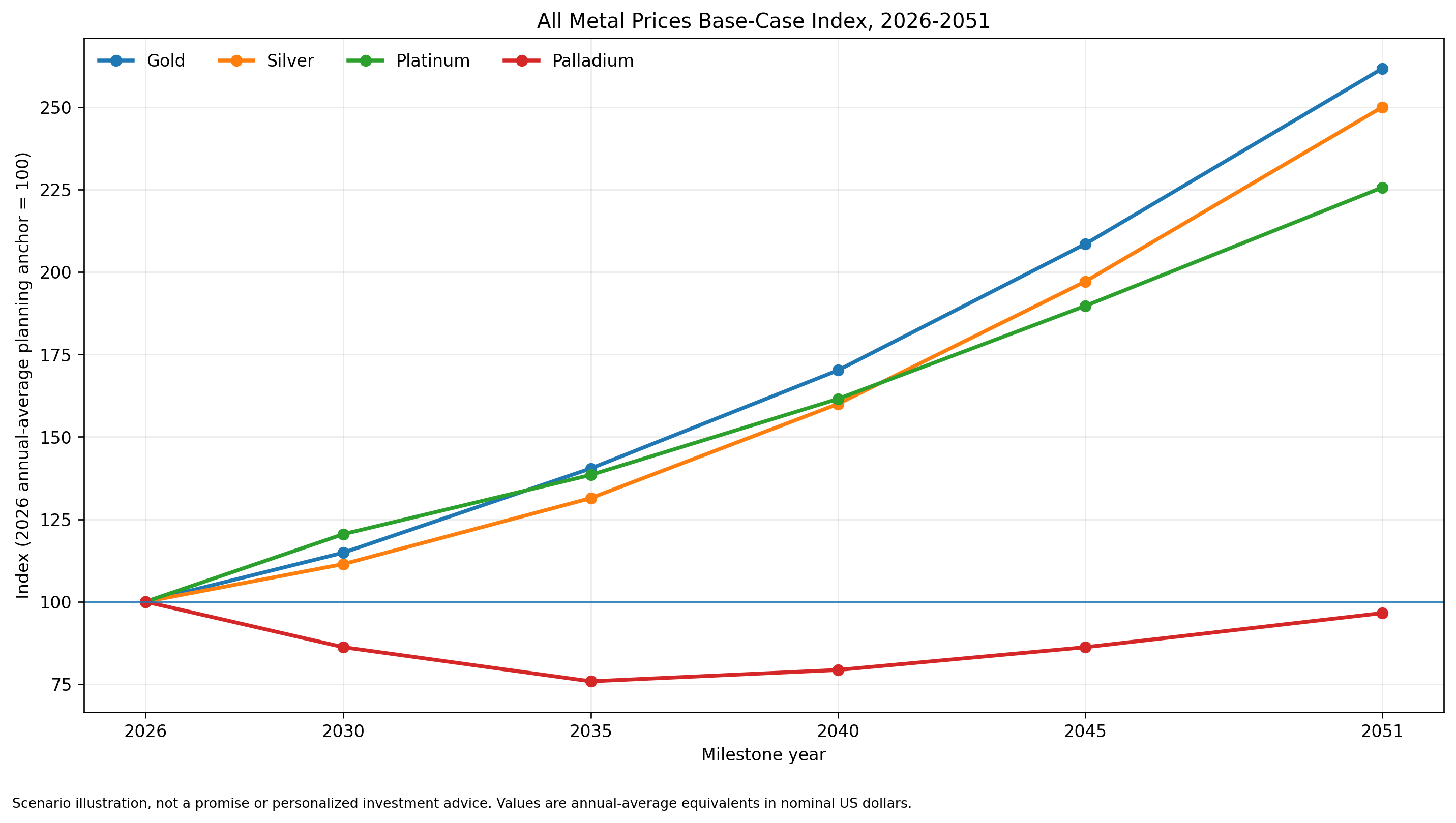
The chart highlights the report's principal divergence. Gold, silver, and platinum rise in nominal terms, although for different reasons. Palladium contracts first and only recovers gradually. The central path does not say palladium will be calm or unprofitable in every subperiod. A supply interruption can produce a sharp rally inside a declining secular trend, just as a monetary panic can produce a gold spike followed by several years of consolidation.
| Metal | Stability case | Central case | Stress case | Central in 2026 dollars* |
|---|---|---|---|---|
| Gold | $6,000 | $12,300 | $25,000+ | about $6,635 |
| Silver | $50 | $175 | $500 | about $94 |
| Platinum | $1,400 | $4,400 | $10,000 | about $2,373 |
| Palladium | $450 | $1,400 | $4,500 | about $755 |
*Deflated at 2.5% annually for 25 years. The stress case is not a ceiling; it is an order-of-magnitude planning band.
The inflation conversion changes the interpretation. Gold at $12,300 in 2051 sounds almost four times the 2025 average, but it is roughly $6,635 in 2026 purchasing power under the illustrative inflation rate. Silver at $175 becomes about $94. Platinum at $4,400 becomes approximately $2,373. Palladium at $1,400 becomes about $755. Nominal gains can coexist with modest real gains, especially for a metal whose industrial demand is shrinking.
Five Phases of the 2026-2051 Market
2026-2030: Revaluation, volatility, and inventory repair
The first phase begins after a dramatic 2025-2026 revaluation. Gold, silver, and platinum are likely to spend part of this period digesting higher prices. Jewelry demand should adapt through lower weights, higher recycling, and product redesign. Industrial users will accelerate thrifting. Investors will alternate between fear of missing further gains and fear that the rally has gone too far. The World Bank's projected 2027 correction is a plausible example of this digestion rather than a contradiction of the long-run case (World Bank 2026b).
Physical retail markets should remain more sensitive to sudden investment waves than wholesale benchmarks. Coin and small-bar fabrication cannot expand instantly. During shocks, retail asks may rise faster than spot, dealer buybacks may become selective, and delivery times may lengthen. During calm periods, premiums can collapse even while the metal price stays high. Buyers entering this phase should treat unusually large premiums as a separate bet on product scarcity.
Platinum's expected deficits through 2030 create the clearest inventory test. If above-ground stocks decline as WPIC expects, the market becomes more responsive to mine disruptions and investment flows. Palladium is likely to move in the opposite direction as automotive demand weakens and recycling recovers. Yet low prices will pressure high-cost producers, limiting how large and durable a surplus can become (WPIC 2026a; Johnson Matthey 2026).
2031-2035: The transport and solar inflection
By the early 2030s, vehicle powertrains should have moved far enough to make the platinum-palladium split clearer. The IEA's 2026 exploratory scenarios put electric vehicles near half of global car sales in 2035 and the global EV fleet at as many as 510 million, more than six times the 2025 level. Battery-electric vehicles use no exhaust catalyst, but hybrids and plug-in hybrids retain internal-combustion systems. The balance between those categories will determine whether autocatalyst demand falls quickly or merely changes composition (IEA 2026a).
Silver's transport exposure is more favorable because electrification increases electrical contacts, power electronics, charging, and grid investment. The Silver Institute has projected automotive silver demand growth through 2031, with battery-electric vehicles becoming the leading source of automotive silver demand before the end of the decade. The exact ounces per vehicle will fall as engineers thrift, but total vehicle electrification can still raise aggregate demand (Silver Institute 2025b).
Solar deployment will be the other critical test. The IEA expects nearly 4,600 gigawatts of renewable capacity additions between 2025 and 2030, with solar photovoltaics representing almost 80% of the increase. That scale supports silver consumption, while low module margins create a powerful incentive to reduce silver per watt. By 2035 the market should know whether deployment growth or material efficiency is winning the race (IEA 2025a).
2036-2040: Recycling becomes primary-market competition
The third phase should bring a larger wave of secondary supply. Vehicles sold in the 2020s and early 2030s will enter scrap streams. Photovoltaic panels will begin to retire in larger numbers. Electronic waste will continue to grow. The International Telecommunication Union estimated 62 million tonnes of e-waste in 2022, containing about $91 billion of metals, including $15 billion of gold, while less than one quarter was formally collected and recycled. Better collection and refining can convert part of that lost value into recurring supply (ITU 2024).
Recycling does not eliminate scarcity. Collection is costly, material is dispersed, ownership is fragmented, and recovery rates depend on design and regulation. High prices improve the economics but can also cause consumers to hold valuable products longer. Closed-loop industrial recycling may reduce gross metal purchases without creating metal available to investors. The central scenario assumes secondary supply takes a larger share of the market, but not enough to make primary mining irrelevant.
Provenance should also become more important during this phase. Refineries, exchanges, vaults, manufacturers, and regulators will have stronger incentives to distinguish responsibly sourced and verified recycled metal from anonymous material. A documented chain may command a better bid because it lowers assay, compliance, and reputational risk. This is especially valuable for gold, where the object can survive for generations and pass through many legal owners.
2041-2045: Mature clean-energy systems and slower unit growth
By the early 2040s, many clean-energy technologies should have moved from rapid adoption to replacement and optimization. Growth may slow, but the installed base will be enormous. Silver demand will depend less on the annual percentage growth of solar additions and more on replacement cycles, grid expansion, electronics, and whether new cell architectures remain silver-intensive. Platinum demand will depend on whether hydrogen, fuel cells, chemicals, glass, and other applications have become large enough to offset the long decline in combustion catalysts.
Commodity intensity usually falls when a material becomes expensive. Engineers have twenty years to redesign around bottlenecks. That does not mean demand disappears; it means demand becomes a moving target. The central scenario assumes that efficiency improvements prevent straight-line extrapolation from today's ounces per panel, vehicle, catalyst, or device. The stress scenario assumes deployment or performance requirements outrun those improvements.
The investment market should be more digital by this phase. Fractional allocated ownership, regulated tokenised claims, automated collateral management, and near-continuous trading could make wholesale-style access available to small investors. The Bank for International Settlements has described how tokenisation and atomic settlement can reduce reconciliation and settlement frictions. Those advantages will matter only if the claim is legally sound and the payment asset is reliable (BIS 2025, 2026).
2046-2051: Monetary trust, replacement demand, and the value of proof
The final phase is less about discovering whether precious metals still exist and more about discovering which functions remain valuable. Gold's role will depend on whether governments and investors still pay for an asset outside another party's liability structure. Silver and platinum will depend on a mature industrial ecosystem in which replacement demand and recycling interact. Palladium will depend on the residual internal-combustion fleet, hybrid policy, chemical uses, and the level to which mine supply has contracted.
By 2051, proof may be nearly as important as metal. A buyer should be able to verify refiner, serial number, assay, chain of custody, vault location, liens, insurance, responsible-sourcing status, and prior ownership without relying on a paper certificate that can be copied. The market will still need trusted institutions. Technology can reduce the cost of verification, but it cannot make an insolvent custodian solvent or convert an unsecured claim into allocated title.
The central case assumes precious metals remain part of both industrial civilization and the financial system. It does not assume that today's products, dealers, exchanges, or platforms survive unchanged. The durable assets are the metal, the legal claim, and the ability to transfer ownership. Everything around them is replaceable.
Gold Forecast, 2026-2051
Central path: $4,700 to about $12,300
Gold has the highest central 2051 price because it starts with the highest unit value and receives the strongest monetary compounding assumption. The central path rises from a 2026 annual-average anchor near $4,700 to $5,400 in 2030, $6,600 in 2035, $8,000 in 2040, $9,800 in 2045, and $12,300 in 2051. The implied long-run nominal growth rate is moderate relative to the extraordinary 2025-2026 rally. Most of the gain arrives through compounding over time, not through a permanent repetition of crisis-year returns.
The case rests on three persistent sources of demand. First, households in large gold-consuming markets continue to use gold as jewelry, savings, collateral, and intergenerational wealth. Second, investors use bars, coins, exchange-traded products, futures, and allocated accounts for diversification and crisis protection. Third, central banks hold gold as a reserve asset that is no private issuer's liability. The weight of each source changes with price, currency, policy, and income, but the diversity makes gold less dependent on any single industrial technology.
Official-sector demand and reserve diversification
Central-bank purchases are the central variable that separates the stability and stress cases. A reserve manager does not need to believe gold will outperform every asset. Gold can be useful because it diversifies credit, currency, and sanction risk and can be held in the central bank's own vaults. The 2026 survey results show strong intent, but intent is not a fixed annual tonnage. Purchases can slow when prices surge, budgets tighten, or desired allocations are reached (World Gold Council 2026c).
The stability case assumes official buying normalizes and becomes price sensitive. Gold still rises to about $6,000 by 2051 because nominal global output, incomes, and wealth grow, but the monetary premium expands little. The stress case assumes repeated reserve diversification, capital controls, fiscal dominance, or currency crises. Under those conditions, gold above $25,000 is conceivable in nominal terms, especially if the dollar itself loses purchasing power. The figure should not be read as a precise threshold; it marks a different monetary regime.
Mine supply is slow, but above-ground stocks are vast
Gold's supply structure is unusual. Nearly all gold ever mined remains above ground in some form, so the market is not limited to annual mine production. Higher prices can release jewelry, bars, coins, and institutional holdings. At the same time, new mine supply responds slowly because exploration, permitting, financing, construction, and ramp-up can take many years. The World Gold Council's long-term return framework uses global nominal GDP and the structure of above-ground stocks rather than treating mine output alone as the price engine (World Gold Council 2024).
This combination reduces the risk of literal exhaustion and increases the importance of ownership behavior. A few percentage points of existing stock moving from weak to strong hands can matter more than a modest change in mine output. The central forecast assumes mine production grows slowly and recycling rises with price, preventing an unlimited squeeze but not eliminating the monetary premium.
Real rates, currencies, and opportunity cost
Gold produces no coupon. Its opportunity cost rises when safe real yields rise and falls when cash and bonds lose purchasing power or credibility. Yet the relationship is not mechanical. Gold can rise alongside high nominal yields if inflation, fiscal risk, or geopolitical risk rises faster. It can fall during monetary easing if investors had already priced the move or if risk appetite recovers. The World Gold Council's 2026 scenario work explicitly framed gold outcomes as conditional on growth, yields, the dollar, risk, and momentum rather than a single-variable rule (World Gold Council 2026a).
Over twenty-five years, the central case assumes real rates fluctuate around moderate levels and fiscal credibility remains incomplete. A sustained decade of high real yields, low inflation, stable currencies, and reduced official demand would move gold toward the stability path. A cycle of negative real rates, financial repression, debt monetisation, or reserve fragmentation would move it toward the stress path.
Buying and selling gold under the forecast
For long-term physical buyers, recognizability and bid depth are more durable than novelty. Widely traded sovereign coins and standard bars from accepted refiners are likely to remain easier to compare and sell than obscure commemoratives, high-markup proof products, or proprietary shapes. Small denominations offer flexibility but usually carry higher percentage premiums. Large bars reduce fabrication cost but concentrate assay, transport, and counterparty risk.
Sellers should preserve invoices, photographs, serial numbers, packaging, assay documents, and custody records. Gold's high value per unit makes authentication economically worthwhile. As provenance systems improve, a bar with a clean, verifiable history may receive a faster and stronger bid than anonymous metal requiring full re-assay. Jewelry should be evaluated both as an object and as metal; destroying brand, antique, artistic, or gemstone value for a melt quote can be an expensive error.
Silver Forecast, 2026-2051
Central path: $70 to about $175
Silver's central path rises from roughly $70 in 2026 to $78 in 2030, $92 in 2035, $112 in 2040, $138 in 2045, and $175 in 2051. In indexed terms, the gain is close to gold's but the route should be more violent. Silver's smaller market, lower unit value, larger industrial share, and sensitivity to investor flows make it prone to overshoots in both directions.
The central case assumes industrial demand grows in gross terms but silver intensity falls in many applications. It also assumes investment demand remains episodic rather than permanently absorbing every ounce of deficit. The result is a rising long-run floor with recurring spikes and corrections. A 30% or 50% drawdown would not invalidate the central path; silver has historically combined powerful rallies with deep reversals.
Solar: scale versus thrifting
Solar photovoltaics are the defining industrial variable. The IEA's near-term deployment forecast is enormous, and solar represented almost four-fifths of projected renewable-capacity growth through 2030. Yet photovoltaic manufacturers have strong incentives to reduce silver per cell because metal cost affects module economics. The Silver Institute's 2026 outlook already expected industrial fabrication to soften partly because of thrifting and substitution in photovoltaics (IEA 2025a; Silver Institute 2026a).
The stability case assumes copper plating, thinner fingers, improved pastes, and other process changes sharply reduce silver intensity. Solar capacity can expand while silver use per gigawatt falls fast enough to keep total demand manageable. The stress case assumes high-efficiency architectures, reliability requirements, rapid deployment, and manufacturing bottlenecks keep silver essential, causing total demand to outrun thrift. The central case sits between them: silver per watt declines, but the installed base grows faster for much of the period.
Vehicles, electronics, grids, and data infrastructure
Silver's electrical conductivity gives it a broad role in contacts, switches, power electronics, sensors, charging systems, and control equipment. Electric vehicles can contain more electrical systems than conventional vehicles even though manufacturers continuously reduce material intensity. Grid modernization, renewable integration, automation, semiconductors, and data centers expand the number of applications in which small amounts of silver are dispersed across high-value equipment.
Dispersal is bullish for demand but difficult for recovery. A large bullion bar is easy to recycle; milligrams spread across millions of devices are not. The ITU's e-waste figures show the scale of recoverable value that current collection systems miss. The long-run silver balance will depend on whether regulation and product design make those tiny quantities economical to capture (ITU 2024).
Deficits, inventories, and the danger of simple arithmetic
A market deficit is not the same as an empty warehouse. Deficits are met by above-ground inventories, exchange stocks, investor holdings, producer hedging, and changes in fabrication demand. The 2026 deficit therefore supports tightness but does not imply a specific price. If investment holders are willing to sell at higher prices, the market clears without industrial shutdown. If holders refuse, lease rates, premiums, and prices can rise sharply until demand is destroyed or new supply appears.
The central scenario assumes cumulative deficits reduce the cushion but do not exhaust it. Mine supply grows slowly because much silver is produced as a by-product of lead, zinc, copper, and gold operations; a high silver price does not automatically justify a new mine if the host-metal economics are weak. Recycling rises, particularly after the mid-2030s, but collection and refining constrain the response.
Silver's monetary wildcard
Silver often behaves like leveraged gold during investment waves. Its lower price makes coins and small bars accessible, while its smaller market means new flows can have a larger price effect. The same structure makes the exit dangerous. When monetary fear subsides or leveraged positions are liquidated, silver can fall faster than gold even if industrial demand remains healthy.
The $500 stress case requires more than ordinary industrial growth. It assumes a combined event: strong monetary demand, persistent physical tightness, limited substitution, and a weaker dollar. Without that combination, triple-digit silver can still occur, but sustaining it as an annual average is harder. The $50 stability case assumes industrial efficiency and recycling offset growth while investment demand normalizes after the 2025-2026 surge.
Buying and selling silver under the forecast
Silver's low value-to-weight ratio makes transaction costs unusually important. Storage, shipping, insurance, and handling can consume a larger share of value than for gold. Small government coins may carry large premiums during retail shortages and then sell back near ordinary bullion bids after supply normalizes. Large bars usually reduce premium but are less convenient to divide, ship, and test.
A long-term buyer should compare the dealer's current repurchase bid before purchasing, not just the advertised premium. A seller with large quantities should compare local coin shops, national dealers, refiners, and wholesale routes on a net basis after freight, insurance, assay, and payment time. Tarnish rarely destroys metal value, but condition and original packaging can matter for products with a collectible or retail premium.
Platinum Forecast, 2026-2051
Central path: $1,950 to about $4,400
Platinum's central path rises from about $1,950 in 2026 to $2,350 in 2030, $2,700 in 2035, $3,150 in 2040, $3,700 in 2045, and $4,400 in 2051. The case is less monetary than gold's and less volume-driven than silver's. It rests on supply concentration, an initial deficit, a diversified industrial base, substitution between platinum-group metals, jewelry and investment demand, and a possibility - not a certainty - that hydrogen technologies become material users.
The path is intentionally moderate after 2030. A market can begin in deficit and still avoid an explosive price if higher prices reduce jewelry and investment demand, improve recycling, and encourage substitution. WPIC's forecast of average deficits through 2030 supports the early rise, but the later decades require new demand or continuing mine constraints rather than simply carrying the same deficit forward forever (WPIC 2026a).
Supply concentration and mine economics
Platinum mine supply is highly concentrated in southern Africa, with additional output from Russia, North America, and Zimbabwe. Concentration raises sensitivity to electricity, labor, capital, policy, logistics, and geopolitical risk. It also creates a complex basket economics problem: miners often produce several platinum-group metals together. Weak palladium or rhodium prices can reduce the profitability of an operation even if platinum is strong.
The stress case assumes chronic underinvestment, closures, political or energy disruption, and limited inventory. Under that combination, $10,000 platinum is possible in nominal 2051 dollars. The stability case assumes capital enters, mine performance improves, recycling grows, and demand substitution works, leaving platinum near $1,400 despite general inflation. The central case assumes supply remains constrained enough to preserve a scarcity premium without a permanent physical crisis.
Automotive substitution and the EV transition
Platinum benefits when automakers substitute it for more expensive palladium in gasoline catalysts, but it also faces the same ultimate challenge: battery-electric vehicles do not need exhaust catalysts. Hybrid vehicles complicate the transition because they retain engines and may require robust emissions control during frequent cold starts. Emissions standards can raise loadings per vehicle even as the number of catalyst-equipped vehicles falls.
The central forecast assumes automotive platinum demand declines gradually after the early 2030s rather than collapsing immediately. Substitution from palladium and a long hybrid tail cushion the first phase; battery-electric penetration dominates later. The critical monitoring variables are global production by powertrain, catalyst loading, platinum-palladium price ratios, emissions regulation, and recycling recovery.
Hydrogen: meaningful option, dangerous slogan
Platinum is used in proton-exchange-membrane fuel cells and electrolysers, giving it exposure to low-emissions hydrogen. The opportunity is real but often overstated in sales material. The IEA reported that low-emissions hydrogen remained less than 1% of global production in 2025 and that projects operational or at final investment decision were set to reach about 4.2 million tonnes per year by 2030 - strong growth from a small base, but far below earlier ambitions (IEA 2025b).
The central path assumes hydrogen becomes a useful, growing application without single-handedly transforming the market. The stress path assumes PEM technologies win a large share of electrolyser and fuel-cell deployment while thrift is limited. The stability path assumes competing technologies, delayed infrastructure, high costs, and low loadings keep platinum demand modest. Investors should monitor installed capacity and actual metal loadings, not announced project pipelines alone.
Jewelry, investment, and price identity
Platinum can gain jewelry demand when gold becomes expensive because retailers and consumers compare color, purity, durability, and ticket price. Johnson Matthey described Chinese retailers rotating gold inventory into platinum during the 2025 price surge. That response is price sensitive: if platinum becomes too expensive relative to gold, the advantage narrows. Jewelry can therefore stabilize demand without supporting any price level unconditionally (Johnson Matthey 2026).
Investment demand is smaller and more variable than gold's but can be decisive in a tight market. Coins, bars, ETFs, and Chinese futures access can absorb marginal ounces. The same ounces can return quickly when prices fall. Platinum's long-run valuation should therefore include an investment premium, but not assume permanent investor accumulation.
Buying and selling platinum under the forecast
Platinum retail markets are thinner than gold and silver. Product choice matters. A common sovereign coin or recognized bar may receive a stronger bid than an obscure round even if both contain the same metal. Dealer inventories and hedging capacity can change spreads quickly. Buyers should ask for the live repurchase bid and verify whether the dealer regularly trades the product.
Industrial scrap, jewelry, catalysts, and laboratory equipment require different selling channels. A refiner may pay more for homogeneous, documented material than a retail bullion dealer. Catalysts require sampling and assay because visual inspection cannot determine recoverable metal. Settlement terms, sampling rights, treatment charges, and accountability for residues can matter as much as the headline percentage of spot.
Palladium Forecast, 2026-2051
Central path: decline, stabilization, partial recovery
Palladium's central path is the only one that does not compound upward from the start. It moves from about $1,450 in 2026 to $1,250 in 2030 and $1,100 in 2035, then recovers to $1,150 in 2040, $1,250 in 2045, and $1,400 in 2051. In real terms, the 2051 central value is substantially below the 2026 anchor. The forecast reflects declining automotive demand offset later by mine closures, lower recycling, remaining hybrid and gasoline uses, and a smaller but better-balanced market.
The path should not be interpreted as a recommendation to short palladium for twenty-five years. Concentrated supply and a relatively small market can create violent rallies. A mine strike, sanction, export restriction, inventory squeeze, or slower EV adoption can move price far above the central line. The secular direction and the cyclical trade are different questions.
Automotive concentration is the core risk
Johnson Matthey estimated that the automotive sector accounted for more than 80% of palladium demand and projected total demand to fall 9% in 2026. The IEA expects the electric share of global car sales to approach 50% by 2035 in its exploratory scenarios. If battery-electric sales continue rising beyond that point, the installed base of catalyst-equipped vehicles will eventually shrink even if hybrids remain important (Johnson Matthey 2026; IEA 2026a).
The stability case, at roughly $450 in 2051, assumes battery-electric adoption is rapid, catalyst loadings fall, substitution toward platinum persists, and industrial uses do not replace automotive demand. The stress case, around $4,500, assumes hybrids dominate longer, emissions rules require high loadings, mine supply contracts sharply, Russian exports are disrupted, or investors create a squeeze. The central case assumes a slower transition and meaningful supply rationalization.
Why surplus forecasts can reverse
Palladium supply does not remain fixed while demand falls. Low prices reduce the value of autocatalyst scrap and can delay collection. They pressure primary mines, especially operations with high costs or weak by-product credits. Producers may close shafts, defer capital, or reduce output. A forecast surplus can therefore erode as the price that creates it damages future supply.
This reflexivity explains the U-shaped central path. The market weakens through the early 2030s as demand contraction outruns supply adjustment. Later, a smaller mining and recycling base approaches the remaining demand. Palladium may never regain its former inflation-adjusted peaks, but it need not become valueless.
Residual industrial and strategic uses
Palladium also serves electronics, chemical catalysts, dentistry, hydrogen purification, and other specialized uses. These sectors are too small to replace automotive demand at current scale, but they can set a floor after the vehicle market contracts. Strategic stockpiling can also matter because production is geographically concentrated and metal is difficult to substitute instantly in qualified industrial processes.
The critical question is not whether another application will be announced. It is whether annual ounces consumed in new applications grow faster than automotive ounces disappear. The forecast assumes they do not through the 2030s. A material revision would require verified, scalable demand rather than laboratory potential.
Buying and selling palladium under the forecast
Palladium bullion is a specialist market. Retail premiums and dealer spreads can be wide, especially when investor interest is low. A buyer should confirm that the intended exit channel actually trades the product, how the bid is calculated, and whether assay or delay is likely. The metal's volatility can make price locks and settlement timing important.
Sellers of catalysts should not infer value from the palladium spot price alone. The recoverable mix includes platinum, palladium, and rhodium, and yields vary by catalyst type, age, contamination, and processing. Competitive assay-based quotes are preferable to opaque per-piece offers for large or recurring lots. Documentation becomes especially valuable as theft controls and chain-of-custody requirements tighten.
Cross-Metal Drivers Through 2051
Inflation, real yields, and the US dollar
Gold and silver respond most directly to monetary conditions, but all four metals are priced internationally in currencies and financed through inventories, leases, and derivatives. Higher real yields can reduce investment demand and raise carrying costs. A stronger dollar can pressure dollar-denominated prices while local-currency prices rise elsewhere. Inflation raises mine, energy, labor, refining, and transport costs, creating a supply floor even when demand is weak.
The central case does not assume continuous dollar decline. It assumes alternating cycles in which inflation, growth, and policy credibility vary. This produces long stretches where metals lag other assets and shorter periods where they reprice abruptly. A portfolio decision should therefore consider opportunity cost and liquidity, not only the endpoint.
Fiscal capacity, sanctions, and reserve politics
Government debt and geopolitical fragmentation can increase demand for assets outside a single issuer's credit. They can also weaken growth and industrial demand. Sanctions may change which bars, refiners, banks, and vaults are acceptable even when the metal itself is chemically identical. The commercial value of provenance therefore includes legal eligibility, not merely purity.
The stress case assumes geopolitical shocks recur often enough to alter reserve behavior and physical flows. The stability case assumes institutions restore confidence and trade remains broadly integrated. Reality will likely alternate between both, which is why price ranges widen with time.
Mine investment, project lead times, and by-product supply
Precious-metal mine supply cannot be modeled from price alone. Gold and platinum projects face long discovery and permitting cycles. Silver is often a by-product, so its supply depends on base-metal investment. Palladium and platinum are co-produced with other PGMs, nickel, and copper. A high price for one metal may not rescue an operation if the total basket and cost structure are weak.
The central case assumes capital remains available but disciplined. Projects with strong grades, infrastructure, jurisdiction, and environmental performance advance; marginal projects struggle. Supply responds, but slowly enough that inventories and recycling remain essential buffers.
Recycling and urban mining
Recycling is the principal long-run bearish force that is compatible with a healthy economy. Higher collection rates can recover metal without new mines, reduce emissions, and lower dependence on concentrated jurisdictions. The ITU's e-waste data show a large gap between embedded value and documented recovery. Closing even part of that gap would add meaningful secondary supply (ITU 2024).
The effect differs by metal. Gold jewelry and bullion are already recycled efficiently because unit value is high. Silver is often too dispersed to recover economically. Platinum and palladium recycling depends heavily on the vehicle scrappage cycle and catalyst collection. The 2030s should therefore bring the largest incremental change for PGMs and electronic silver, while gold recycling remains a mature, price-sensitive flow.
Substitution, thrifting, and qualification time
Substitution is not instantaneous. A cheaper material must meet performance, durability, safety, and regulatory requirements, and manufacturers must qualify the new process. Once completed, however, substitution can permanently reduce demand. Platinum-for-palladium catalyst substitution is a recent example; copper-for-silver photovoltaic contacts are a potential future example.
Thrifting is subtler because the metal remains but less is used per unit. It can allow total deployment to grow without proportional metal demand. The central forecast assumes thrifting in all major industrial applications. The stress scenario requires either unusually rapid deployment or technical limits that keep unit intensity high.
Energy, water, and environmental constraints
Mining and refining require energy, water, infrastructure, and social license. Climate-related disruptions can damage operations and transport. Carbon policy can raise costs for high-emission supply while increasing demand for metals used in clean technologies. Responsible sourcing and due diligence will therefore affect both availability and market access.
The OECD's mineral guidance provides a risk-based framework for companies to identify and address human-rights, conflict, corruption, and financial-crime risks in mineral supply chains. By 2051, compliance is likely to be more integrated into pricing, finance, insurance, and eligibility for major markets rather than treated as a separate sustainability report (OECD 2016).
How Buying Precious Metals Is Likely to Change
Physical metal will remain, but product selection will become more deliberate
Coins and bars will not disappear simply because digital access improves. Physical possession solves a different problem: it removes some intermediary exposure and can provide portability, privacy within the law, and direct control. It also creates storage, theft, insurance, authentication, and liquidity problems. The future buyer will choose physical metal when those trade-offs fit the purpose, not because every form of metal ownership is equivalent.
Standardization should become more valuable. Products with recognized weight, fineness, manufacturer, serial number, and two-way dealer markets are easier to finance and resell. Decorative and collectible products can still be valuable, but the buyer should separate artistic or numismatic value from metal value and demand evidence for both.
Exchange-traded and allocated ownership
Exchange-traded products provide liquidity and eliminate personal handling, but the investor owns a security governed by offering documents. Allocated accounts identify specific bars or metal held for the client; unallocated accounts generally create a claim on a provider rather than ownership of identified pieces. Each structure has different fees, creditor rights, redemption rules, and operational risks.
Over the forecast period, institutional-quality custody should become available in smaller increments. That can reduce retail spreads and make periodic buying easier. It does not make every provider safe. Buyers should read the legal terms, auditor reports, insurance scope, bar lists, sub-custody arrangements, and redemption conditions rather than relying on the phrase 'backed by metal.'
Tokenised metal and 24-hour settlement
Tokenisation can divide ownership into small units, support around-the-clock transfer, automate collateral, and combine asset and payment settlement. BIS work on unified ledgers and Project Agorá demonstrates the broader technical direction toward programmable and atomic settlement. For precious metals, the most useful application is likely to be a verifiable digital claim on professionally vaulted, allocated metal rather than a token whose only support is a marketing assertion (BIS 2025, 2026).
A token should be evaluated as a legal and operational stack. Who owns the bar? Is the token holder a direct owner, trust beneficiary, secured creditor, or unsecured claimant? Where is the metal? Can it be pledged twice? Who audits it? What happens in bankruptcy? Is redemption practical at the holder's scale? Which law governs? Can transfers be frozen? A blockchain can make a bad claim move faster; it cannot repair the claim.
Premium comparison will become easier and more necessary
Price-comparison tools should reduce information asymmetry by showing benchmark, dealer ask, payment method, shipping, tax, and live repurchase bid together. A low advertised premium can be offset by card fees or a weak exit bid. The best consumer interface will calculate round-trip break-even rather than celebrating the purchase price alone.
The formula should be applied before purchase. If a silver product costs $120 delivered and can be sold immediately for $90, the benchmark must rise by one third merely to restore nominal break-even, assuming the spread does not change. That is a product decision, not a metal forecast.
Fraud will follow the new channels
The future market will contain old fraud in modern packaging: inflated markups, false scarcity, fake storage, nonexistent metal, unauthorized leverage, affinity sales, pressure tactics, fabricated audits, and manipulated tokens. The CFTC warns that precious-metal schemes often sell at inflated prices and charge high commissions while using fear about the financial system. No forecast can compensate for buying a claim that does not exist (CFTC 2026a, 2026b).
A legitimate seller should disclose the exact product, metal content, all-in price, fees, custody, delivery, cancellation terms, and repurchase policy. Buyers should independently verify the company, avoid financing they do not understand, and compare the dealer's bid with the ask. Urgency is a poor substitute for due diligence.
How Selling Precious Metals Is Likely to Change
The dealer bid will become more visible
Retail metal websites have historically emphasized the ask. The next generation should emphasize executable two-way markets. A seller should be able to see the benchmark, product-specific bid, assay assumptions, fees, and settlement time before shipping. Standard products with verifiable provenance may receive automated conditional bids; unusual or high-value items will still require inspection.
Transparency will not eliminate spreads. Dealers incur hedging, capital, fraud, logistics, and inventory costs. It should make spreads easier to compare. The seller's objective is not the highest verbal percentage of spot but the highest credible net proceeds under enforceable terms.
Digital provenance and bar identity
Serialised bars already support identification. Over time, secure records can link refiner, production batch, assay, responsible-sourcing status, custody, transfers, and liens. A buyer can then distinguish an eligible, continuously controlled bar from one that has left the trusted chain and requires re-assay. The economic benefit is lower verification cost and faster settlement, not technological decoration.
Provenance systems must avoid becoming a single point of failure. Data can be wrong at entry, keys can be stolen, and private databases can become inaccessible. Physical inspection, independent audit, legal contracts, and redundant records remain necessary. The strongest system combines digital history with real-world controls.
Recycling channels will become more specialized
The growth of urban mining should create more specialized channels for electronics, catalysts, photovoltaic equipment, dental alloys, laboratory scrap, and industrial residues. Each requires sampling, pre-processing, recovery technology, and environmental compliance. Sellers of recurring industrial material should negotiate assay methods, payables, treatment charges, price-fixing windows, and dispute procedures rather than accept a generic cash-for-metal offer.
Consumer jewelry and small bullion will remain local and online retail businesses. High-value collectible objects should continue to use auction and specialist markets. The right channel is determined by where value resides: metal content, brand, rarity, workmanship, gemstones, provenance, or industrial recoverability.
Records will affect price, tax, and access
Invoices, cost basis, weights, fineness, serial numbers, photographs, assay certificates, storage statements, shipping records, and sale settlements should be retained. These records support authenticity, insurance, tax reporting, estate administration, compliance, and the next buyer's confidence. Missing records do not necessarily make metal worthless, but they increase friction.
Tax and reporting rules will remain jurisdiction-specific and may change repeatedly before 2051. The forecast does not assume a universal regime. Sellers should verify the rules that apply at the time and avoid structuring transactions around outdated online summaries.
Premiums, Spreads, and Crisis Pricing
Spot price and physical availability can separate
The 2020 pandemic demonstrated how wholesale metal and finished retail products can diverge. A similar separation can recur whenever mints, refiners, carriers, dealers, or payment systems become bottlenecks. A futures price can remain liquid while small coins are unavailable; a dealer can pay below spot for an unpopular product while asking far above spot for a scarce one.
The central forecast assumes retail systems become more efficient, reducing normal spreads. It also assumes crisis episodes continue to widen them. Buyers should not extrapolate emergency premiums into permanent product value. Sellers should recognize that a high retail ask does not guarantee an equally high dealer bid.
Premiums are an inventory signal
A premium compensates for fabrication, distribution, financing, and scarcity. When it rises sharply, it signals that the specific product is difficult to replace at the current benchmark. It does not necessarily signal that the underlying metal is mispriced. Production can catch up, investor demand can fade, and the premium can collapse without a fall in spot.
This is especially important for silver and small platinum or palladium products, where manufacturing runs are limited. Long-term owners should prefer products whose normal bid survives after scarcity disappears.
Dealer economics and the future bid
A dealer's bid reflects the expected resale channel, hedge cost, assay risk, fraud risk, capital, and inventory. Highly recognized bullion can be hedged and resold quickly. Scrap jewelry may require testing and refining. A rare coin may need specialist authentication and a patient buyer. The headline metal forecast has different relevance in each case.
Automation should narrow bids for standard verified products, while regulation and fraud controls may widen the gap for anonymous or high-risk material. The future market is therefore likely to be simultaneously more liquid and more discriminatory.
What Could Invalidate the Central Forecast?
| Signal | Evidence to watch | Likely revision |
|---|---|---|
| Credible fiscal and monetary stabilization | Sustained positive real yields, falling debt burdens, low inflation volatility, reduced reserve diversification | Lower gold and silver paths |
| Official-sector gold acceleration | Multi-year central-bank purchases above recent norms; broader participation; reduced price sensitivity | Higher gold path and wider stress band |
| Silver thrifting breakthrough | Commercial copper-plated PV at scale; rapid silver-per-watt decline; flat industrial ounces despite deployment | Lower silver path |
| Silver recovery breakthrough | High collection rates and economical recovery from electronics and retired PV modules | Lower silver path after the 2030s |
| Platinum mine disruption | Persistent South African power, labor, capital, or closure problems; inventory cover falls | Higher platinum path |
| Hydrogen scale-up | Large PEM electrolyser and fuel-cell installations with verified platinum loadings | Higher platinum path |
| Faster battery-electric transition | BEV share exceeds IEA trajectories; hybrid share weak; catalyst fleet contracts quickly | Lower palladium and later lower platinum auto demand |
| Hybrid-heavy transition | Long hybrid tail, stricter emissions rules, high catalyst loadings | Higher palladium and platinum paths |
| Tokenised custody failure | Major insolvency, false reserves, legal-title dispute, or cyber loss | Higher premium for physical/allocated metal; lower trust in digital claims |
| Mining and recycling boom | Rapid project approvals, lower costs, high recovery, stable jurisdictions | Lower platinum, silver, and palladium paths; moderate gold effect |
A revision should not be triggered by every weekly price move. It should be triggered when the underlying system changes. A new high caused by momentum is less important than a durable shift in central-bank policy. A mine outage is less important than a closure cycle. A hydrogen announcement is less important than a commissioned plant with audited loadings. A useful forecast distinguishes signal from spectacle.
A Practical Framework for Buyers, 2026-2051
- Define the job. Decide whether the metal is intended for crisis liquidity, long-term diversification, industrial exposure, gifting, collecting, collateral, or short-term speculation. The correct product depends on the purpose.
- Choose the ownership form. Compare physical possession, professional allocated storage, exchange-traded products, futures, and tokenised claims. Do not treat them as interchangeable merely because each references the same metal.
- Calculate the all-in ask. Include premium, payment fee, tax, shipping, insurance, custody, financing, and any conversion or redemption cost.
- Obtain the immediate bid. Ask what the seller or a competing dealer would pay for the exact product today. Use the bid to calculate round-trip break-even.
- Verify authenticity and title. Confirm weight, fineness, refiner or mint, serial number where applicable, legal ownership, custody, and absence of liens.
- Evaluate liquidity. Prefer products and structures with multiple credible exit routes. A deep market matters most when urgency is high.
- Size for volatility. Assume gold can suffer multi-year drawdowns and silver, platinum, or palladium can lose half their value during a cycle. Avoid leverage that converts volatility into forced sale.
- Preserve evidence. Store invoices, photographs, assay documents, serial numbers, bar lists, custody statements, and correspondence separately from the metal.
- Review annually. Compare actual market balances, premiums, regulation, and technology with the assumptions in this report. Rebalance based on purpose, not headlines.
- Reject pressure. A forecast is not a reason to accept urgency, undisclosed markups, financed transactions, or claims of guaranteed safety.
The framework is intentionally operational. It does not tell every buyer to own the same metal or allocation. It reduces the chance that a correct macro view is undermined by a bad product, weak claim, excessive premium, leverage, or nonexistent exit.
A Practical Framework for Sellers, 2026-2051
- Identify the asset before requesting a price. Record product, quantity, gross weight, pure metal content, fineness, maker, serial number, condition, packaging, and provenance.
- Separate metal value from object value. Branded jewelry, antiques, art objects, medals, and numismatic coins may be worth more intact than melted.
- Use the right channel. Compare bullion dealers for standard products, refiners for homogeneous scrap, specialists for collectible objects, and auction markets for rarity or provenance.
- Request executable net quotes. Specify the benchmark, fixing time, deductions, assay method, fees, shipping, insurance, payment timing, and the treatment of residues.
- Compare at the same moment. Volatile markets make quotes taken hours apart difficult to compare. Lock terms when appropriate and understand who bears price risk in transit.
- Control custody. Use insured shipping, tamper-evident packaging, documented weights, photographs, and clear loss procedures. For large lots, consider independent assay or supervised sampling.
- Protect identity and safety. Do not advertise high-value holdings publicly or meet unknown buyers without secure procedures. Verify payment finality before releasing metal.
- Retain settlement records. Keep the final assay, weight, price, fees, payment proof, and tax documentation.
- Challenge unexplained deductions. A lower bid may be reasonable for assay, refining, damage, or illiquidity, but the reason should be stated and comparable.
- Do not confuse a forecast with timing certainty. A metal can be in a long-term bull case and still fall sharply before a planned sale date. Match liquidity needs to the asset's volatility.
Frequently Asked Questions
Will gold reach $10,000 before 2051?
It is plausible in nominal dollars and occurs in the central path during the second half of the forecast. The timing is highly uncertain. At 2.5% inflation, $10,000 in the late 2040s would have far less purchasing power than $10,000 in 2026. The more useful question is what monetary regime and real return would accompany the number.
Could silver reach $100?
Yes. The central path crosses $100 between 2035 and 2040, and a speculative or physical squeeze could produce $100 much earlier. Sustaining a $100 annual average requires more than a brief spike. Industrial demand, investment flows, inventories, recycling, and substitution must support it.
Is platinum more likely than palladium to outperform?
In the central scenario, yes. Platinum begins in deficit, has more diversified demand, and can benefit from substitution and hydrogen options. Palladium faces a larger automotive headwind. Palladium can still outperform for years during a supply shock or hybrid-heavy transition.
Will electric vehicles make palladium worthless?
No. Battery-electric adoption reduces the dominant source of demand, but remaining gasoline and hybrid vehicles, industrial uses, strategic inventories, and supply contraction can preserve value. The forecast's stability case is low, not zero.
Does a market deficit guarantee a higher price?
No. Deficits can be met from inventories, investor sales, hedging, and substitution. The price response depends on where the stock is held, how willing owners are to sell, and how quickly demand or supply adjusts.
Is physical metal better than an ETF for twenty-five years?
They solve different problems. Physical metal provides direct control but creates storage, insurance, and resale friction. An exchange-traded product provides liquidity and convenience but adds fund, custodian, legal, and market-structure exposure. The correct choice depends on purpose and jurisdiction.
Will tokenised gold replace coins and bars?
It may replace part of the transactional and fractional-ownership market, especially where regulated custody and redemption are strong. It will not remove demand for direct possession or eliminate title and counterparty risk. Coins, bars, allocated accounts, ETFs, and tokens are likely to coexist.
Which metal has the best risk-reward ratio?
There is no universal answer. Gold has the strongest monetary depth and usually the tightest spreads. Silver has greater upside sensitivity and industrial growth but higher volatility and storage cost. Platinum offers deficit and substitution exposure in a thinner market. Palladium offers supply-shock optionality against a difficult secular demand trend.
How should inflation change the targets?
Deflate nominal targets into today's purchasing power. Under 2.5% annual inflation, the price level roughly doubles over twenty-eight years and rises about 85% over twenty-five years. A nominal metal gain below the inflation rate is a real loss before spreads, tax, and storage.
What products will be easiest to sell in 2051?
Likely candidates are standard-weight products from recognized mints or refiners with verifiable authenticity and broad dealer markets. The exact brands may change. Durable characteristics are standardization, proof of title, assay confidence, and multiple exit channels.
How often should this forecast be updated?
At least annually, using complete price, supply, demand, and market-structure data. It should also be reviewed after a major monetary regime change, war or sanction affecting supply, mine closure cycle, regulatory change, tokenised-custody failure, or verified technology breakthrough.
What would make the entire forecast framework obsolete?
A technology that replaces precious metals across their major functions at low cost, a monetary system that eliminates demand for reserve diversification, or a recovery system that makes secondary supply overwhelmingly abundant would require a new framework. More likely, individual assumptions will fail at different times and the ranges will be revised.
Conclusion
The 2026-2051 precious-metals market will not be one trade. Gold will be judged by monetary trust, official reserves, real yields, and the willingness to hold an asset outside another party's liability. Silver will be judged by the race between electrification and thrift. Platinum will be judged by whether diversified industrial uses and supply constraints outlast the decline of combustion catalysts. Palladium will be judged by how quickly automotive demand contracts and how forcefully supply follows it down.
The central forecast - $12,300 gold, $175 silver, $4,400 platinum, and $1,400 palladium in 2051 - is useful only because the assumptions are visible. The stability and stress bands are not decorative. They acknowledge that twenty-five years can contain wars, recessions, booms, mine closures, new technologies, regulatory changes, frauds, and monetary experiments that cannot be dated in advance.
For buyers and sellers, the durable lesson is more practical than prophetic. Know the metal, the product, the claim, the custodian, the premium, the bid, the carrying cost, and the exit. Preserve proof. Compare executable prices. Separate nominal value from purchasing power. A forecast can frame a decision; it cannot rescue a transaction built on poor title, inflated markup, leverage, or nonexistent liquidity.
Precious metals have survived repeated changes in currency, industry, and market infrastructure because they are physical materials with properties that remain useful. Their prices have never moved in a straight line, and their commercial forms have never stopped evolving. The period to 2051 should be no different.
Continue with the single-metal evidence
This comparison compresses four different markets. Use the individual studies for each metal’s assumptions, tables, signposts and limitations:
- Gold scenarios through 2051
- Silver scenarios through 2051
- Platinum market outlook through 2051
- Palladium scenarios through 2051
- Central-bank Gold reserve scenarios through 2051
- Central-bank reserve history, 1609–2026
For an item or offer, leave the scenario research and use a manual-input calculator or selling checklist.
Research Method and Limitations
This report was prepared from public information available through August 24, 2026. It prioritizes primary or authoritative sources: the World Bank, IMF, World Gold Council, Silver Institute, World Platinum Investment Council, Johnson Matthey, International Energy Agency, LBMA, BIS, OECD, ITU, CFTC, FINRA, CME Group, U.S. Mint, and public fund filings. Industry organizations have relevant expertise but also institutional interests; their estimates are used with attribution and compared where possible.
The 2026 anchors are rounded annual-average planning values. Gold, silver, and platinum are tied to the 2025 LBMA averages and the World Bank's projected 2026 changes. Palladium is synthesized from current market evidence and specialist forecasts. Later milestones are scenario outputs, not consensus forecasts. No claim is made that prices will touch or close at the stated values in any specific year.
Supply-and-demand estimates are revised as mine, recycling, fabrication, investment, over-the-counter, and inventory data improve. A reported deficit is a model of market flows, not a direct count of every above-ground ounce. Industrial forecasts depend on technology adoption and material intensity, both of which change in response to price.
The report does not model local currencies, taxes, capital controls, bid-ask spreads, product premiums, storage, financing, or individual circumstances in the milestone table. Those factors can dominate realized returns. It also does not forecast mining-company equity performance, which includes management, jurisdiction, dilution, cost, reserve, and capital-allocation risks beyond the metal price.
The scenario ranges are intentionally broad and should be updated. Their purpose is to prevent false certainty, identify monitoring variables, and support editorial planning for AllMetalPrices.com. They are not an offer, solicitation, guarantee, or individualized recommendation.
References
- Bank for International Settlements (BIS). 2025. "The Next-Generation Monetary and Financial System." Source
- Bank for International Settlements (BIS). 2026. "Project Agorá: Exploring Tokenisation of Wholesale Cross-Border Payments." Source
- Commodity Futures Trading Commission (CFTC). 2026a. "Precious Metal Frauds." Source
- Commodity Futures Trading Commission (CFTC). 2026b. "Gold Is No Safe Investment." Source
- Commodity Futures Trading Commission (CFTC). 2020. "Beware of Gold and Silver Schemes Designed to Drain Your Retirement Savings." Source
- CME Group. 2026. "Gold Futures Overview." Source
- Financial Industry Regulatory Authority (FINRA). 2024. "Investor Bulletin: 10 Things to Ask Before Buying Physical Gold, Silver or Other Metals." Source
- International Energy Agency (IEA). 2025a. "Renewables 2025: Renewable Electricity." Source
- International Energy Agency (IEA). 2025b. "Global Hydrogen Review 2025: Executive Summary." Source
- International Energy Agency (IEA). 2026a. "Global EV Outlook 2026: Executive Summary." Source
- International Energy Agency (IEA). 2026b. "Global Energy Review 2026: Solar PV and Wind." Source
- International Monetary Fund (IMF). 2026. "World Economic Outlook Update: Global Economy in Crosscurrents of War and Technology." Source
- International Telecommunication Union (ITU). 2024. "A Record 62 Million Tonnes of E-Waste Was Produced in 2022." Source
- Johnson Matthey. 2026. "PGM Market Report, May 2026." Source
- London Bullion Market Association (LBMA). 2026a. "LBMA Annual Precious Metals Forecast Survey: 2025 Results and Annual Averages." Source
- London Bullion Market Association (LBMA). 2026b. "2026 Precious Metals Forecast Survey: Analysts Forecasts." Source
- London Bullion Market Association (LBMA). 2026c. "About Loco London." Source
- London Bullion Market Association (LBMA). 2025. "Responsible Gold Guidance Version 9." Source
- Organisation for Economic Co-operation and Development (OECD). 2016. "Due Diligence Guidance for Responsible Supply Chains of Minerals from Conflict-Affected and High-Risk Areas, Third Edition." Source
- Silver Institute. 2025a. "Silver Industrial Demand Reached a Record 680.5 Moz in 2024." Source
- Silver Institute. 2025b. "Silver Demand Forecast to Expand Across Key Technology Sectors." Source
- Silver Institute. 2026a. "Global Silver Investment to Remain Strong in 2026 Against the Backdrop of a Sixth Consecutive Annual Market Deficit." Source
- Silver Institute. 2026b. "World Silver Survey 2026." Source
- U.S. Mint. 2026. "Bullion Coins." Source
- World Bank. 2026a. "The Commodity Markets Outlook in Eight Charts." Source
- World Bank. 2026b. "Precious Metals Retreat from Record Highs." Source
- World Gold Council. 2024. "Gold's Long-Term Expected Return." Source
- World Gold Council. 2026a. "Gold Mid-Year Outlook 2026: Point Break." Source
- World Gold Council. 2026b. "Central Bank Gold Reserves Survey 2026." Source
- World Gold Council. 2026c. "Gold Demand Trends Q2 2026: Central Banks." Source
- World Gold Council. 2026d. "Gold Demand Trends Q2 2026: Outlook." Source
- World Platinum Investment Council (WPIC). 2026a. "Two-to-Five-Year Supply and Demand View." Source
- World Platinum Investment Council (WPIC). 2026b. "Platinum Quarterly, Q1 2026." Source