
ALL METAL PRICES — HISTORICAL RESEARCH PAPER
Central Banks and Precious Metals: From Coin Reserves to the Modern Gold Revival
A documented history of gold, silver, convertibility, reserve management, custody, and official-sector buying from 1609 to 2026
Quick Answer: What Is the History of Central Banks and Precious Metals?
Central banks did not begin by choosing gold as a timeless investment. They inherited metallic monetary systems. Their earliest problems were practical: degraded coins, multiple units, shortages of acceptable money, note redemption, government finance, and the need to settle large payments. Gold and silver entered central-bank vaults because they were already money or the material into which bank money promised to convert.
| Historical role | What the metal did | Institutional consequence |
|---|---|---|
| Coin and settlement reserve | Supported coin exchange, deposits, and redeemable notes | Public banks verified value and centralized high-quality settlement |
| Convertibility anchor | Defined a fixed currency value and constrained note issue | Central banks defended parity through rates, gold flows, and emergency measures |
| International reserve and intervention asset | Settled official claims and supported fixed exchange rates | Cooperation expanded through accounts, swaps, pooling, and the IMF |
| Market-priced sovereign reserve | Diversifies reserves and carries no issuer credit risk | Gold remains official property without fixing the domestic money supply |
The shortest accurate chronology
- 1609–1815: exchange banks and early note issuers turned mixed coin into standardized balances. The Riksbank (1668) and Bank of England (1694) became durable public monetary institutions. [10] [2] [11]
- 1815–1914: silver and bimetallic systems persisted, but a growing number of economies converged on gold. Central banks became guardians of convertibility and gradually learned to reconcile parity defense with crisis lending. [8] [12] [4]
- 1914–1944: war suspensions, an unstable interwar restoration, depression, controls, devaluation, and official concentration of gold broke the prewar model. The BIS was founded in 1930 amid a larger effort to institutionalize central-bank cooperation. [11] [13] [14]
- 1944–1971: Bretton Woods tied currencies to the dollar and the dollar to gold for foreign monetary authorities. Rising foreign dollar claims and shrinking confidence in conversion produced the London Gold Pool, a two-tier gold market, and finally closure of the U.S. gold window. [5] [15] [6]
- 1971–2009: gold was demonetized in the sense that it no longer fixed major currencies, but official holders did not abandon it. IMF and European sales made the official sector a major source of market supply. [16] [17] [18]
- 2010–2026: central banks became annual net buyers again. Purchases accelerated after 2022, while price gains increased the reserve share of gold already held. Gold became the second-largest global reserve asset by market value in 2024, behind the U.S. dollar. [7] [19] [20]
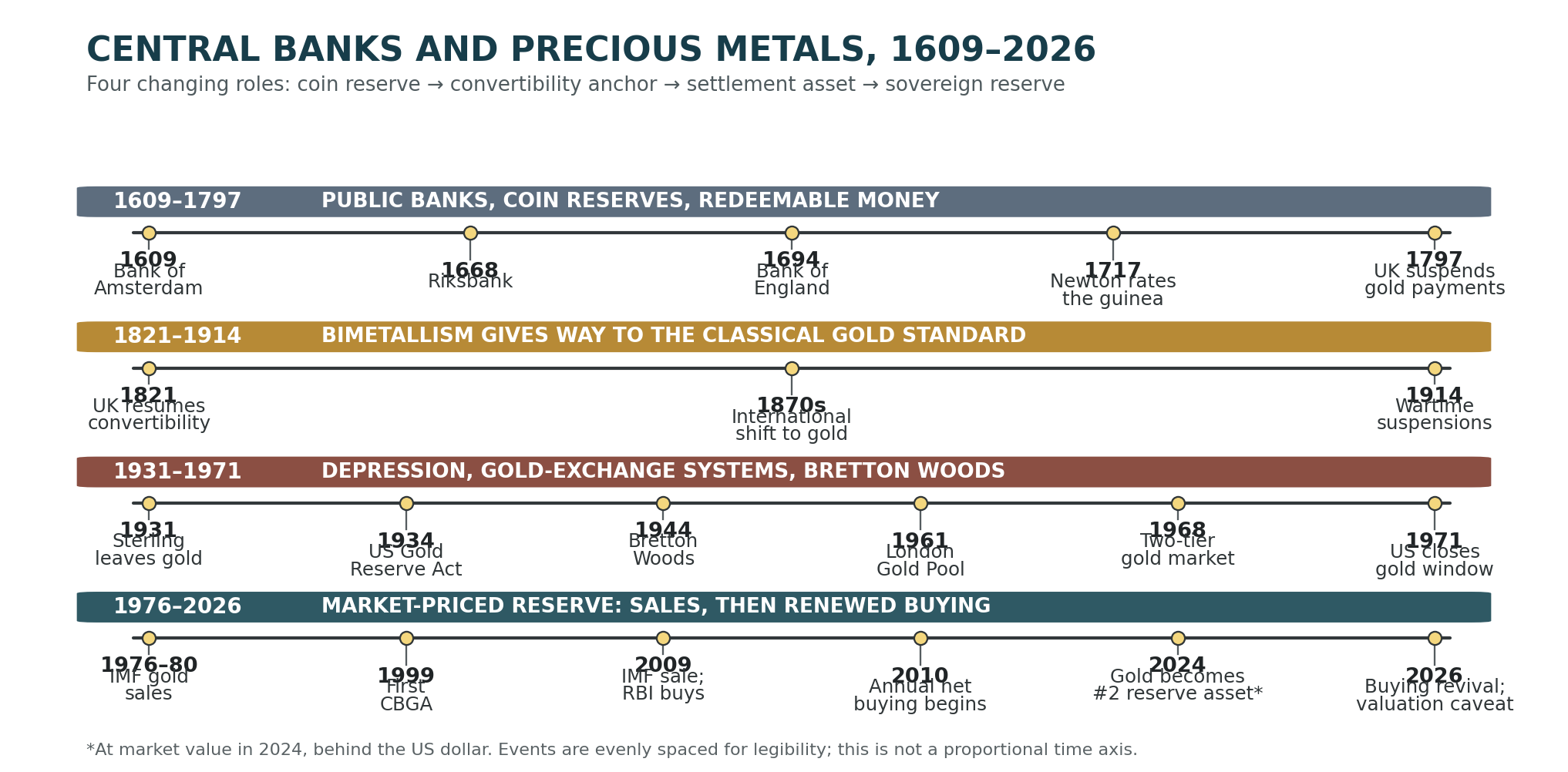
Read the timeline as text
- 1609: the Bank of Amsterdam begins.
- 1668: the Riksbank is established.
- 1694: the Bank of England is established.
- 1717: Newton rates the guinea.
- 1797: the United Kingdom suspends gold payments.
- 1821: the United Kingdom resumes convertibility.
- 1870s: an international shift toward gold accelerates.
- 1914: wartime suspensions begin.
- 1931: sterling leaves gold.
- 1934: the United States passes the Gold Reserve Act.
- 1944: Bretton Woods is negotiated.
- 1961: the London Gold Pool begins.
- 1968: a two-tier gold market replaces the Pool.
- 1971: the United States closes the official gold window.
- 1976–1980: the IMF sells and restitutes gold.
- 1999: the first Central Bank Gold Agreement begins.
- 2009: the IMF sale includes an official purchase by the Reserve Bank of India.
- 2010: annual central-bank net buying resumes.
- 2024: gold becomes the second-largest global reserve asset by market value, behind the U.S. dollar.
- 2026: official buying remains active, with high-price and valuation caveats.
Events are evenly spaced for legibility; the image is not a proportional time axis.
Abstract
Modern central banking grew out of institutions created to repair unreliable coin systems, improve wholesale payments, finance states, and stabilize note issue. Precious metal was present at the birth of that system because seventeenth- and eighteenth-century money still depended heavily on the weight and fineness of coin. The Bank of Amsterdam converted a disorderly mixture of coins into trusted ledger money; Sweden’s Riksbank emerged after a note-issuing bank failed to meet redemption demands; and the Bank of England combined public finance, deposits, note issue, and access to metallic reserves. These were not identical institutions, and none initially possessed the full mandate of a modern central bank. Their histories nevertheless show why a credible monetary balance sheet mattered before “central bank reserves” became an electronic liability. [1] [2] [3]
The relationship then changed four times. First, gold and silver were reserves against coin and redeemable notes. Second, gold became the central constraint of an international convertibility system. Third, under the interwar gold-exchange standard and Bretton Woods, central banks increasingly held reserve currencies as well as gold and used cooperation, swaps, controls, and pooled intervention to defend fixed parities. Fourth, after official dollar-gold convertibility ended in 1971, gold ceased to define the unit of account but remained on official balance sheets as a market-priced reserve asset. The late twentieth century brought large official sales; the twenty-first brought a durable return to net buying. [4] [5] [6] [7]
Silver is indispensable to this history because bimetallic systems and silver standards shaped many early central banks. Yet modern reserve statistics distinguish “monetary gold,” not a general basket of precious metals. Platinum and palladium entered bullion and industrial markets far too late—and without the monetary conventions, official stocks, and settlement infrastructure that made gold exceptional. This paper therefore covers all four metals but gives gold the weight that official institutions themselves give it. [8] [9]
Educational and historical material. This paper does not provide personalized investment, legal, accounting, or tax advice. Published and last reviewed August 24, 2026.
1. What Counts as a Central-Bank Precious-Metal Reserve?
The phrase “central-bank precious metals” invites a category error. Gold, silver, platinum, and palladium are all precious metals in commercial usage, but international reserve accounting does not treat them symmetrically. The IMF category is monetary gold: gold bullion and qualifying gold accounts held by monetary authorities as reserve assets. Allocated gold gives title to specific bars; an unallocated account is a claim for delivery rather than ownership of particular bars. Gold bullion held outside reserve purposes can be nonmonetary gold even when a central bank owns it. [9]
This distinction explains why official statistics can discuss “gold reserves” while a mint or central bank may separately possess silver, platinum, or palladium for coin production, commemorative programs, refining, or commercial operations. Those stocks are not automatically international reserves. Modern reserve assets must be controlled by monetary authorities and available for balance-of-payments financing, intervention, or related confidence purposes. The legal and statistical convention is therefore narrower than the metallurgical category “precious metals.”
Central bank, treasury, and sovereign ownership are not the same thing
A second source of confusion is ownership. The Bank of England stores the United Kingdom’s gold on behalf of HM Treasury and acts as custodian for other central banks and governments; the metal does not become the Bank’s property merely because it is in the Bank’s vault. The New York Fed likewise states that none of the gold in its vault belongs to the Federal Reserve System. In the United States, the Treasury owns the government gold stock, while the Federal Reserve’s historical balance-sheet relationship to gold operated through gold certificates. [21] [22] [23]
An accurate history must therefore separate four questions: Who legally owns the metal? Who has custody? Which institution decides whether to buy, sell, swap, or relocate it? How is it valued on the public balance sheet? These can point to different bodies. A sovereign may retain ownership, a central bank may manage the reserve, a foreign central bank may provide custody, and a finance ministry may retain authority over disposition.
What this paper means by “selling”
Official metal leaves a balance sheet through more than a cash sale. It may be auctioned, exchanged with another official institution, restituted to members, used in a swap, lent, moved between locations, transformed into market-standard bars, or reclassified. Conversely, reported reserve growth can come from outright purchases, domestic mine acquisitions, transfers, or corrections. An increase in the dollar value of holdings may be pure revaluation, not new buying.
That last point became especially important in the 2020s. A sharp rise in gold’s market price can lift its share of reserves even if the number of tonnes is unchanged. The IMF’s 2026 reserve-management note emphasizes both sides of gold: it carries no issuer credit risk and can strengthen a balance sheet over long horizons, but it is volatile, non-interest-bearing in its passive form, and poorly suited to the immediately liquid tranche of reserves. [24]
2. Before Central Banks: Mints, Treasuries, Money Changers, and Public Banks
Central banks arrived late in the history of precious-metal money. For most of recorded monetary history, rulers and cities managed the metal problem through mints, legal-tender rules, treasury receipts, tax acceptance, money changers, and periodic recoinage. A coin’s face carried a political guarantee, but its market acceptability still depended on weight, fineness, wear, clipping, and confidence that the issuer would not alter the standard.
The same coin could have a legal value, a bullion value, and a foreign-exchange value. Mixed circulation made large payments expensive to verify. Merchants had to sort pieces by origin and condition, discount doubtful coins, and calculate between units. A public institution that accepted many coins, valued them by intrinsic metal, and transferred standardized balances on a ledger could reduce those frictions even before it issued a national currency.
Why a vault and a ledger could be more useful than another coin
A high-quality ledger balance separated the payment function of money from the physical movement of each piece. Once merchants trusted the institution’s valuation and records, they could transfer claims without repeatedly weighing the underlying coin. The innovation was not that metal disappeared; it was that metal became concentrated behind a more efficient settlement instrument.
This model also exposed a permanent temptation. A bank whose liabilities circulated at par could earn income by lending some of the assets placed with it. If the public expected full and immediate redemption, however, illiquid loans could make a solvent-looking institution unable to meet withdrawals. The tension between safe settlement, elastic credit, public finance, and reserve adequacy would reappear in every later metallic regime.
A precursor is not automatically a modern central bank
The Bank of Amsterdam is often described as a central-bank precursor because it created trusted bank money and supported wholesale settlement. It did not begin with a modern inflation target, monopoly of national banknote issue, or a general lender-of-last-resort mandate. Likewise, seventeenth-century public banks often served governments and privileged merchants rather than managing a nationwide banking system.
Still, these institutions established three ideas central to later monetary architecture: money could be a transferable entry on a trusted public balance sheet; final settlement could be centralized; and the quality of the reserve asset mattered to the credibility of private payments. The BIS’s modern description of the Bank of Amsterdam—founded to check the “confusion of coin”—captures the continuity between metallic settlement and today’s central-bank money. [1]
3. The Bank of Amsterdam: Turning Disordered Coin into Bank Money
Amsterdam’s city government established the Wisselbank in 1609 in one of Europe’s most active trading centers. The immediate problem was not a theoretical shortage of money but a practical excess of heterogeneous coin. Pieces from many jurisdictions circulated together; clipping, wear, and debasement made their nominal values unreliable. The bank accepted local and foreign coin, assessed it according to intrinsic value, and credited customers with standardized bank money after fees. [10]
Payments between account holders could then be settled by book transfer. For wholesale commerce, this substituted a uniform accounting asset for repeated bags of mixed metal. The bank guilder gained a reputation distinct from circulating coin, and its premium reflected the convenience and reliability of settlement in bank money. Precious metal remained foundational, yet the economically valuable product was a trusted claim recorded on the city bank’s ledger.
Reserve discipline and the limits of metallic reputation
Popular retellings sometimes turn the Wisselbank into a perfectly reserved vault. Its history was less tidy. The bank’s balance sheet evolved; it extended credit and became entangled with the Dutch East India Company. Secrecy delayed recognition that the liabilities were no longer matched by immediately available metal to the extent depositors assumed. The institution’s eventual decline shows that metallic association alone cannot substitute for transparent governance and credible fiscal support. [1]
That failure matters to central-bank history because it reveals two different sources of monetary trust. The first is the quality and availability of the reserve asset. The second is the institutional capacity to honor the liability in bad states of the world. A gold- or silver-backed promise can fail if the metal has been lent, pledged, misvalued, seized, or made inaccessible. Conversely, a well-governed central bank can maintain par settlement today without promising metal redemption because its liabilities rest on law, taxation, collateral policy, and monetary authority.
Why Amsterdam belongs in a precious-metals history
The Wisselbank did not merely warehouse bullion. It standardized value across coin varieties, improved the salability of balances, and made the location of metal less important than the integrity of records. Those functions prefigure modern allocated custody, clearing, and settlement. When gold changes ownership inside the Bank of England today, bars usually need not move; the owner’s name changes in the Bank’s system. The technology is different, but the economic purpose—trusted transfer without unnecessary physical handling—is recognizable. [21]
Amsterdam therefore marks a first major transition: precious metal from circulating object to reserve behind ledger money. Later central banks would add note issue, government banking, lender-of-last-resort operations, macroeconomic policy, and foreign-exchange management. The fundamental settlement insight came earlier.
The history begins with a coin problem, but the institutional solution was an accounting system.
4. The Riksbank and the Bank of England: Redemption, Public Credit, and Durable Central Banks
Sweden provides a direct link between unusual metallic money and early banknotes. A shortage of silver and gold, combined with the state’s interest in supporting copper, produced a copper standard and enormous plate money. Stockholms Banco issued Europe’s first modern banknotes in 1661, but expansion outran its capacity to redeem them. The bank failed, and in 1668 the Swedish parliament established Riksens Ständers Bank, later Sveriges Riksbank. The Riksbank describes itself as the world’s oldest central bank. [25] [2]
The episode contained a lesson that metallic systems repeatedly taught: a note is convenient because it is lighter and easier to transfer than metal, but its market value depends on redemption credibility. When too many claims are issued against an inadequate or illiquid reserve, the public’s attempt to convert at once creates the crisis the reserve was supposed to prevent.
The Bank of England joined metallic credibility to sovereign borrowing
The Bank of England was founded in 1694 as a private institution acting as banker to the government, primarily to help finance war against France. Its subscribers provided funds to the state and received privileges that eventually supported a dominant role in note issue and government finance. Early years were shaped by the demands of public borrowing, coinage, deposits, and redemption. [3] [11]
This origin is important because it complicates the notion that a central bank exists only to restrain governments. The Bank was born from a fiscal need. Its credibility nevertheless depended on making government-linked liabilities acceptable to private holders. Over time, the institution that helped finance the state also became a guardian of the monetary standard and a stabilizer of the banking system.
Metal reserves were simultaneously monetary, fiscal, and political
Gold and silver in an early central bank were not a passive portfolio allocation. They met note redemption, settled international claims, supported the exchange rate, and provided a visible assurance that paper promises could become universally accepted coin. War, invasion fears, harvest failures, and overseas payments could all drain the stock. A central bank’s metallic reserve was therefore a buffer against both financial panic and the state’s external obligations.
That multiple use created recurring conflict. Raising interest rates could attract metal and protect convertibility but worsen domestic distress. Lending freely could stop a bank run but encourage gold outflow. Financing war could preserve the state while weakening redemption. The central-bank art that emerged during the next two centuries was not mechanical obedience to metal; it was political and financial judgment conducted under a metallic constraint.
5. Recoinage, Newton, and Britain’s Uneven Road to Gold
Seventeenth-century England’s silver coinage suffered from clipping, wear, and differences between the mint value and the market value of bullion. The Great Recoinage of the 1690s attempted to replace deficient hammered silver with milled coin. Isaac Newton arrived at the Royal Mint as Warden in 1696 and became Master in 1699, administering recoinage and enforcing the coinage laws. [26]
In 1717 Newton recommended a valuation that led to the guinea being fixed at 21 shillings. The rating made gold coin relatively attractive compared with silver at the official mint relationship. Silver tended to leave circulation or be used as bullion while gold became increasingly central to high-value payments. Britain did not flip into a fully modern gold standard on a single day, but Newton’s recommendation became one of the institutional steps toward a de facto gold regime. [26]
Convertibility could be suspended without destroying the state
The French wars tested the system. In 1797 invasion fears and withdrawals reduced the Bank of England’s gold from £16 million to £2 million, according to the Bank’s own historical account. The government ordered the Bank to stop paying notes in gold. The Restriction Period lasted until 1821. Britain continued to tax, borrow, issue notes, and fight while convertibility was suspended, demonstrating that metallic redemption was a policy regime rather than a natural condition of money. [11]
Suspension, however, did not make the prior parity irrelevant. Political debate turned on note issue, inflation, the proper standard, and the terms of resumption. Parliament formally adopted a gold standard in the Coinage Act of 1816, and cash payments effectively resumed in 1821. Returning at the old parity imposed adjustment costs but restored a rule that creditors and international merchants associated with fiscal and monetary credibility. [12]
The Bank Charter Act attempted to make discipline visible
The 1844 Bank Charter Act separated the Bank’s Issue and Banking departments and tied expansion of note issue beyond a fiduciary amount to gold. The architecture was designed to make the metallic constraint more automatic and to limit discretionary over-issue. Yet crises in 1847, 1857, and 1866 required official letters allowing the Bank to breach or suspend the statutory limit. The rule survived partly because policymakers were willing to relax it in emergencies. [50]
This is a recurring pattern in central-bank precious-metal history. A rigid promise can strengthen confidence in ordinary times, but a system that never adapts may force liquidation during panic. The practical credibility of a metallic standard often depended on the market’s belief that temporary emergency action would not become permanent abandonment.
Gold discipline was strongest when the authorities were believed to possess enough discretion to save the system without repudiating the standard.
6. Bimetallism: When Central Banks Had to Manage Gold and Silver Together
The nineteenth century was not simply an age of gold. Silver remained coin, legal tender, reserve material, and the anchor of major currencies. Bimetallic laws defined the monetary unit in both metals at a fixed ratio. A mint or central bank willing to buy and sell either metal at that legal relationship created a form of price guarantee. When the market ratio moved, holders brought the overvalued metal to the mint and exported or melted the undervalued one.
France’s system was unusually influential. The franc germinal defined a fixed weight in silver and an equivalent weight in gold. The IMF’s historical analysis describes France’s double price guarantee as maintaining a 15½-to-1 relationship and quasi-fixed exchange rates between gold- and silver-currency countries. The Banque de France’s willingness to settle in either metal added elasticity that a pure one-metal system lacked. [8] [27]
Bimetallism was an international bridge, not merely a political slogan
Because countries used different metallic anchors, French bimetallism helped connect them. A gold inflow could be absorbed while silver remained available for payment, or vice versa, within the limits of the legal ratio and coinage rules. The arrangement reduced exchange-rate volatility across a divided monetary world. It also made French reserve policy a significant part of international adjustment.
The United States established a 15-to-1 statutory relationship in the Coinage Act of 1792. Later changes in mint ratios and coinage policy shifted which metal circulated. The Coinage Act of 1873 ended the standard silver dollar’s place in the open-mint system and became notorious among silver interests as the “Crime of 1873.” Falling silver prices then sharpened conflict between creditors favoring gold and debtors, farmers, and miners seeking expanded silver monetization. [28] [29]
Why silver lost the reserve contest
Silver’s displacement was not proof that it lacked monetary history. It reflected network effects, changing production, international policy coordination, and the decision of major states to converge on gold. Germany’s post-unification shift, U.S. legal changes, restrictions on silver coinage, and the movement of Scandinavian and other economies into gold reduced the international usefulness of silver reserves. The market value of silver also required much greater physical volume for a given reserve amount.
By the late nineteenth century, countries remaining on silver could face exchange-rate volatility against the expanding gold bloc. Central banks and treasuries increasingly valued an asset accepted at the core financial centers. Once gold became the common settlement standard, holding gold was useful partly because other official institutions held and redeemed it. Silver’s monetary network weakened itself as members left.
7. The Classical Gold Standard, 1870s–1914
The classical gold standard emerged from convergence rather than a single treaty. Britain had long operated on gold; Germany shifted after unification; the Scandinavian countries adopted gold in the 1870s; France and other bimetallic economies restricted silver coinage; the United States returned to effective gold convertibility in 1879; and additional states joined as trade and finance became more integrated. [12]
Each participating currency represented a fixed quantity of gold. Because two currencies were each defined in metal, their mint parities implied stable bilateral exchange rates. Shipping, insurance, handling, and interest costs created “gold points”: exchange-rate boundaries at which it became profitable to export or import bullion rather than buy foreign exchange. Central banks did not need to move metal after every transaction, but the possibility of movement disciplined the price of currencies.
A gold standard was a rule for central-bank behavior
The popular image is automatic: a country losing gold contracts money and credit, prices fall, exports recover, and gold returns. Actual adjustment depended on institutions. Central banks changed discount rates, altered lending terms, bought or sold bills, used foreign balances, negotiated credits, and sometimes discouraged gold exports through informal “gold devices.” The rule was credible because authorities generally treated convertibility as a priority, not because policy disappeared.
The Bank of England’s position was distinctive. London’s financial markets were deep, sterling bills financed world trade, and the Bank held a comparatively small reserve relative to the liabilities and transactions linked to the city. A change in Bank Rate could influence international short-term funds, domestic credit, and the incentive to ship gold. The system’s apparent economy in metal therefore rested on confidence in London and on other countries’ willingness to hold sterling claims.
Gold created a hierarchy of currencies
At the center were currencies readily convertible in major markets and accepted as reserves. Around them were countries that held gold, sterling, francs, or other foreign assets to defend their own parity. This was already partly a gold-exchange system: not every reserve had to be a bar in a domestic vault. The network saved metal but introduced credit and concentration risks. A claim on London was liquid so long as confidence in sterling and the Bank’s convertibility remained intact.
Contemporary prosperity gave the standard a reputation for natural stability. In reality, it was supported by political willingness to tolerate interest-rate increases, unemployment, and domestic deflation in defense of parity; by limited electoral pressure compared with later democracies; and by cooperation in moments when the core itself was threatened. The gold standard was a social and political commitment expressed through a metal rule.
8. How Central Banks Actually Defended Gold Convertibility
A central bank under gold had a balance-sheet objective that modern inflation targeting does not: it had to remain able to convert its monetary liabilities at the legal parity. The reserve was therefore not simply a long-term store of value. It was inventory for settlement and redemption. Its adequacy depended on the amount of notes and deposits, access to foreign exchange, the credibility of policy, and the speed at which gold could be mobilized.
Discount-rate policy
Raising the discount rate was the most visible defense. Higher short-term rates could attract funds, discourage capital outflow, reduce domestic borrowing, and improve the exchange rate before metal left the vault. Yet the transmission was uncertain. A rate increase could also deepen a banking crisis or signal desperation. Authorities had to judge whether a gold loss reflected seasonal trade, a temporary panic, fiscal weakness, or doubt about the parity itself.
Gold devices and reserve composition
Central banks used less visible methods as well. They could change the price or location at which gold was supplied, select which bars or coins were available, charge handling costs, redeem in inconvenient forms, use foreign bills, or borrow metal from another institution. The Banque de France was famous for managing the mix of gold and silver and for exercising discretion over how demands were met. Such devices softened the supposedly automatic system.
Foreign balances and correspondent accounts
A reserve manager could hold a deposit or bill in a foreign center rather than ship metal immediately. Those assets earned income and could finance intervention, but they were claims on another institution. Gold bullion carried no issuer liability; a sterling or franc balance did. The trade-off between yield, liquidity, and credit exposure—still central to reserve management—was already present.
Moral suasion and market relationships
Central banks also relied on information and influence. They knew major banks, bullion dealers, bill brokers, mints, and treasuries. They could ask institutions to delay exports, arrange syndicates, or provide liquidity on terms designed to preserve the reserve. A metallic standard did not eliminate the importance of reputation, private negotiation, or privileged access.
The BIS summarizes pre-1914 cooperation as limited, bilateral, and ad hoc. During crises such as Baring in 1890 and the 1907 panic, emergency support served the overriding objective of maintaining convertibility. The international system lacked a permanent multilateral central-bank body, but it was not devoid of rescue operations. [4]
9. Metallic Discipline Versus the Lender of Last Resort
The central contradiction of the gold-standard central bank was clearest during panic. Banks needed cash when depositors distrusted private liabilities. The central bank could create notes or deposits against acceptable collateral, but excessive creation might trigger conversion into gold. Refusing assistance protected the reserve in the narrow sense while allowing solvent institutions to fail and destroying the credit system that supported the currency.
The Bank of England’s nineteenth-century crises gradually established a practical doctrine: lend decisively against good collateral, at a rate that discouraged routine dependence, while preserving confidence in the standard. Walter Bagehot’s famous formulation distilled practices that had evolved unevenly. It was less a mechanical formula than a political promise that temporary liquidity would be available when market assets could not be sold without ruinous discounts. [50]
The suspension letter as an emergency valve
British authorities sometimes authorized the Bank to exceed the note limits of the 1844 Act. The mere announcement that the legal constraint could be relaxed helped stop runs, and in some episodes the additional notes were barely used. This suggests that credibility came from contingent capacity: the public was reassured because the central bank could expand if necessary, even though the long-run parity rule remained. [50]
International support protected the center
In the Baring crisis of 1890, the Bank of England arranged assistance involving the Bank of France and major financial institutions. Gold or liquid claims supplied from abroad bought time for an orderly response. Such cooperation was exceptional, but it demonstrated that national convertibility could depend on transnational official relationships. [51]
The United States lacked a central bank between 1836 and 1913. Its banking system faced recurrent seasonal strains and panics, while Treasury gold reserves became a public measure of monetary confidence. During the 1890s, falling Treasury gold and debate over silver intensified fears about the dollar standard. The 1907 panic, managed largely through private coordination, strengthened the case for an institution able to provide an elastic currency and centralize reserves. [30] [31]
Gold was not the sole cause of crises, but it shaped the response
Banking structure, speculation, poor assets, harvest finance, fiscal policy, and political shocks all mattered. The metallic commitment constrained which remedies looked legitimate and how quickly they could be deployed. A central bank could rescue banks only if the market believed rescue would not become permanent inflation or abandonment of parity. That conditional trust explains why emergency lending and gold defense evolved together.
10. Empire, Trade Finance, and the Geography of Official Metal
The international gold standard was geographically uneven. London sat at the center of trade finance, insurance, bullion dealing, and sterling bills, while colonial and peripheral monetary systems often held reserves in the financial assets of imperial centers. A currency could therefore be described as gold-linked even when relatively little bullion was held locally.
Currency boards and colonial treasuries commonly issued local money against external reserve assets. The arrangement promised convertibility at a fixed rate into an anchor currency rather than direct public redemption into a domestic gold coin. Sterling securities and bank balances could serve because sterling itself was convertible and because London offered deep markets. The chain ended in gold, but most users interacted with claims higher up the pyramid.
The location of gold followed security and liquidity
A bar stored in London could be more useful for intervention than an identical bar in a remote domestic vault. It could be sold, swapped, or transferred between official accounts without ocean transport. The modern Bank of England describes the same advantage: custody in London gives central banks access to the liquidity of the London gold market, and trades usually change ownership records rather than the physical location of bars. [21]
This geography also created political exposure. War, sanctions, capital controls, or a dispute with the custodian’s government could restrict access. A reserve held abroad was liquid in normal markets but potentially vulnerable in geopolitical stress. A reserve held at home maximized physical control but might be harder or slower to mobilize internationally. The storage debate that later surrounded German and other central-bank gold is rooted in this old trade-off.
Silver zones did not disappear at once
Large parts of Asia continued to use silver currencies or silver-linked units after Europe moved toward gold. International merchants therefore crossed between monetary zones, and shifts in the gold-silver ratio affected trade prices, debts, and government revenue. Countries could adopt a gold-exchange standard—fixing to a gold currency while using foreign reserves and token coin—without importing a full stock of circulating gold.
The long-run monetary system thus economized on physical metal through layers of claims. The IMF’s historical work notes that bank settlement in gold or silver coexisted with extensive credit and that active central-bank management varied across countries. The “gold standard” label concealed a range of institutional designs. [32]
11. World War I: Suspension, Gold Campaigns, and the Militarization of Reserves
The outbreak of World War I exposed the limits of a system built for peacetime convertibility. Governments needed to mobilize credit on a scale incompatible with maintaining unrestricted redemption and free gold export. Exchanges closed, bank holidays were declared, convertibility was suspended or constrained, and states used controls to conserve foreign exchange and metal. [32]
Central banks became war-finance institutions. They discounted government paper, supported bond markets, managed note expansion, and helped organize foreign payments. The Bank of England’s own history records that it bought a large share of the 1914 War Loan after public subscriptions proved insufficient and concealed the weakness of demand to preserve confidence. [11]
Gold acquired a patriotic and strategic meaning
Governments, including France, encouraged citizens to surrender gold coin, jewelry, or foreign assets. The language of “gold for the nation” converted private metal into a public reserve and framed hoarding as disloyal. Central banks and treasuries concentrated metal because imported food, raw materials, weapons, and debt service could require settlement acceptable abroad even when domestic redemption was suspended. [27]
The distinction between internal and external convertibility widened. A government might prevent citizens from exchanging notes for coin while still using gold or gold-linked foreign exchange for international obligations. This separation anticipated later systems in which official institutions, but not the public, held conversion rights.
Inflation changed the parity question
War finance expanded money and debt while disrupting production. Price levels diverged across countries. Returning to prewar gold parities afterward therefore required deflation, currency devaluation, or a politically difficult mix. The metal content of a prewar unit remained legally simple, but the economy required to sustain that content had changed.
The war also rearranged the physical map of reserves. The United States accumulated gold and foreign claims as it supplied belligerents and later entered the war. London’s prewar supremacy was weakened by debt and loss of reserves. New York’s importance grew, helping prepare the conditions for a postwar system with more than one monetary center.
World War I did not end the prestige of gold. It strengthened the belief among many policymakers that restoration was necessary to prove fiscal and monetary normality. The attempt to recreate that credibility under changed economic and political conditions shaped the interwar disaster.
12. The Interwar Gold-Exchange Standard and the Birth of the BIS
After 1918, policymakers sought a system that recovered exchange-rate stability while economizing on scarce gold. The interwar gold-exchange standard allowed central banks to hold reserve currencies—especially sterling and dollars—alongside bullion. The arrangement appeared efficient: one country’s liquid liability became another country’s reserve, reducing the need for every monetary authority to warehouse the full metallic equivalent of its money.
Efficiency carried a structural risk. A reserve-currency claim was only as safe as the issuing country’s parity and banking system. If central banks simultaneously converted sterling or dollar balances into gold, the center could not satisfy every claim without contraction, controls, borrowing, or suspension. The system multiplied internationally liquid assets but also multiplied promises against the core gold stocks.
Britain returned at the prewar parity
The United Kingdom restored gold convertibility in 1925 at the prewar rate. Sterling’s overvaluation, postwar debts, labor conflict, and the changed distribution of reserves made the commitment difficult to sustain. The Bank of England and other central banks attempted to manage the system through rates, credits, and cooperation, but domestic political tolerance for deflation was far lower than before 1914. [52]
Cooperation became institutional rather than occasional
Interwar restoration required technical advice, stabilization loans, correspondent relationships, and coordination among monetary authorities. The BIS was founded in 1930, originally connected to German reparations but designed as a bank and meeting place for central banks. The BIS later described its creation as the first institutional embodiment of multilateral central-bank cooperation. [14] [4]
This was a major change in the relationship between gold and central banks. Under the classical standard, common rules and London’s market leadership had provided a degree of coordination. The interwar system needed explicit institutions because wartime debts, reparations, unstable capital flows, and competing national objectives could not be reconciled by gold points alone.
The reserve-currency layer weakened the apparent gold backing
A central bank might report strong reserves while holding claims that another authority might itself be unable to convert. The distinction between gross and net liquidity became crucial. Gold was the ultimate asset because it was not another state’s liability, but forcing settlement into gold could accelerate the crisis. The system depended on central banks not all exercising their strongest legal claim at once.
13. The Great Depression: When Gold Defense Transmitted Deflation
The Great Depression turned the interwar gold system from a symbol of normality into a mechanism of contagion. Banking failures and falling prices increased the public’s demand for cash and safe assets. Central banks facing gold losses often raised rates, restricted credit, or refused aggressive expansion because they feared devaluation and reserve depletion. Domestic stabilization and parity defense pointed in opposite directions.
The Federal Reserve’s own historical account notes that the gold standard transmitted tightening and deflation across countries. When one central bank defended its reserve, pressure could shift to another. A country losing gold contracted; a country gaining gold was not compelled to expand symmetrically. The result was a global bias toward monetary scarcity. [33] [34]
Sterling’s exit broke a central reserve promise
In September 1931, after a run on sterling and loss of reserves, the United Kingdom suspended the gold standard. The Bank of England describes the departure as a response to collapsed confidence and a severe reserve drain. Because many central banks and governments held sterling, the decision imposed losses and prompted reassessment of reserve-currency claims. [11]
Countries then chose among devaluation, controls, gold blocs, and continued defense. France and several partners stayed on gold longer, accumulating reserves and sustaining deflationary pressure. Others left earlier and gained more room to expand money, lower rates, or stabilize banks. The sequence undermined the idea that one universally accepted parity rule could survive democratic demands for employment and financial rescue.
Gold became a constraint on emergency banking policy
In the United States, Federal Reserve Banks operated under statutory gold-reserve requirements. During the panic of 1933, concern about reserve ratios and conversion shaped the response. President Franklin Roosevelt’s nationwide bank holiday stopped withdrawals and created space to inspect banks, while separate measures restricted gold payments and exports. [35]
The lesson is not that metal mechanically caused the Depression. Policy errors, banking fragility, debt, fiscal choices, and international politics all mattered. Gold made those failures mutually reinforcing by tying national monetary responses to reserve defense. The system asked central banks to protect a fixed metallic price precisely when societies demanded that they protect banks, jobs, and domestic prices.
14. The United States, 1933–1934: From Federal Reserve Gold to Treasury Gold
Roosevelt’s gold program changed both the dollar’s value and the institutional ownership of U.S. monetary gold. In April 1933, the administration restricted private gold holding, export, and redemption as part of a broader effort to stop banking panic and escape the deflationary constraint. The measures were controversial because they altered contracts and removed a redemption right long associated with the dollar. [36]
The Gold Reserve Act of January 1934 transferred ownership of monetary gold in the United States to the U.S. Treasury and prohibited redemption of dollars for gold. The official dollar price was then raised from $20.67 to $35 per fine troy ounce. Revaluation increased the dollar book value of the government’s stock and helped capitalize the Exchange Stabilization Fund. [13] [37]
The central bank did not simply “keep the gold”
This ownership structure is still frequently misunderstood. The U.S. government’s bullion is Treasury property. The Federal Reserve received gold certificates and operated within the monetary framework established by Congress and the Treasury. A modern observer who asks how much gold “the Fed owns” is asking the wrong question; the relevant stock is Treasury-owned, while the Federal Reserve’s monetary liabilities are no longer redeemable into it.
Devaluation separated domestic money from official gold policy
The public could no longer demand a gold coin or bar at the statutory price, but gold remained a central state asset and international monetary reference. The Treasury bought domestic and foreign gold at the new price, and the United States accumulated an extraordinary share of world monetary gold during the 1930s and World War II. Domestic fiat-like operation and official gold concentration therefore expanded together.
The statutory valuation also created a lasting accounting oddity. U.S. Treasury gold continues to be carried at the legal value of $42.2222 per fine troy ounce, far below market value. Treasury datasets report both weight and book value; the gap demonstrates why balance-sheet figures must be interpreted under the applicable accounting rules rather than treated as current sale proceeds. [23]
A template for official-only gold
The 1930s U.S. settlement anticipated Bretton Woods. Gold ceased to be ordinary domestic money, yet official institutions retained a defined relationship to it. The right to convert became narrower, the state’s control became stronger, and the metal’s function shifted from public redemption to international reserve policy.
15. World War II: Evacuation, Looted Gold, and the Rise of New York Custody
On the eve of another European war, gold was no longer merely a parity reserve. It was portable national wealth that could finance imports, support governments in exile, and survive occupation—if it could be moved in time. Central banks and treasuries shipped metal away from vulnerable capitals and ports. The BIS reports that it helped transport more than 140 tonnes from Europe to New York between June 1938 and June 1940, mostly for European central banks. [38]
The Banque de France dispersed much of France’s stock abroad before occupation. Other countries sent gold to Canada, the United States, the United Kingdom, colonies, or neutral jurisdictions. Evacuation required ships, insurance, secrecy, diplomatic permissions, bar lists, and trusted custodians. The physical character of gold—compact, durable, and accepted without an issuer’s promise—made it useful in a way that domestic securities might not be after a government lost territory. [27]
Occupation exposed the importance of provenance
Nazi Germany seized monetary gold from occupied central banks and gold from persecuted individuals. Some metal was remelted and re-stamped to conceal origin before being used in international payments. Postwar restitution became a difficult process of archives, assays, claims, and diplomatic settlement. The BIS acknowledges receiving 3.7 tonnes from the Reichsbank that investigations later traced to looted Belgian and Dutch central-bank gold; it returned that amount to the Tripartite Gold Commission in 1948. [38]
This history is why an official bar is more than weight and purity. Serial numbers, refiner marks, custody records, transfer documents, and chain of title can carry legal and moral significance. Modern responsible-sourcing standards and bar lists did not arise solely from wartime restitution, but the episode demonstrates the consequences of treating fungibility as a substitute for provenance.
New York became a central vault for official gold
Much of the gold held at the New York Fed arrived during and after World War II. The vault’s stock later peaked at more than 12,000 tons in 1973, in the New York Fed’s wording. As of 2024 it held about 507,000 bars weighing 6,331 metric tons for the U.S. government, foreign governments, central banks, and international organizations; none belongs to the New York Fed. Depositors receive back the exact bars deposited, so custody records preserve specific ownership. [22]
Wartime relocation created the modern geography of central-bank gold: large domestic stocks for sovereignty, and major foreign holdings in New York and London for safety, settlement, and market access. The tension between those purposes remains visible in later repatriation programs.
16. Bretton Woods: Gold at the Apex of a Dollar-Centered System
Delegates from 44 countries met at Bretton Woods, New Hampshire, in July 1944 to design a monetary system that avoided both the rigidity of the interwar gold standard and the instability of competitive devaluation. They created the IMF and what became the World Bank. Currencies were assigned par values, normally against the U.S. dollar, while the United States undertook to convert official foreign dollar holdings into gold at $35 per fine troy ounce. [5]
The arrangement was not a return to ordinary gold coin redemption. Private U.S. residents could not present dollars for bullion at the Treasury window. The conversion right belonged principally to foreign monetary authorities. Gold sat at the apex, the dollar mediated the system, and other central banks defended their exchange rates through intervention and domestic policy.
Why the dollar solved a gold shortage
Postwar reconstruction required reserves and international liquidity. The United States held an exceptional concentration of monetary gold and possessed the productive capacity to supply goods and finance. Dollars earned through exports, aid, borrowing, and military spending could be held as reserves or used in trade. A pure gold system would have required a larger physical redistribution of metal; a dollar-gold system expanded liquidity through U.S. liabilities.
The IMF formalized rules that gold alone could not provide
Members contributed quotas in gold and currency, obtained financing for temporary balance-of-payments needs, and could adjust parities in cases of fundamental disequilibrium. Capital controls remained permissible. The goal was fixed but adjustable exchange rates: enough commitment to support trade, enough flexibility to avoid forcing every domestic shock through deflation.
Central banks under Bretton Woods therefore held a mixed reserve portfolio. Gold remained the ultimate official asset, but dollars and sterling were liquid, interest-bearing, and useful for intervention. This reproduced the economy—and the risk—of a gold-exchange standard. The system created more reserve claims than the underlying U.S. gold stock could cover if all holders converted simultaneously.
Gold’s role was powerful but deliberately narrow
The official price anchored the dollar internationally, while domestic monetary policy operated through the Federal Reserve, banking regulation, fiscal policy, and controls. Gold did not mechanically set the quantity of every country’s money. The system worked through official discretion and cooperation layered over a conversion promise.
17. From Dollar Shortage to Dollar Glut: Defending $35 Gold
In the early postwar years, Europe and Japan needed dollars to buy American goods and rebuild. U.S. aid and overseas spending supplied liquidity. As recovery advanced, the problem reversed. Persistent U.S. balance-of-payments deficits placed more dollars in foreign official hands, while the U.S. monetary gold stock did not grow with those claims. The very deficits that supplied world reserves weakened confidence in conversion.
Central banks did not passively wait for a run. They cooperated through the IMF, the BIS, Treasury stabilization operations, and bilateral arrangements. Beginning in 1962, Federal Reserve swap lines gave participating central banks temporary access to one another’s currencies, reducing the need to settle every pressure through U.S. gold. By the end of 1962, the network covered nine central banks and up to $900 million equivalent. [6] [37]
The London Gold Pool attempted to manage the market price
In November 1961, the United States and seven European central banks formed the London Gold Pool. Participants coordinated sales and purchases in the London market to keep the private price near $35. When private demand pushed upward, the pool supplied metal; when demand weakened, it could buy. The operation made central-bank vaults an active buffer between a statutory official price and a global market. [6]
The Pool’s logic contained a one-way risk. If market participants believed devaluation was likely, they could buy gold at or near the official price while the official sector absorbed the loss of reserves. Defense might restore confidence after a temporary disturbance, but it became expensive when the underlying imbalance persisted.
Reserve currencies required voluntary restraint by their holders
Some central banks converted dollars into gold; others maintained dollar balances for political, strategic, or portfolio reasons. Official behavior was not uniform. Cooperation delayed the crisis, but every holder knew that early conversion was safer than waiting if aggregate dollar claims exceeded the available stock.
This is the central reserve-currency dilemma: the world wants a liquid, expanding stock of safe claims, yet expansion can undermine the promise that makes those claims safe. Gold exposed the inconsistency because it provided a visible settlement alternative. The growing gap between foreign official dollars and U.S. gold did not determine the exact date of collapse, but it made confidence increasingly dependent on policy rather than arithmetic.
18. The Two-Tier Gold Market and the Closing of the U.S. Gold Window
A surge of private demand in March 1968 exhausted the London Gold Pool’s willingness to defend the market. Major central banks then adopted a two-tier arrangement. Official transactions continued at $35 per ounce, but central banks agreed not to buy or sell gold in the private market. The market price could float while the official parity remained on paper. [15]
The compromise severed the mechanism that had kept the market and official prices aligned. It also revealed that gold now had two identities: a legal settlement asset within the official system and a commodity or investment asset priced by private demand. The wider the gap, the stronger the incentive for an official holder to obtain gold at $35—if the United States continued to honor the promise.
Capital controls and swap lines bought time
The United States restricted foreign investment and lending, used Treasury instruments, and expanded central-bank swaps. European authorities often cooperated because a disorderly dollar devaluation threatened their reserves and exchange rates. Yet U.S. inflation, fiscal pressures, external deficits, and speculative flows continued. Bretton Woods increasingly depended on foreign monetary authorities accumulating dollars they might prefer not to hold.
August 15, 1971 changed the convertibility contract
President Richard Nixon announced that the United States would suspend the conversion of dollars into gold for foreign official holders. The decision was described as temporary but the window never reopened. Negotiations produced new exchange-rate parities in the Smithsonian Agreement, yet the system of durable fixed rates unraveled by 1973. [6]
The end is often compressed into the phrase “Nixon took the dollar off gold.” That is directionally correct but historically incomplete. Domestic public redemption had already ended in the 1930s. What closed in 1971 was the remaining official international conversion channel. Central banks could still own, trade, swap, lend, and value gold; they could no longer demand that the U.S. Treasury exchange dollars for it at $35.
Gold survived the rule that had made it monetary
After 1971, gold’s market price rose and fluctuated dramatically. Official holders faced a new question: should they treat the stock as obsolete monetary history, a strategic reserve, an asset to sell, or a hedge against the fiat system that replaced convertibility? Their answers changed over the next four decades.
19. After Convertibility: Demonetization Without Disappearance
The 1970s legal reforms reduced gold’s formal role in the international monetary system. The IMF’s Second Amendment removed the official gold price and ended the obligation to use gold in transactions with the Fund. Exchange rates among major currencies floated, and monetary policy increasingly targeted domestic objectives rather than a metal parity. [16]
“Demonetization” can mislead if it implies that official gold ceased to be a reserve asset. The IMF continued to hold a large stock. National central banks and treasuries retained thousands of tonnes. Gold no longer defined the legal unit of account or guaranteed currency redemption, but it remained property with a liquid international market and no issuing government.
The IMF sold and restituted part of its stock
From 1976 to 1980 the IMF disposed of roughly 50 million ounces, reducing its holdings by about one-third. Half was restituted to members at the former official price in proportion to quotas; half was auctioned, with profits helping finance concessional support for low-income countries. The sales increased private-market supply and symbolized a deliberate reduction in gold’s institutional privilege. [17]
The Fund’s remaining gold was still valuable precisely because its market price was no longer fixed at the old official level. The IMF today describes gold as an important reserve asset even though the fixed exchange-rate system ended in the early 1970s. [16]
Central banks began to separate monetary policy from reserve investment
Under convertibility, gold management and domestic money creation were mechanically linked. Afterward, a central bank could change interest rates or expand its balance sheet without promising gold redemption. Reserve management became a portfolio function organized around liquidity, safety, return, intervention needs, and institutional risk tolerance. Gold competed with government securities and deposits rather than standing above them as the compulsory redemption asset.
That competition exposed gold’s disadvantages: no coupon, storage and insurance costs, price volatility, and operational constraints. It also clarified its advantages: no issuer default, independence from a single currency, deep bullion markets, and survival across political regimes. The post-1971 debate was no longer whether a central bank had enough gold to honor every note. It was how much non-liability reserve asset it wanted in a portfolio dominated by state-issued claims.
20. The Official Selling Era, the Central Bank Gold Agreements, and the 2009 Pivot
By the 1990s, several advanced-economy central banks considered their inherited gold holdings excessive relative to modern reserve needs. Government bonds offered income, foreign-currency portfolios could be actively managed, and gold’s price had underperformed its 1980 peak for years. Sales by Belgium, the Netherlands, Canada, the United Kingdom, Switzerland, and others reinforced expectations that official gold would continue to reach the market. [7]
Uncoordinated sales became a market-stability problem
A central bank can sell far more metal than a typical private holder. Announcement risk alone can depress prices if traders expect a sequence of auctions. In September 1999, 15 European central banks, including the ECB, issued the first Central Bank Gold Agreement, coordinating and limiting planned sales. Later agreements were signed in 2004, 2009, and 2014. The stated purpose was not to support a target price but to reduce disorder and uncertainty created by official disposals. [39]
The ECB itself sold gold between 2005 and 2009 in conformity with the agreements. By 2019, the signatories judged that a formal framework was no longer necessary: significant sales had already faded, and central banks globally had become net buyers. The agreement was allowed to expire. [18]
The IMF’s 2009 sale showed how official metal could move without flooding the market
The IMF approved the sale of 12.97 million ounces, or 403.3 tonnes—one-eighth of its holdings at the time—as part of a new income model and support for concessional lending. A large portion was placed directly with official buyers at market-based prices before the remainder was sold into the market under safeguards. [16]
The Reserve Bank of India purchased 200 tonnes during October 2009 in an off-market official transaction. RBI described the operation as reserve management: foreign-currency assets were exchanged for gold, so total reserves did not rise merely because the composition changed. [40]
The global financial crisis altered the opportunity-cost calculation
Low interest rates reduced the income sacrificed by holding gold. Banking stress, sovereign-credit concerns, unconventional monetary policy, and rapid reserve accumulation in emerging markets increased demand for diversification. In 2010, central banks as a group became annual net purchasers for the first time in decades. [7]
21. The Modern Gold Revival, 2010–2026
The post-2010 buying cycle broadened the geography of official gold. Emerging-market central banks with large dollar and euro portfolios added metal to diversify reserves, build public confidence, support domestic mine-purchase programs, or reduce exposure to sanctions and geopolitical fragmentation. Purchases were not uniform and some institutions sold for liquidity, coin production, or portfolio reasons, but the global direction changed.
The pace accelerated sharply in the early 2020s. The World Gold Council estimates net purchases above 1,000 tonnes in 2022, 2023, and 2024. Its full-year 2024 release initially estimated 1,045 tonnes; the comparison table published with its full-year 2025 report later revised 2024 to 1,092.4 tonnes. In 2025 buying moderated to 863 tonnes but remained far above the 2010–2021 annual average of 473 tonnes. These estimates combine reported changes with estimates of unreported activity, so they should not be treated as a complete country-by-country ledger. [19] [41]
Price changes now matter as much as tonnage
By 2024, central-bank holdings were near levels last seen in the Bretton Woods era. Together with higher market prices, that stock made gold the second-largest global reserve asset by market value, behind the U.S. dollar. In 2025 the price rise pushed gold’s measured share of total official reserves still higher. The ECB cautions that much of this change was valuation: at constant end-2023 prices, gold’s share was far lower and roughly level with the euro in its 2026 comparison. [20] [42]
Current buyers describe diversification, not a return to convertibility
Poland increased gold from 103 tonnes in 2018 to 550 tonnes by the end of 2025. The Czech National Bank rebuilt from 12 tonnes at the end of 2022 to 84.1 tonnes by July 2026 and targets 100 tonnes by 2028. These policies sit inside fiat monetary systems and diversified reserve portfolios; neither bank promises to redeem its currency in gold. [43] [44]
The 2026 Central Bank Gold Reserves Survey found that 89% of respondents expected global official holdings to increase over the following year and a record 45% expected their own holdings to rise. The survey drew 76 central-bank responses; responses were anonymous and the base varies by question. Respondents cited crisis performance, diversification, inflation concerns, and geopolitical risk. Surveys describe expectations, not binding purchase plans, but they confirm that gold is an active reserve-management subject rather than a museum asset. [45]
The revival remains conditional
High prices can slow purchases. Liquidity needs can force sales. A central bank with abundant liquid securities may value gold differently from one exposed to sanctions or currency concentration. The IMF’s 2026 guidance warns that gold is volatile, only conditionally diversifying, and poorly suited to the liquidity tranche. Modern official buying is therefore strategic, not evidence that gold has become riskless or that a new universal standard is imminent. [24]
22. Why Gold Survived—and Why Silver, Platinum, and Palladium Did Not Become Core Reserves
Gold’s survival rests on an accumulated institutional network. Central banks inherited large stocks; London, New York, the BIS, refiners, assayers, and bullion banks developed custody and trading infrastructure around those stocks; international statistics created a specific category of monetary gold; and deep markets allow large official transactions. History produced liquidity, and liquidity reinforced history.
| Metal | Historic official role | Modern central-bank position |
|---|---|---|
| Gold | Coin, redemption reserve, parity anchor, official settlement asset | Recognized as monetary gold; widely held, traded, swapped, lent, and revalued |
| Silver | Coin, silver-standard and bimetallic reserve, subsidiary currency | Generally a commodity or mint input, not a standard reserve-asset category |
| Platinum | No broad historic monetary standard; limited coinage | Bullion and industrial metal without an established official reserve network |
| Palladium | Twentieth-century industrial and bullion market | No general monetary-reserve convention or deep legacy official stock |
Gold can be held as specific bars on an allocated basis, in qualifying unallocated accounts, or through transactions such as swaps and deposits. The Bank of England provides allocated custody and access to London liquidity. The BIS offers central banks spot, forward, swap, option, upgrading, safekeeping, settlement, and location-exchange services in London, Bern, and New York. [21] [46]
Custody is part of reserve strategy. Germany’s Bundesbank decided in 2013 to bring 300 tonnes from New York and 374 tonnes from Paris to Frankfurt, completing the program early in 2017; roughly half the reserve was then at home, with the rest in New York and London. The arrangement balanced public confidence and domestic control against the ability to transact in major markets. [47]
Accounting can change the apparent importance of gold without a purchase. The Eurosystem revalues gold at market rates, placing unrealized gains in revaluation accounts rather than distributable income. The Banque de France reports 2,436.8 tonnes and notes that its quantity has been unchanged since 2009, even though market value has varied enormously. [48] [49]
What official activity means for buyers and sellers
Central-bank buying can influence sentiment, available supply, and the long-run narrative around gold, but it does not create a guaranteed price floor. Official institutions trade in wholesale bars and accounts, often off market; a retail investor buys coins or small bars with fabrication premiums and later sells at a dealer bid. Benchmark price, retail asking price, repurchase price, storage, taxes, and timing remain separate quantities.
The more useful lesson is institutional. A bar’s value depends not only on metal content but on title, custody, assay, location, market standard, and the ability to resell. Central banks pay close attention to those details because reserve assets must remain mobilizable in stress. Private buyers should apply the same logic at a smaller scale: verify the product, seller, spread, storage claim, insurance, and exit market.
Conclusion
Central banks did not move in a straight line from gold to paper. They moved from metallic coin problems to public ledgers; from mixed gold and silver reserves to gold-centered convertibility; from bullion settlement to reserve-currency layers; from official dollar-gold conversion to market-priced gold; and from large sales to renewed accumulation. Each transition changed what the metal meant without erasing the institutions built around it.
The enduring role of gold is therefore neither proof that fiat money has failed nor a historical accident without present value. It is a path-dependent reserve choice with distinctive legal, market, and geopolitical properties. Silver belongs to the origin story, while platinum and palladium belong mainly to the later bullion and industrial economy. Gold alone crossed every stage: money, promise, constraint, settlement asset, and sovereign reserve.
Method: This paper prioritizes central-bank, treasury, IMF, BIS, mint, and Federal Reserve historical sources. World Gold Council estimates are identified as industry data and used where no complete real-time official series exists. Current figures are dated; valuation changes are separated from tonnage changes. Interpretive conclusions are the author’s synthesis of the cited evidence.
How can a reserve manager check responsible sourcing?
Begin with the bar list, refiner identity, custody records and chain of title. As a practical due-diligence sequence, reconcile those records with the refiner's status and the assurance reports covering the relevant year. Investigate gaps instead of treating a market-accreditation label as proof of every bar's origin.
The LBMA Responsible Gold Guidance, Step 4, requires annual independent assurance of a refiner's supply-chain due-diligence processes. Its public Compliance Report and independent Assurance Report can show the scope and findings. The Country of Origin Annex is confidential, so public reports do not disclose a complete bar-by-bar sourcing trail.
This is a suggested review sequence based on those controls, not evidence that every central bank follows it. Refiner-level assurance, legal ownership and physical custody answer different questions; unresolved provenance or report qualifications need further investigation. Guidance checked October 8, 2026.
References and Source Notes
Primary and institutional sources are prioritized. Links point directly to the issuing central bank, treasury, mint, IMF, BIS, Federal Reserve history project, or clearly identified secondary source.
- Bank for International Settlements. 2026. “Anchoring trust in money: innovation beyond stablecoins.” Direct source.
- Sveriges Riksbank. n.d. “History.” Accessed August 24, 2026. Direct source.
- Alice Beagley, Bank of England. 2021. “Why was the Bank of England founded?” Accessed August 24, 2026. Direct source.
- Bank for International Settlements. 2012. “Central bank cooperation: reflections on the experience of the last eight decades.” Direct source.
- Federal Reserve Bank of St. Louis. 2013. “Creation of the Bretton Woods System.” Direct source.
- Federal Reserve Bank of St. Louis. 2013. “Nixon Ends Convertibility of U.S. Dollars to Gold.” Direct source.
- World Gold Council. 2023. “The history, context and outlook for central bank gold buying.” Direct source.
- International Monetary Fund. 2023. “Gold, Silver, and Monetary Stability.” Direct source.
- International Monetary Fund. 2022. “Classification of Financial Assets and Liabilities.” Direct source.
- Bank for International Settlements. 2017. “Central bank cryptocurrencies.” Direct source.
- Bank of England. n.d. “History.” Accessed August 24, 2026. Direct source.
- Economic History Association. 2010. “Gold Standard.” Direct source.
- Federal Reserve Bank of St. Louis. 2013. “Gold Reserve Act of 1934.” Direct source.
- Bank for International Settlements. n.d. “History of the BIS.” Accessed August 24, 2026. Direct source.
- Federal Reserve Bank of St. Louis. 2013. “Launch of the Bretton Woods System.” Direct source.
- International Monetary Fund. 2022. “Gold in the IMF.” Direct source.
- International Monetary Fund. 1998. “Financial Organization and Operations of the IMF.” Direct source.
- European Central Bank. n.d. “Foreign reserves and own funds.” Accessed August 24, 2026. Direct source.
- World Gold Council. 2025. “Central banks: Gold Demand Trends full year 2024.” Direct source.
- European Central Bank. 2025. “Gold demand: the role of the official sector and geopolitics.” Direct source.
- Bank of England. n.d. “Gold.” Accessed August 24, 2026. Direct source.
- Federal Reserve Bank of New York. n.d. “Gold Vault.” Accessed August 24, 2026. Direct source.
- U.S. Department of the Treasury. n.d. “U.S. Treasury-Owned Gold.” Accessed August 24, 2026. Direct source.
- International Monetary Fund. 2026. “Gold in Central Bank Reserves: Strategic Considerations, Market Risks, and Practical Guidance.” Direct source.
- Sveriges Riksbank. n.d. “Historical timeline.” Accessed August 24, 2026. Direct source.
- Royal Mint Museum. n.d. “Isaac Newton, Warden and Master of the Royal Mint 1696–1727.” Accessed August 24, 2026. Direct source.
- Banque de France. n.d. “The history of the Banque de France.” Accessed August 24, 2026. Direct source.
- United States Mint. 2024. “The Coinage Act of 1792.” Accessed August 24, 2026. Direct source.
- United States Mint. 2017. “The Crime of 1873.” Direct source.
- Federal Reserve Bank of St. Louis. 2013. “Banking Panics of the Gilded Age.” Direct source.
- Federal Reserve Bank of St. Louis. 2015. “The Meeting at Jekyll Island.” Direct source.
- International Monetary Fund. 2000. “The International Monetary System in the (Very) Long Run.” Direct source.
- Federal Reserve Bank of St. Louis. 2013. “The Great Depression.” Direct source.
- Federal Reserve Bank of St. Louis. 2013. “Banking Panics of 1930–31.” Direct source.
- Federal Reserve Bank of St. Louis. 2013. “Bank Holiday of 1933.” Direct source.
- Federal Reserve Bank of St. Louis. 2013. “Roosevelt’s Gold Program.” Direct source.
- U.S. Department of the Treasury. n.d. “Exchange Stabilization Fund History.” Accessed August 24, 2026. Direct source.
- Bank for International Settlements. n.d. “The BIS during the Second World War.” Accessed August 24, 2026. Direct source.
- European Central Bank. 2019. “As market matures central banks conclude that a formal gold agreement is no longer necessary.” Direct source.
- Reserve Bank of India. 2009. “RBI purchases Gold under IMF’s Limited Gold Sales Programme.” Direct source.
- World Gold Council. 2026. “Central banks: Gold Demand Trends full year 2025.” Direct source.
- European Central Bank. 2026. “The international role of the euro, June 2026.” Direct source.
- Narodowy Bank Polski. n.d. “Foreign exchange reserve management.” Accessed August 24, 2026. Direct source.
- Czech National Bank. n.d. “The CNB’s gold.” Accessed August 24, 2026. Direct source.
- World Gold Council. 2026. “Central Bank Gold Reserves Survey 2026.” Direct source.
- Bank for International Settlements. n.d. “Products and services.” Accessed August 24, 2026. Direct source.
- Deutsche Bundesbank. n.d. “Timeline.” Accessed August 24, 2026. Direct source.
- European Central Bank. n.d. “FAQs on the ECB’s Annual Accounts.” Accessed August 24, 2026. Direct source.
- Banque de France. 2024. “Behind the Bank’s doors.” Direct source.
- Bank of England. 2017. “The Bank of England as lender of last resort: new historical evidence from daily transactional data.” Direct source.
- Bank of England. 2012. “The Bank and the banks.” Direct source.
- Bank of England. 1968. “The Exchange Equalisation Account—its origins and development.” Direct source.