
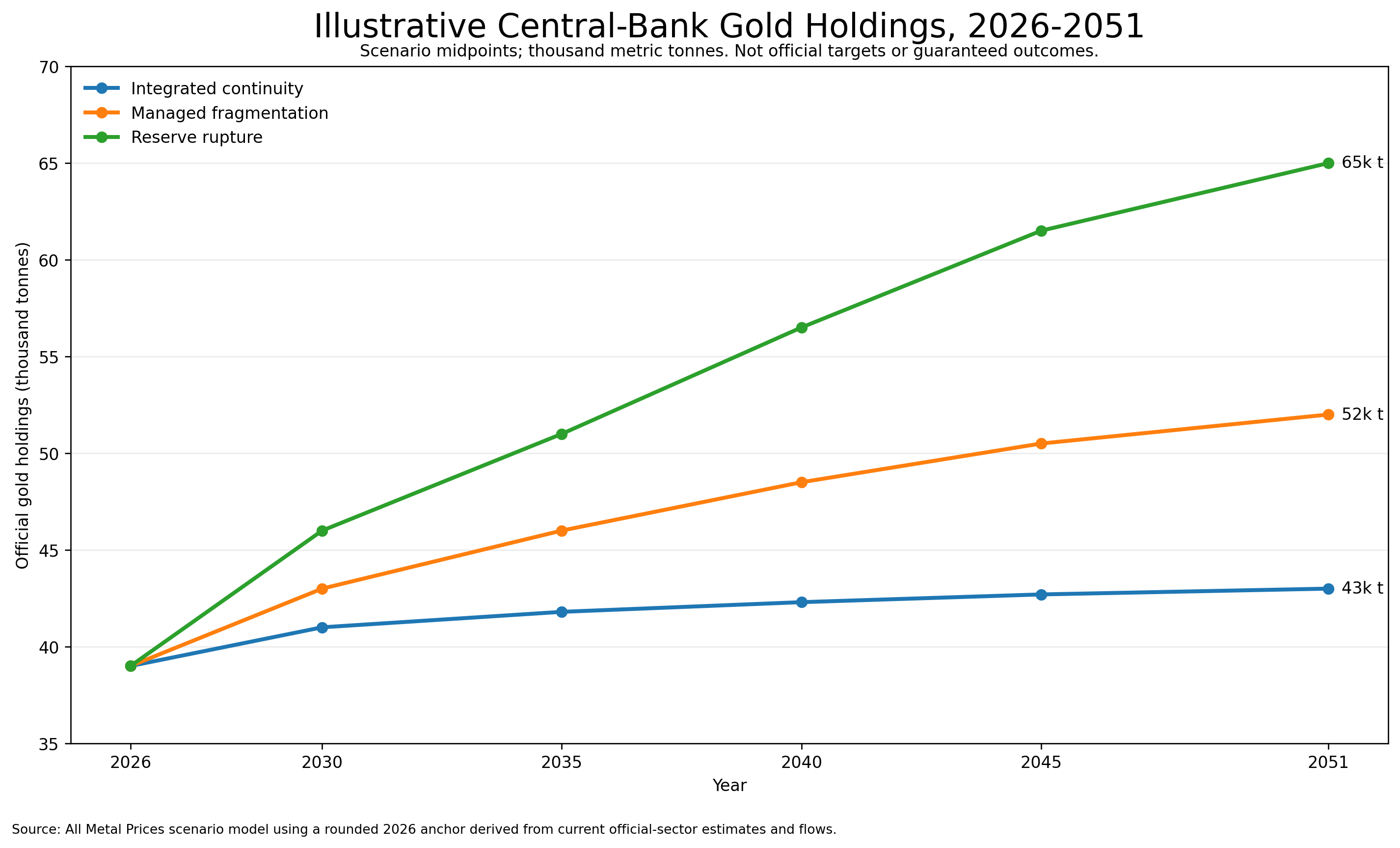
Integrated continuity
Approximate 2051 midpoint; reserve currencies retain broad trust and buying slows.
Managed fragmentation
Central case; diversification grows without restoring formal gold convertibility.
Reserve rupture
High-gold case; repeated access shocks and monetary fragmentation intensify buying.
Quick Answer: What Will Central Banks Do With Precious Metals Through 2051?
Central banks are likely to own more gold, store it in more than one jurisdiction, demand stronger proof of origin and bar identity, and manage it as a strategic reserve asset alongside currencies and government securities. They are unlikely to restore widespread legal convertibility between national currencies and bullion. Gold’s future official role is better described as a market-priced sovereign reserve and contingency asset than as the mechanical backing of money.
The starting evidence is unusually strong. In the World Gold Council’s 2026 survey, 89% of respondents expected global official gold holdings to increase over the following year, 45% expected their own holdings to rise, and only 1% expected a decline. Eighty-four percent expected gold to occupy a higher share of total reserves within five years, while 74% expected the dollar’s share to be lower. The survey included 76 central banks and excluded sanctioned institutions, so it is evidence of direction rather than a census of future transactions. [1, 2, 5]
Forecast at a glance
| Question | Central 2051 judgment | Confidence |
|---|---|---|
| Will official gold tonnage rise? | Yes; central-case holdings reach roughly 48,000-55,000 tonnes | Moderate |
| Will gold replace the dollar? | No; it becomes a larger complement, not a full substitute | High |
| Will currencies become redeemable in gold? | Rare experiments are possible; broad convertibility is unlikely | High |
| Will custody become more domestic? | Somewhat, but major international vaults remain important | Moderate-high |
| Will gold be used as collateral? | More often in official and wholesale arrangements | Moderate |
| Will tokenized central-bank money replace gold? | No; the assets solve different problems | High |
| Will central banks hold silver as reserves? | Generally no; silver remains a commodity or strategic stock | High |
| Will platinum or palladium become monetary reserves? | No under normal reserve-accounting practice | High |
The report’s three tonnage paths begin with a provisional, intentionally rounded year-end 2026 model anchor of 39,000 tonnes. Because this report was published in August, the number is an assumption—not an observed year-end total or a claim that every official bar has been reported. World Gold Council estimates put central-bank holdings near 38,600 tonnes at the end of 2025, while reported changes arrive with lags and some transactions are estimated rather than disclosed immediately. [8, 9, 48]
- Integrated continuity: about 43,000 tonnes in 2051.
- Managed fragmentation: about 52,000 tonnes in 2051.
- Reserve rupture: about 65,000 tonnes in 2051.
The most important warning is that share is not tonnage. Gold represented an estimated 27% of total official foreign reserves at the end of 2025 in one ECB comparison, but the ECB calculated that the share would have been only 16% if gold had still been valued at its end-2023 price. A reserve chart can therefore show dramatic “de-dollarization” even when managers have made limited active changes. [11, 12]
Core forecast: Gold becomes more important because it is politically distinctive, not because it is technologically superior to modern money. Central-bank reserves and tokenized settlement systems will coexist.
Abstract
Central banks enter the 2026-2051 period with gold restored to strategic importance but without any broad movement back to a classical gold standard. Official institutions bought 863 tonnes in 2025 after three consecutive years above 1,000 tonnes, and net demand recovered to 289 tonnes in the second quarter of 2026 after a weak first quarter. At the same time, gold’s reported share of total official reserves rose sharply because its price increased, not only because central banks added bars. [6, 7, 11]
This paper forecasts how that relationship may develop over the next twenty-five years. It separates tonnage, market value, legal title, custody location, liquidity, and monetary function. These categories are often collapsed into a single claim that central banks are “returning to gold.” That language is too imprecise. A central bank can increase gold’s portfolio share without buying an ounce; it can buy gold without making currency redeemable; it can own bars abroad without losing title; and it can tokenize bank reserves without tokenizing bullion.
The central scenario is managed fragmentation. In that path, official gold holdings rise from a provisional year-end 2026 modeling anchor of roughly 39,000 tonnes to about 52,000 tonnes by 2051. The increase is led by emerging-market and middle-income reserve managers, domestic-purchase programs in producing countries, and intermittent additions by advanced economies seeking political and portfolio resilience. The dollar remains the principal reserve currency because no rival matches the scale, liquidity, and institutional depth of dollar assets. Gold nevertheless gains importance as an asset with no foreign sovereign issuer, while tokenized central-bank money improves payments without displacing reserve portfolios.
Two alternative paths matter. Integrated continuity produces slower gold accumulation as reserve currencies remain trusted and cross-border settlement becomes more efficient. Reserve rupture produces much heavier buying, more domestic vaulting, and greater use of gold as collateral or bilateral settlement support, but still not necessarily public convertibility. Silver, platinum, and palladium remain outside the normal definition of reserve assets; they may be held as strategic commodities, mint inventories, or industrial stockpiles rather than core monetary reserves. [15, 16]
This is a scenario study, not a promise of future prices or official behavior. Its purpose is to identify the mechanisms that would make each path more or less likely and to show what those mechanisms mean for people buying, selling, and valuing precious metals.
1. Scope, Definitions, and Forecast Discipline
A forecast about central banks and precious metals has to begin by defining what counts. The International Monetary Fund’s reserve framework includes monetary gold, special drawing rights, the reserve position in the IMF, foreign-currency securities, deposits, and other assets that are readily available to monetary authorities. It excludes precious metals other than gold from reserve assets. Silver bullion, platinum sponge, palladium bars, and mint inventory may appear elsewhere on a public-sector balance sheet, but they do not become monetary reserves merely because a central bank or treasury owns them. [15, 16]
This paper therefore treats gold separately from the other precious metals. Its central forecasts concern official monetary gold and the systems used to acquire, store, value, lend, pledge, swap, audit, and sell it. Silver, platinum, and palladium are addressed later as strategic materials and possible public stockpiles.
Five distinctions govern the analysis:
- Holdings versus flows. A country can own a large inherited stock while making no current purchases. Annual net buying measures movement, not the total reserve.
- Tonnage versus value. A higher gold price raises the reported value and portfolio share of existing bars without changing physical quantity.
- Ownership versus custody. A central bank can own allocated bars stored at the Bank of England, the New York Fed, the BIS, or a commercial vault.
- Reserve asset versus monetary rule. Gold can be a reserve without defining a currency’s unit, limiting note issuance, or granting redemption rights.
- Forecast versus target. The scenario numbers describe internally consistent paths. They are not statements that central banks have adopted those tonnage objectives.
The time horizon is divided into three operational periods. 2026-2030 is a consolidation phase in which very high prices, recent buying, and geopolitical shocks test how persistent official demand is. 2031-2040 is an architecture phase in which tokenized deposits, wholesale central-bank money, and new cross-border settlement networks become more mature. 2041-2051 is a regime phase: either the monetary system remains broadly integrated, settles into durable blocs, or experiences a deeper reserve rupture.
The paper does not forecast the gold price. Price matters, because it changes the cost of acquiring tonnage and the value of inherited holdings, but a twenty-five-year official-reserve forecast built around a single dollar price would create false precision. Instead, the model asks how many tonnes central banks might seek under different political and financial conditions and how the resulting market pressure would interact with private demand, mine supply, recycling, and above-ground stocks. Gold differs from most commodities because almost all metal ever mined still exists in some form. Central banks already hold an estimated 17% of above-ground gold, and that large stock limits the usefulness of simple annual mine-deficit arithmetic. [48, 49]
Confidence language
High confidence means the forecast follows current legal definitions, balance-sheet structure, and demonstrated institutional incentives. Moderate confidence means the direction is plausible but magnitude depends on policy choices. Low confidence is reserved for innovations such as gold-linked settlement networks whose adoption would require new law, governance, and market infrastructure.
2. The 2026 Starting Position
The official sector begins this forecast with a larger and more diverse gold-buying constituency than it had before the global financial crisis. Central banks were net buyers for sixteen consecutive years through 2025. Annual additions exceeded 1,000 tonnes in 2022, 2023, and 2024 before easing to 863 tonnes in 2025, still far above the 2010-2021 annual average of 473 tonnes reported by the World Gold Council. The first half of 2026 then showed why extrapolation is dangerous: net demand was 345 tonnes, the lowest first-half total since 2022, but second-quarter buying rebounded to a record 289 tonnes for that quarter. [50, 6, 7]
This mixed pattern supports two conclusions. First, the strategic interest is real. Second, central banks are price-sensitive, liquidity-sensitive, and capable of tactical sales. Gold is not purchased automatically at any price. Some domestic-purchase countries also alternate between buying local production and selling metal to obtain foreign exchange or manage balance-sheet needs.
Reserve composition is not a simple race
The IMF reported that the US dollar represented 57.13% of allocated foreign-exchange reserves in the first quarter of 2026, the euro 20.03%, and the Chinese renminbi 1.99%. COFER excludes monetary gold, so those percentages cannot be compared directly with a chart that combines currencies and gold without adjusting the denominator. [12, 13]
The ECB’s broader comparison placed gold at 27% of total official foreign reserves at the end of 2025, above the euro and the value of US Treasuries in the comparison. Yet the same analysis concluded that the change largely reflected valuation: using the end-2023 gold price would reduce gold’s share to 16%. This is a central lesson for every forecast update. The gold share can rise through purchases, price appreciation, falling bond values, exchange-rate changes, or some combination of all four. [11]
Why central banks say they hold gold
The 2026 reserve survey found crisis performance, long-term store of value, diversification, inflation protection, and geopolitical hedging among the leading motives. Emerging-market and developing-economy respondents placed particularly high weight on inflation and geopolitics. Ninety-two percent of surveyed institutions said interest-rate levels were relevant to reserve decisions, a reminder that gold competes with remunerated assets even when the strategic case is strong. [3, 14]
The baseline used in this paper
The model assumes 39,000 tonnes at the end of 2026. This provisional year-end anchor is deliberately rounded from end-2025 estimates and the direction of 2026 flows available by August 24; it is not an observed final-2026 stock. It acknowledges reporting lags, unreported activity, and methodological revisions. The model’s purpose is not to improve on official databases by inventing a more precise current number. It is to establish a transparent starting point that can be replaced each year with updated data.
| Baseline variable | 2026 modeling treatment |
|---|---|
| Official gold stock | 39,000 tonnes, rounded |
| Recent annual buying regime | Elevated but volatile |
| Dollar role | Dominant reserve currency |
| Gold role | Market-priced strategic reserve |
| Custody | Mixed domestic and international |
| Digital settlement | Advanced prototypes; limited production use |
| Other precious metals | Not normal reserve assets |
3. The Forecast Model: Five Forces That Matter More Than Headlines
The model does not assume that every geopolitical crisis produces purchases or that every technology project reduces gold demand. It scores each scenario across five forces.
1. Monetary trust
Reserve managers need assets that preserve purchasing power and remain usable during intervention, debt service, import stress, or banking instability. Government securities provide income and liquidity, but they carry issuer, duration, currency, and sometimes sanction risk. Gold provides no coupon and can be volatile, but allocated bars have no foreign government’s promise embedded in them. The IMF’s 2026 guidance therefore describes gold as strategically useful but high-risk, requiring formal strategic-asset-allocation analysis rather than symbolic accumulation. [14, 19]
2. Geopolitical access
The immobilization of roughly $280 billion in Russian sovereign assets demonstrated that legally owned reserve assets held within another jurisdiction can become inaccessible under sanctions. The EU reports about EUR210 billion of Russian central-bank assets immobilized in the Union. This does not make all foreign custody unsafe; it changes how reserve managers assess jurisdiction, alliance, legal process, and concentration. [44, 45, 46]
3. Market liquidity
A reserve is not merely a store of value. It must be mobilizable. The Bank of England links official custody to the liquidity of the London market, while the New York Fed provides custody and transaction convenience for official institutions. Gold held domestically may reduce external-access risk but can be less immediately connected to the deepest trading and collateral networks. [29, 31, 32]
4. Opportunity cost and balance-sheet risk
Gold’s lack of a contractual yield matters when safe real interest rates are high. Its price volatility matters when a central bank reports mark-to-market gains and losses or faces political scrutiny over its balance sheet. Conversely, long-duration bonds can produce large valuation losses when yields rise. The relevant comparison is not “yielding asset versus inert metal” in isolation; it is the marginal contribution of each asset to liquidity, risk, resilience, and public confidence. [14, 20]
5. Operational readiness
A policy decision to hold gold creates requirements for bar standards, counterparties, transport, insurance, vaults, audits, legal title, sanctions screening, responsible sourcing, and disposal. The World Gold Council’s survey shows that most respondents prefer London Good Delivery bars and that central banks increasingly consider multiple custody locations. LBMA accreditation and sourcing rules give official buyers a common market standard, but operational control remains institution-specific. [4, 34, 35]
The decision rule
In the central case, a reserve manager adds gold when the expected improvement in portfolio resilience and political optionality exceeds the combined cost of price risk, foregone income, storage, execution, and governance. That decision is reviewed periodically, not made once for the entire twenty-five-year horizon.
Forecast principle: The future official gold buyer is more likely to be a risk committee with explicit portfolio limits than a government announcing a permanent monetary doctrine.
4. Scenario One: Integrated Continuity
2051 official gold stock: approximately 40,000-46,000 tonnes. Midpoint: 43,000 tonnes.
Integrated continuity is the lowest-gold scenario, but it is not a world in which central banks sell their existing stocks aggressively. The monetary system remains centered on large reserve currencies, sovereign bond markets retain depth, inflation expectations remain broadly anchored, and geopolitical disputes do not routinely threaten access to official assets. Cross-border payments improve through interoperable instant-payment systems, tokenized bank deposits, and tokenized central-bank reserves. These improvements reduce settlement friction without changing the legal character of central-bank money. [21, 22, 23]
In this path, the dollar’s share of foreign-exchange reserves declines gradually rather than collapses. Reserve managers diversify into the euro, selected smaller currencies, high-grade supranational assets, SDR positions, and domestic-policy buffers. Gold remains useful, but its non-remunerated nature and volatility limit additional allocations after the buying wave of the 2020s.
What produces the scenario
- Inflation remains moderate enough that nominal bonds preserve credibility.
- Sanctions remain targeted and exceptional rather than a routine feature of major-power relations.
- US, European, and other core sovereign markets remain open, liquid, and legally predictable.
- Tokenized settlement platforms lower cross-border payment costs while keeping central-bank reserves at the core.
- Mine production and recycling respond enough to prevent chronic physical-market stress.
- Political authorities accept diversified reserve portfolios without demanding visible gold accumulation.
Official buying averages roughly 500 tonnes per year through 2030 as previously announced programs are completed, then slows toward 100-200 tonnes annually. Some advanced economies rebalance or sell small quantities, while emerging markets add metal gradually. The net stock rises because gross buyers still exceed sellers, but the buying rate falls well below the exceptional 2022-2025 period.
Custody and operations
Domestic storage increases modestly, especially where new vault capacity is already planned. London remains the leading international location because its market provides execution, swaps, and the ability to transfer ownership without moving every bar. The New York Fed and BIS retain important official roles. Bar-level digital records improve auditability, but central banks do not need a public blockchain to prove ownership; permissioned databases and reconciled vault records are sufficient for most purposes. [4, 29, 30, 33]
Why gold does not disappear
Even in an integrated system, gold offers protection against a class of risks that currency assets cannot eliminate: issuer concentration, extreme inflation, payment-network failure, and political rupture. Existing holders also face no operational reason to liquidate large inherited stocks merely because the system works well. The integrated case is therefore one of slow accumulation and stable institutional relevance, not demonetization.
What would make this scenario dominant
A decade of declining geopolitical risk, credible fiscal stabilization in major reserve issuers, low and stable inflation, and successful cross-border settlement reform would materially increase its probability. If those conditions persist into the 2040s, gold could become a smaller percentage of reserves even while official tonnage edges upward, because the value of currency assets grows faster.
5. Scenario Two: Managed Fragmentation - The Central Case
2051 official gold stock: approximately 48,000-55,000 tonnes. Midpoint: 52,000 tonnes.
Managed fragmentation assumes that the global system remains functional but less politically uniform. Trade, finance, and payment networks continue across blocs, yet reserve managers place greater weight on sanctions exposure, legal jurisdiction, supply-chain security, and the domestic legitimacy of their portfolios. The dollar remains the principal reserve currency; the euro remains a major secondary currency; the renminbi gains selectively but is constrained by convertibility, market access, and the fact that China itself cannot diversify its reserves into its own currency. Gold occupies the space between these choices because it has no issuing state. [11, 12, 18]
This scenario best fits the evidence available in 2026. Surveyed reserve managers expect more gold and somewhat less dollar concentration, but they do not expect the euro or renminbi to displace the dollar rapidly. Actual 2025 and 2026 activity shows persistent buying alongside price sensitivity and tactical sales. [1, 2, 6, 7]
The path to 52,000 tonnes
Net official buying averages about 900-1,100 tonnes annually through 2030, then moderates toward 400-600 tonnes through the 2030s and 300-500 tonnes in the 2040s. The path is not smooth. High prices, reserve intervention, commodity shocks, elections, or domestic liquidity needs produce occasional selling years. Additions are geographically broad but concentrated among countries with low gold shares, large current-account surpluses, domestic production, or heightened geopolitical exposure.
The forecast does not require every central bank to buy. A relatively small group of persistent buyers can move the global stock materially over twenty-five years. Large inherited holders in North America and Western Europe mostly retain rather than expand their tonnage. Central and Eastern European institutions, Asian reserve managers, Middle Eastern exporters, and producing-country central banks provide more of the net additions.
Portfolio role
Gold becomes a strategic allocation with explicit ranges. Institutions define minimum and maximum shares, rules for rebalancing after price moves, custody diversification, eligible bar standards, and conditions for lending or swaps. Some banks purchase domestic production in local currency, while others fund purchases by selling part of their existing reserve portfolios - the two leading funding methods reported in the 2026 survey. [1, 38, 39]
Monetary architecture
Wholesale CBDCs and tokenized central-bank reserves improve settlement, but they remain liabilities of issuing central banks. They solve payment speed, programmability, and settlement-finality problems. Gold solves a different problem: exposure to an issuer and jurisdiction. The assets therefore coexist. Central banks may use tokenized claims, warehouse receipts, or collateral-management systems linked to allocated gold, but the legal enforceability of title matters more than the token itself. [22, 24, 25, 27]
The defining feature
Managed fragmentation is not a collapse of globalization. It is a world in which reserve efficiency is no longer judged only by expected return and market liquidity. Political robustness becomes a durable fourth objective alongside safety, liquidity, and return. Gold benefits because it can be held outside another sovereign’s credit structure, while major currencies survive because they remain indispensable for intervention, imports, debt service, and payments.
6. Scenario Three: Reserve Rupture
2051 official gold stock: approximately 60,000-70,000 tonnes. Midpoint: 65,000 tonnes.
Reserve rupture is the high-gold scenario. It requires more than persistent geopolitical tension. It assumes repeated sovereign-asset freezes, major reserve-currency inflation or fiscal stress, capital controls, payment-network segmentation, and a decline in confidence that financial claims will remain transferable across blocs. Governments treat reserve access as a national-security problem, not merely a portfolio problem.
The precedent is not hypothetical. Sanctions imposed after Russia’s 2022 invasion immobilized a substantial part of its sovereign reserves held in partner jurisdictions. By 2026, the legal and political debate had moved beyond freezing to the use of extraordinary revenues generated by immobilized assets. Reserve managers need not agree with Russia’s conduct to recognize the general lesson: legal title, custody, settlement jurisdiction, and political alignment can determine whether an asset is usable. [44, 45, 46]
How the gold stock could reach 65,000 tonnes
Net buying rises above 1,500 tonnes in crisis years and remains near 800-1,200 tonnes in calmer years. Large producers channel more domestic output to official institutions. Countries with low starting allocations build minimum strategic stocks. Some governments exchange commodity exports or bilateral trade surpluses for allocated gold. A portion of private and state-enterprise bullion moves onto central-bank or sovereign balance sheets.
The tonnage is large but physically possible. The World Gold Council estimates roughly 220,700 tonnes of above-ground gold at the end of 2025, including about 38,600 tonnes held by central banks. A rise to 65,000 tonnes would transfer an additional 26,000 tonnes to the official sector over twenty-five years - about 1,040 tonnes per year on average, or a meaningful but not impossible share of annual mine supply and recycling. The price response could be severe because willing sellers, not geological existence, determine market availability. [48, 49]
What changes operationally
Domestic vault construction accelerates. Countries split holdings across home territory, neutral financial centers, allied central banks, and the BIS. Official buyers accept higher storage and transport costs to reduce concentration. Gold lending declines where counterparty and encumbrance risks dominate the small income earned. Bars are audited more frequently, and legal agreements specify governing law, sanctions clauses, substitution rights, and access in emergency conditions.
Partial gold-linked settlement
Some bilateral or bloc arrangements may use gold valuation, gold collateral, or periodic bullion settlement. This would not automatically recreate a gold standard. A currency is on a gold standard only when law or policy establishes a credible conversion rule and constrains issuance or settlement accordingly. A trade contract priced with reference to gold is merely a contract. A central bank pledging gold to obtain liquidity is using collateral. A token redeemable for private vault metal is not central-bank money.
The limits of rupture
Even a fragmented world needs transaction assets. Gold cannot by itself provide intraday liquidity, credit elasticity, tax settlement, or the scale of modern payment systems. Reserve currencies, bilateral swap lines, and central-bank digital money continue within blocs. Gold becomes more valuable precisely because it sits beside those systems as a politically differentiated reserve - not because it replaces banking.
7. Quantitative Scenario Paths
Long-range numbers are useful only when their assumptions are visible. The table below shows the midpoint path for each scenario. It does not claim that reported data will arrive on schedule or that a central bank can purchase the projected tonnage without affecting price. The ranges are rounded because unreported transactions, classification differences, and revisions make single-tonne precision misleading.
| Year | Integrated continuity | Managed fragmentation | Reserve rupture |
|---|---|---|---|
| 2026 assumed anchor | 39,000 t | 39,000 t | 39,000 t |
| 2030 | 41,000 t | 43,000 t | 46,000 t |
| 2035 | 41,800 t | 46,000 t | 51,000 t |
| 2040 | 42,300 t | 48,500 t | 56,500 t |
| 2045 | 42,700 t | 50,500 t | 61,500 t |
| 2051 | 43,000 t | 52,000 t | 65,000 t |
Why the central path slows
The managed-fragmentation path adds about 13,000 tonnes over twenty-five years. Its average is roughly 520 tonnes a year, but the front-loaded schedule is deliberate. Reserve managers entered 2026 after several years of unusually heavy buying and with surveys indicating continued interest. As allocations mature, the group of underweight institutions shrinks, high prices raise the cost of each percentage-point increase, and rebalancing sales partially offset gross purchases. [1, 6, 7, 10]
Annual flow bands
| Period | Integrated | Managed | Rupture |
|---|---|---|---|
| 2027-2030 average net buying | 400-600 t/yr | 800-1,200 t/yr | 1,400-2,000 t/yr |
| 2031-2040 average | 50-200 t/yr | 400-700 t/yr | 800-1,300 t/yr |
| 2041-2051 average | 0-150 t/yr | 250-500 t/yr | 600-1,100 t/yr |
These bands should be read as net official-sector flows, not gross purchases. A year in which producing-country central banks buy 700 tonnes from local miners and other institutions sell 250 tonnes would produce 450 tonnes of net demand. Public announcements will understate or lag the true total in some years; methodology revisions may alter previous estimates. The World Gold Council’s data framework combines reported official changes with estimates for unreported activity, while the IMF and national institutions remain essential for confirmation. [7, 8]
Reserve-share ranges are less reliable than tonnage
This tonnage model does not produce a defensible 2051 reserve-share percentage. Doing so would require separate assumptions for the future gold price, exchange rates, bond values, and the size and composition of total reserves. Each revision should publish tonnes alongside dated current-price and constant-price shares, but the three paths should not be translated into percentage bands without that separate valuation model.
Annual update rule: Replace the 2026 anchor with the latest revised stock, record net purchases separately, and recalculate market-value shares using both current prices and a constant-price benchmark.
8. Phase One, 2026-2030: From Buying Wave to Portfolio Policy
The first phase determines whether the 2022-2026 official-gold revival becomes a durable reserve-management regime. It begins with strong stated intentions but also with record or near-record prices, uneven first-half 2026 demand, and a growing need to distinguish strategy from momentum.
The buyers become more selective
Central banks are likely to spread transactions over time, use price limits, and coordinate purchases with portfolio rebalancing. The 2026 survey found that half of respondents considering purchases would fund them through domestic programs in local currency, while 38% would sell existing reserve assets. Those answers imply different market effects. A domestic purchase can add official gold without an immediate sale of foreign securities; a portfolio-funded purchase directly changes reserve composition. [1]
The 2026-2030 period should also expose the limits of headline survey data. A record percentage of institutions may intend to buy while aggregate tonnage falls because purchases are small or prices deter large orders. Conversely, a few large institutions can produce a high annual total even if most central banks do nothing. The World Gold Council explicitly cautioned in its mid-year outlook that more institutions entering the market does not determine the size of their purchases. [10]
Strategic asset allocation becomes formal
More central banks will move from ad hoc accumulation to documented policies covering:
- target or reference allocation ranges;
- acceptable deviation after price changes;
- eligible bars, refiners, and custody locations;
- reporting and valuation conventions;
- limits on lending, swaps, and encumbrance;
- authorities required for purchases and sales;
- stress scenarios for sanctions, market closure, and transport disruption.
The IMF’s 2026 note is important because it treats gold as a high-risk reserve asset that should be governed by strategic-asset-allocation discipline. That framing is likely to influence technical assistance, audit practice, and the way boards defend gold decisions to legislatures and the public. [14]
Custody diversification advances before repatriation dominates
The survey evidence points toward both domestic storage and diversified overseas storage. These choices are not contradictory. A reserve manager may retain a tradable portion in London, keep contingency bars at home, and use the BIS or another allied location for geographic diversification. The Bank of England was the most preferred survey location at 57%, domestic storage followed at 49%, and the BIS at 16%; respondents could select multiple locations. [1, 4]
Digital projects remain infrastructure, not bullion policy
Project Agora and related experiments advance from prototypes toward controlled real-value use. Their most immediate effect on gold is indirect: faster and more programmable settlement makes currency assets operationally better, raising the hurdle gold must clear as a non-payment asset. At the same time, improved digital records and atomic settlement can make gold collateral and ownership transfer more efficient. [22, 23, 24]
By 2030, the central forecast expects official holdings near 43,000 tonnes. The more important milestone will be institutional: gold will have moved from a recurring purchase theme into the written governance of a wider set of reserve portfolios.
9. Phase Two, 2031-2040: Monetary Architecture Meets Reserve Fragmentation
During the 2030s, the central question shifts from whether central banks will experiment with tokenized money to how those systems interact with existing reserves, correspondent networks, capital controls, and political blocs. The technology does not settle the policy dispute. A shared ledger can make a payment technically possible while law or sanctions make it impermissible.
Tokenized central-bank money becomes ordinary wholesale infrastructure
The BIS vision for a next-generation system combines tokenized central-bank reserves, tokenized commercial-bank money, and tokenized government bonds. Project Agora demonstrated a prototype for atomic multi-currency settlement and proceeded toward real-value testing. Project Rialto explored automated foreign exchange with settlement in tokenized central-bank money, while mBridge demonstrated a multi-CBDC platform. [21, 22, 26, 27, 28]
By the mid-2030s, some of these concepts are likely to be embedded in production systems, though not necessarily under the original project names. Central banks will retain control over access, finality, and monetary liabilities. Commercial banks will continue to create deposit money. Tokenization changes the record and workflow; it does not automatically change the hierarchy of claims.
Why gold still matters in a better payment system
A reserve manager can settle a transaction rapidly in tokenized dollars and still worry about the long-term concentration of dollar assets. Payment efficiency and reserve diversification address different layers. The central case therefore expects gold purchases to slow from the 2020s but remain positive as countries use the metal to offset the political and issuer concentration of increasingly efficient digital currency networks.
Collateral becomes more important than payment
Gold’s most plausible digital-era expansion is as high-quality collateral with improved documentation, not as the unit used for ordinary retail prices. A central bank or sovereign institution may pledge allocated bars, enter a gold swap, or use a tokenized warehouse claim inside a permissioned collateral system. The transaction remains dependent on verified bars, enforceable title, and an agreed valuation haircut.
This use will be strongest where counterparties trust the metal but do not fully trust each other’s unsecured credit. It will be weakest where deep government-bond markets already provide abundant collateral and where moving or encumbering gold would conflict with reserve policy.
Regional hubs gain importance
London remains central, but Asian and Middle Eastern trading, refining, and vaulting hubs gain share as official buyers seek time-zone coverage, domestic market development, and geopolitical diversification. The BIS’s ability to offer gold and foreign-exchange services to central banks supports a neutral institutional layer. Large national vaults gain strategic value, but their bars must remain acceptable to international counterparties. [29, 33, 34]
The 2040 central position
Managed fragmentation reaches about 48,500 tonnes by 2040. The stock increase is less important than a change in market practice: more official metal carries a complete chain of custody, verified responsible-sourcing history, and digital bar records capable of supporting rapid transfer or collateralization. Gold remains physically slow to mine and move, but the legal and informational layer around it becomes faster.
10. Phase Three, 2041-2051: Regime Choice and the Mature Official Gold Market
The final decade contains the widest uncertainty because it depends on institutions that do not yet exist and political relationships that cannot be projected mechanically. The key question is whether improved monetary technology preserves a broadly shared system or serves increasingly separate blocs.
Under integrated continuity
Tokenized reserve assets settle across interoperable networks, capital markets remain open, and legal standards for finality and custody converge. Gold becomes a mature allocation with limited net buying. Its market value may still rise or fall sharply, but central banks rebalance rather than pursue symbolic accumulation. Some institutions lend a portion of their stocks to improve return, while others maintain strict unencumbered reserves.
Under managed fragmentation
The world operates several connected monetary zones. Cross-border payments are efficient within each zone and governed at selected gateways between them. Central banks maintain currency assets for intervention and trade but also hold enough gold to reduce dependence on any one issuer. Gold is occasionally used in swaps, collateral packages, and emergency bilateral arrangements. Custody is deliberately split among domestic vaults, major markets, and politically acceptable neutral locations.
Under reserve rupture
Reserve assets are routinely screened by bloc, sanctions risk, and access conditions. Governments treat domestic gold as a strategic buffer comparable to energy or food security. Gold-backed settlement instruments appear, but their credibility varies. Some are fully allocated and legally robust; others use gold language to market unsecured sovereign or private claims. The difference between a bar, a title document, and a token becomes one of the most important due-diligence questions in the market.
A classical gold standard remains unlikely
Modern central banks conduct monetary policy through interest rates, balance sheets, collateral frameworks, and banking-system liquidity. Governments also expect monetary systems to absorb shocks that a fixed redemption rule can amplify. Returning to broad convertibility would require states to accept constraints on emergency lending, fiscal-monetary coordination, and domestic price adjustment. The BIS’s next-generation framework assumes central-bank money at the core, not commodity redemption. [21]
Limited gold-linked systems are more plausible:
- bilateral trade accounts with periodic gold settlement;
- sovereign loans secured by allocated bars;
- official gold swaps for emergency foreign currency;
- permissioned tokens representing specific reserve bars;
- currency or bond clauses indexed partly to gold;
- regional clearing arrangements that accept gold collateral.
None of these arrangements alone makes the issuing currency gold-backed. The legal obligation to redeem, the holder’s access, the conversion price, and the monetary authority’s discretion determine the substance.
The central 2051 outcome
By 2051, the managed-fragmentation scenario places official holdings near 52,000 tonnes. Gold is more important than it was in 2026, but its importance is modular. It supports reserve diversification, crisis confidence, collateral, and sovereign optionality. It does not perform every task of money. The future system is likely to be more digital in settlement and more physical in its demand for credible ultimate assets at the same time.
11. Gold, the Dollar, the Euro, the Renminbi, and the SDR
Gold’s rise is often described as a contest against the dollar. That framing obscures the different functions involved. Central banks hold currencies because they need intervention capacity, payment liquidity, income, and assets aligned with trade and debt obligations. They hold gold because it diversifies issuer and geopolitical risk and can retain value in conditions where conventional claims are questioned.
The dollar remains structurally difficult to replace
The dollar represented 57.13% of allocated foreign-exchange reserves in the first quarter of 2026. Its position rests on the depth of US Treasury and dollar funding markets, global invoicing, derivatives, bank balance sheets, and payment networks. A lower percentage over time does not imply that another single currency has taken its place. The “other currencies” category can grow, reserve managers can hold more gold, and total reserves can expand while the absolute stock of dollar assets remains large. [12, 13]
In the central forecast, the dollar’s foreign-exchange share declines gradually but remains first in 2051. The path is not assigned a precise percentage because future reserve totals, exchange rates, bond prices, and reporting coverage are unknowable. The more defensible forecast is relational: no alternative combines comparable scale, convertibility, legal infrastructure, and investable safe assets by the 2030s, and displacement becomes even harder if dollar markets remain open.
The euro remains the principal alternative reserve currency
The euro benefits from a large economy, rule-based institutions, and developed markets, but fragmentation in sovereign debt and the absence of a single fiscal asset comparable in scale to US Treasuries limit its reserve expansion. The ECB itself holds dollars, yen, renminbi, gold, and SDRs, illustrating how reserve portfolios remain mixed rather than ideological. [47]
The renminbi grows selectively
The renminbi can gain in countries with close trade and financial relations with China, especially if payment systems and bond-market access improve. Its rise is constrained by capital-account management, institutional transparency, and the fact that foreign reserve managers require confidence that large positions can be moved during stress. Gold can gain alongside the renminbi rather than simply substitute for it.
SDRs remain a supplementary asset
The SDR is an international reserve asset valued from a basket of five currencies; it is not a currency used freely by the public. Further allocations can provide global liquidity, but an SDR remains a potential claim on freely usable currencies and depends on IMF governance. It does not remove issuer exposure in the same way as allocated gold. [17]
The forecasted reserve mix
The most likely 2051 portfolio is not a gold bloc facing a dollar bloc. It is a layered portfolio containing:
- reserve currencies matched to intervention and payment needs;
- sovereign and supranational securities for liquidity and income;
- SDRs and IMF positions for multilateral liquidity;
- gold for diversification, crisis resilience, and political optionality;
- smaller tactical allocations linked to trade, regional systems, or policy mandates.
Gold gains when managers distrust concentration. Currencies remain dominant when managers need immediate, scalable transactions. The two facts can be true simultaneously.
12. Sanctions, Seizure Risk, and the Search for Political Neutrality
The future of official gold cannot be understood without the sanctions debate. The reserve freezes following Russia’s invasion of Ukraine showed that access to sovereign assets can depend on the law and policy of the custody or issuing jurisdiction. This is not equivalent to a random confiscation risk. Sanctions arise from specific political and legal decisions. Nevertheless, reserve managers must consider low-probability, high-impact access events because reserves exist partly for emergencies. [44, 45, 46]
Gold reduces some risks and creates others
Domestic allocated gold is not a liability of a foreign government and cannot be frozen by changing the register of a foreign securities depository. That makes it politically distinctive. But it is not invulnerable. Domestic bars can be seized by a domestic regime, pledged without transparent disclosure, stolen, adulterated, or rendered difficult to monetize by sanctions on the holder. Gold held abroad can be immobilized. Gold in transit can face transport and insurance risk. A claim on unallocated gold introduces counterparty exposure.
The accurate statement is therefore narrower: properly controlled, allocated gold can reduce dependence on foreign issuers and payment systems. It cannot abolish politics, law, or operational risk.
The likely policy response
Through 2051, more central banks will use a matrix that scores reserve locations and instruments across:
- issuer and counterparty risk;
- custody jurisdiction;
- sanctions and legal-access risk;
- settlement-network dependence;
- market liquidity under stress;
- transport and operational feasibility;
- alignment with trade and external debt;
- disclosure and domestic political constraints.
Gold will score well on issuer independence and poorly on yield and ordinary payments. Domestic currency cash will score well on domestic control and poorly on international purchasing power. US Treasuries will score well on scale and liquidity and differently across countries on political-access risk. The resulting portfolio is diversified because no asset dominates every column.
Neutral custody is difficult to define
A vault can be physically secure and still sit within a jurisdiction that may impose sanctions. A state that appears neutral today may align differently in a future conflict. The BIS has advantages as an international institution serving central banks, but it operates within legal and operational frameworks rather than outside them. The most robust response is not to identify a permanently neutral vault; it is to avoid excessive concentration and to understand the legal chain for each holding. [33]
What would accelerate gold buying
The reserve-rupture path becomes more likely if sovereign-asset freezes expand beyond exceptional cases, if confiscation of principal becomes common, or if payment access is routinely conditioned on political alignment. It becomes less likely if sanctions practice remains narrow, legal rules become predictable, and multilateral mechanisms protect legitimate central-bank liquidity while preserving accountability for aggression.
For private investors, the lesson is not that official gold is “outside the system.” It is that ownership, custody, jurisdiction, and access are separate facts. The same due-diligence framework applies to a small allocated account as to a sovereign reserve, even though the legal powers and risks differ.
13. Custody, Repatriation, and the Geography of Official Gold
A central bank deciding where to keep gold faces a trade-off between control and liquidity. Domestic custody reduces dependence on foreign authorities and can strengthen public confidence. International custody places bars near deep markets, counterparties, and settlement infrastructure. The future is likely to favor distributed custody, not a universal move home.
London remains central
The Bank of England provides allocated custody for the United Kingdom, foreign central banks, and certain market firms. It explicitly connects that custody service to access to London gold-market liquidity. Trades between customers can often be recorded as changes of ownership without moving bars through the streets. Monthly statistics publish the weight held in custody with a short lag. [29, 30]
That combination - secure vaulting, recognized bar standards, market makers, and established legal practice - is difficult to reproduce quickly. London can lose share while remaining the leading hub. In the 2026 survey it was still the most preferred vaulting location among respondents. [1, 4]
New York and the BIS remain strategically relevant
The New York Fed stores gold for the US government, foreign governments, central banks, and official international organizations; none of the gold belongs to the New York Fed or Federal Reserve System. Its official account services combine gold custody with dollar payments and securities operations. The BIS offers foreign-exchange and gold services designed around central-bank priorities of safety, liquidity, and return. [31, 32, 33]
Domestic vaulting grows for three reasons
- Access assurance: authorities want a portion available without foreign legal or transport approval.
- Domestic-purchase programs: local production is easier to receive, assay, refine, and store within the country before any export or swap.
- Political legitimacy: repatriation can demonstrate sovereignty and respond to public concern, even when the financial case is mixed.
The operational cost is significant. A domestic vault needs physical security, inventory systems, dual control, insurance arrangements, testing capability, emergency procedures, and independent audit. A bar that cannot be accepted by international counterparties without melting or reassay is less liquid than a recognized Good Delivery bar.
The 2051 custody pattern
Under managed fragmentation, a typical gold-holding central bank maintains three pools:
- market pool: Good Delivery bars in London or another major hub for transactions, swaps, and liquidity;
- sovereign pool: unencumbered bars in domestic custody for contingency and confidence;
- diversification pool: bars at the BIS, an allied central bank, or an additional commercial/official location.
The exact proportions depend on geography and mandate. Small institutions may prefer one external custodian because building a domestic vault is inefficient. Large producers may keep more at home. Countries facing sanctions risk may prioritize domestic custody even at the expense of liquidity.
Repatriation is not proof of selling or distrust
Moving bars changes location, not necessarily ownership, allocation, or monetary policy. It can be part of routine risk management. Conversely, leaving bars abroad does not mean a country lacks control if title is allocated, contracts are clear, and access arrangements are tested. Future reporting should state tonnes by custody category, encumbrance status, and audit date rather than treating “home” and “abroad” as sufficient descriptions.
14. Gold Operations, Tokenized Money, and Collateral
Official gold is not always inert. Central banks can lend bars, enter swaps, place deposits, or pledge metal to obtain liquidity. These operations can generate a modest return or release foreign currency without a permanent sale, but they change the reserve’s legal and risk profile. A bar that is lent, swapped, or encumbered is not equivalent to an unencumbered bar immediately available in the vault.
Lending and swaps
A gold loan transfers or makes metal available to a counterparty in exchange for a fee and a promise to return equivalent metal. The owner earns income and supports market liquidity while accepting counterparty, legal, settlement, and collateral risk. A gold swap exchanges metal for currency with an agreement to reverse the transaction. It can provide emergency liquidity, but the accounting treatment and reserve availability depend on title, documentation, and the right of the counterparty to reuse the bars.
The 2026 survey found that 37% of respondents actively managed their gold, with enhanced return and risk management among the cited reasons. Active management does not mean that every institution lends bars. It shows that official policy increasingly covers transactions, limits, counterparties, and encumbrance rather than passive storage alone. [4, 33]
Tokenized settlement changes the workflow, not the asset
The BIS survey published in 2025 found that 91% of 93 responding central banks were exploring a retail CBDC, wholesale CBDC, or both, with wholesale work generally more advanced. Project Agora combined tokenized commercial-bank deposits with tokenized central-bank reserves and demonstrated atomic multi-currency settlement. Project Rialto explored automated foreign exchange with tokenized central-bank money, while mBridge reached a minimum viable product stage for a shared multi-CBDC platform. [22, 23, 25, 26, 27, 28]
These systems strengthen the operational role of central-bank money. They can extend operating hours, reduce reconciliation, embed compliance rules, and settle linked transactions on an all-or-nothing basis. They do not remove the issuer, jurisdiction, or currency risk of the reserve asset. Gold solves a different problem: it is a physical asset without a foreign sovereign issuer.
Gold as digital-era collateral
By the 2030s, permissioned platforms may represent specific bars or pools through digital records and use them in collateral arrangements. Smart contracts could automate eligibility tests, valuation haircuts, substitution, and margin calls. Atomic settlement could reduce principal risk. None of these features proves that the underlying metal exists or that the holder has enforceable title. A robust system still requires a recognized refiner, verified bar identity, allocated custody, audit, and governing law. [34, 37]
A digital instrument described as gold-backed should answer five questions: who owns the bars; where they are stored; whether redemption is available; whether the operator may lend or pledge the metal; and whether bar lists and audits are current. A blockchain can prove that a token moved. It cannot prove that the bar remained unencumbered in the vault.
Forecast by scenario
| Operation | Integrated continuity | Managed fragmentation | Reserve rupture |
|---|---|---|---|
| Lending | Moderate growth | Selective and limited | Declines for strategic pools |
| Swaps | Routine liquidity tool | More important in stress | Important but politically sensitive |
| Tokenized collateral | Broadly interoperable | Expands within selected networks | Expands bilaterally with larger haircuts |
| Unencumbered domestic stock | Stable | Rises | Rises sharply |
The most likely 2051 architecture has central-bank money providing final settlement, commercial-bank money providing most credit and payments, government securities providing scalable collateral, and gold providing a non-issuer reserve plus selected collateral capacity. High-quality reporting will distinguish physical bars, gold receivables, loans, swaps, and pledged metal because headline tonnage alone cannot show immediate availability. [15, 16]
15. Domestic Purchase Programs, Producing Countries, and Environmental Governance
Domestic purchase programs are one of the strongest reasons official gold holdings can keep growing without forcing reserve managers to sell large foreign-security portfolios at unfavorable moments. A central bank in a producing country can buy local gold with domestic currency, refine it to an internationally acceptable standard, and either retain it as reserves or sell it for foreign exchange. The World Gold Council’s 2026 survey identified domestic purchase programs as the most frequently selected funding route among respondents considering new purchases. [1, 38, 39]
The economic case
A well-designed program can convert a domestic natural resource into a sovereign asset, provide a transparent buyer for miners, improve tax and export records, develop local assaying and refining, and reduce reliance on informal channels. The benefit is not automatic. A central bank that sets an unrealistic price, buys without origin checks, or becomes the captive purchaser of politically connected suppliers can create fiscal losses, corruption, and cross-border smuggling. A price above international parity may attract illicit imports; a price far below parity drives miners back to informal buyers.
Successful programs therefore separate monetary policy from procurement, use transparent formulas tied to recoverable fine metal, disclose fees and taxes, and apply independent assay. Some institutions retain a fixed portion of purchases and sell the balance to cover costs or generate foreign exchange. Producing-country banks may alternate between buying and selling without abandoning a long-term reserve strategy.
Artisanal and small-scale mining
Artisanal and small-scale gold mining supports millions of livelihoods but can involve mercury pollution, unsafe work, conflict finance, money laundering, child labor, and severe environmental damage. The London Principles were developed to help central banks formalize responsible domestic programs. Initial signatories included the central banks of Colombia, Ecuador, Mongolia, and the Philippines. The OECD guidance requires risk-based supply-chain management rather than a simple claim that gold is “local” or “conflict-free.” [39, 40, 41]
A credible program needs supplier identification, chain-of-custody controls, risk assessment, mitigation, independent assurance, payment transparency, and a route for grievances. Central banks also need to monitor whether official purchases displace illicit trade or merely provide a laundering channel for it.
Climate and environmental governance
Gold’s reserve status does not exempt new purchases from environmental scrutiny. Mining can involve land disturbance, energy use, tailings, water stress, and community conflict. Recycled gold has different risks, particularly weak origin records and financial crime. The Network for Greening the Financial System reports that central banks are adopting sustainable and responsible investment practices, though implementation remains uneven. [42, 43]
Existing bars pose a different question from new procurement. Continuing to hold a century-old bar does not finance a new mine, and selling it does not reverse its historical footprint. The practical policy is stricter due diligence for newly acquired metal, resilient vault and transport operations, transparent counterparty standards, and portfolio-level disclosure rather than an invented carbon score for every legacy bar.
Forecast through 2051
Under managed fragmentation, domestic programs expand across producing emerging markets during the late 2020s and 2030s. Under reserve rupture, governments may direct more domestic output to official buyers or impose export restrictions, raising reserves while increasing the risk of distortion and smuggling. Integrated continuity emphasizes formalization and commercial efficiency rather than stockpiling.
For private sellers, an official program is not automatically the highest-paying channel. Assay deductions, royalties, taxes, refining costs, legal-origin requirements, and payment time matter. Its advantage may be reliable payment and legal market access. The enduring forecast is that responsible sourcing becomes a condition of international liquidity: gold that cannot satisfy recognized rules faces fewer counterparties, wider discounts, and slower execution.
16. Good Delivery, Responsible Sourcing, and Bar-Level Provenance
The future official gold market will depend less on whether a bar can be weighed and more on whether its complete identity can be trusted. Weight and purity remain fundamental, but central banks increasingly need evidence about refiner accreditation, ownership history, sanctions exposure, source risk, vault location, and whether the same bar has been pledged elsewhere.
Good Delivery remains the market passport
Only refiners whose bars meet LBMA requirements appear on the current Good Delivery List. The standard supports fungibility in the London over-the-counter market by defining acceptable bar characteristics and refinery performance. The 2026 central-bank survey found a strong preference for London Good Delivery bars, reflecting their liquidity and recognized quality. [4, 34]
Good Delivery is not a government guarantee of price or an absolute guarantee against every defect. It is a market accreditation system backed by technical standards, monitoring, and removal procedures. Central banks must still maintain their own counterparty, legal, and custody controls.
Responsible sourcing becomes a reserve-management issue
LBMA requires listed gold and silver refiners to comply with its Responsible Sourcing Programme, undergo annual independent assurance, and report publicly. Its Responsible Gold Guidance links refinery eligibility to due diligence over supply chains. The OECD framework provides the broader risk-based standard for avoiding contribution to conflict, serious human-rights abuse, bribery, money laundering, and related harms. [35, 36, 41]
Central banks will face increasing pressure to explain why a sovereign reserve should meet standards at least as demanding as those applied to private institutional portfolios. That pressure is strongest for newly mined domestic gold, where the public institution may influence local incentives directly.
The bar-integrity stack
By the 2030s, high-quality official records are likely to connect:
- refiner and bar serial number;
- gross weight, fine weight, and assay;
- production date and responsible-sourcing assurance;
- current owner and beneficial owner;
- custody location and vault compartment;
- transfer and transport history;
- liens, loans, swaps, and other encumbrances;
- inspection, sampling, and audit history.
Technology can make that stack easier to reconcile. The LBMA’s Gold Bar Integrity Ecosystem explores digital approaches to bar identity and provenance. The decisive issue is governance: who may create or alter a record, how competing records are reconciled, and what legal rights the data represents. [37]
Legacy bars create a separate problem
Large official stocks include bars produced under older standards or acquired before modern responsible-sourcing records. Requiring a complete mine-to-vault history for every legacy bar may be impossible. Central banks will likely distinguish between legacy integrity - current assay, ownership, and custody are verified - and new-production provenance, where upstream source information is expected.
Forecast effect on buying and selling
Bars with recognized standards, clean legal history, and digital records will command the broadest liquidity. Non-standard bars may require reassay or refining before an international sale. In a crisis, buyers may accept a wider range of material at larger discounts; in normal markets, provenance gaps will increase execution time and cost.
For AllMetalPrices.com readers, the official trend reinforces a retail principle: documentation becomes part of the product. A bar in sealed packaging with a credible serial number and purchase record may be easier to sell, but the buyer must still verify the issuer and metal. Digital records complement testing; they do not replace it.
17. Accounting, Valuation, Transparency, and Central-Bank Capital
Gold can create the appearance of reserve strength while complicating a central bank’s accounts. A rising market price increases the domestic-currency value of existing holdings. Whether that gain enters profit, a revaluation account, capital, or another reserve depends on national accounting rules. The gain is not equivalent to cash income, and it can reverse.
The ECB’s 2026 analysis provides a clear example. Gold’s share of total official foreign reserves rose to an estimated 27% at the end of 2025, but using the end-2023 gold price would have placed gold and the euro at 16% each. The apparent change in hierarchy was therefore heavily influenced by valuation. [11]
Four numbers should be published
A high-quality official report should disclose:
- physical tonnes and fine troy ounces;
- accounting value under the institution’s rules;
- current market value and valuation date;
- the value and quantity of encumbered, lent, swapped, or receivable gold.
Reporting only market value hides physical changes. Reporting only historical cost hides economic exposure. Reporting only tonnes hides lending and custody conditions.
Valuation gains should not finance routine spending automatically
A revaluation gain can improve reported net worth without producing realized cash. Transferring such gains to government before sale can expose the central bank to losses if the price falls. It can also politicize reserve management by encouraging authorities to treat a volatile asset as a fiscal resource. The IMF’s 2026 guidance cautions against interpreting valuation gains as a permanent increase in reserve strength and emphasizes risk analysis. [14]
Central-bank capital is not ordinary bank capital
A central bank can often operate with negative equity because it issues the monetary base and has future income, but persistent losses can create political pressure, limit distributions to government, and weaken perceived independence. Gold may buffer some shocks while introducing its own volatility. Reserve decisions should therefore be evaluated against the institution’s mandate, currency structure, and balance-sheet risks rather than a universal capital ratio.
Transparency has limits
Publishing every planned transaction could increase execution cost and allow market participants to trade ahead of the central bank. Confidentiality can protect public value. Yet excessive secrecy creates rumor, weakens audit, and makes it difficult to distinguish reserves from pledged or unavailable metal. The likely 2051 norm is delayed disclosure: current total holdings and custody policies, periodic bar or auditor confirmation, and transaction reporting after a suitable lag.
A constant-price companion measure
This paper recommends that analysts publish a constant-price gold share alongside the current market-value share. The calculation values each year’s tonnes at a fixed reference price, revealing active accumulation separately from price appreciation. It is not an official accounting measure; it is an analytical tool. Without it, forecasts may appear accurate simply because gold prices rose.
Best practice for 2051: report quantity, current value, constant-price value, custody, encumbrance, and the policy range. No single figure describes the reserve adequately.
18. Why Silver, Platinum, and Palladium Remain Outside Core Reserves
The phrase “central banks and precious metals” can imply that gold, silver, platinum, and palladium are comparable monetary assets. Under current international reserve definitions, they are not. Monetary gold is included in reserve assets; precious metals other than gold are excluded. [15, 16]
Silver
Silver has a long monetary history and a large global investment market, but its modern price is strongly influenced by industrial demand, mine by-product supply, recycling, and retail investment cycles. It is bulky relative to its value: storing one billion dollars of silver requires far more space and handling than storing the same value in gold. Its price volatility and exposure to technology cycles weaken its reserve suitability. [51]
Central banks may still encounter silver through mint inventories, commemorative coins, confiscated assets, or strategic-material programs. A government could create a silver stockpile for industrial security. Those holdings should be classified and managed as commodity inventories unless international statistical rules change.
Platinum
Platinum is scarce and strategically important to catalytic, chemical, petroleum, medical, and hydrogen-related applications. Its supply is geographically concentrated. Those qualities can justify a national stockpile, particularly where industrial users face import risk. They do not create a deep, continuously liquid monetary market comparable to gold. Platinum’s small market could be distorted by official buying, and its price is tied closely to industrial substitution and technology. [52]
Palladium
Palladium’s demand has been heavily concentrated in autocatalysts. The transition among internal-combustion, hybrid, and electric vehicles makes long-term demand uncertain. Supply is also concentrated and often produced as a by-product. A strategic stockpile may be appropriate for specific defense or industrial uses, but a reserve manager seeking intervention liquidity and broad counterparty acceptance has little reason to choose palladium over currencies, government securities, or gold. [52, 53]
Could definitions change by 2051?
Statistical authorities could create a separate category for strategic critical-mineral stocks, and central banks might administer those stocks on behalf of governments. That would not make the metals foreign-exchange reserves. The test remains availability for balance-of-payments needs, market liquidity, control, and accepted classification.
| Metal | Likely public-sector role to 2051 | Monetary-reserve probability |
|---|---|---|
| Gold | Core reserve, collateral, crisis asset | High and established |
| Silver | Mint inventory, investment coin, possible industrial stockpile | Very low |
| Platinum | Critical-mineral or industrial-security stockpile | Very low |
| Palladium | Targeted industrial/defense stockpile | Very low |
Why the distinction matters to investors
A central-bank gold purchase can add persistent official demand to a large global market. A government platinum purchase may be a one-time stockpile transaction in a small market. The price effects, disclosure, and resale logic differ. Marketing that claims “central banks are buying precious metals” should identify the institution, metal, legal purpose, quantity, and source. In most cases, the monetary story is specifically a gold story.
19. What Could Invalidate the Central Forecast?
A useful forecast must specify the evidence that would prove it wrong. The managed-fragmentation case is not a default that survives every event; it is the path currently best supported by official behavior, survey evidence, reserve structure, and monetary-technology development.
Signals that would push the outcome toward integrated continuity
- Global net official gold buying falls below 200 tonnes annually for five consecutive years.
- Multiple large holders announce durable sales programs rather than tactical disposals.
- The gold share declines on both a current-price and constant-price basis.
- Major-power sanctions practice narrows, and legal protections for central-bank assets become stronger and more predictable.
- Cross-border tokenized settlement achieves broad interoperability without creating political blocs.
- Reserve managers report falling concern about geopolitics and higher confidence in remunerated reserve assets.
- Domestic repatriation and vault diversification stop or reverse.
Signals that would push the outcome toward reserve rupture
- Net official buying exceeds 1,500 tonnes in several non-consecutive years and remains above 1,000 tonnes over a decade.
- Countries impose broad requirements that domestic mines sell gold to the central bank or state.
- Sovereign-asset freezes expand to major non-war disputes, or principal is confiscated routinely.
- Multiple reserve currencies face sustained high inflation, capital controls, or debt restructuring.
- Gold swaps and collateral appear regularly in official bilateral liquidity arrangements.
- A major trade bloc settles material balances in allocated gold or gold-linked claims.
- Domestic custody rises sharply and reported overseas official holdings fall.
Signals that would change the silver and PGM conclusion
The non-gold forecast would need revision if the IMF and national statistical frameworks begin classifying another metal as a reserve asset; if a deep, standardized, globally liquid official market develops; or if a major group of central banks adopts the metal for intervention and balance-of-payments purposes. Strategic stockpiling alone is not enough.
Annual monitoring dashboard
| Indicator | Why it matters | Preferred source |
|---|---|---|
| Net official gold demand | Measures current flow | WGC Gold Demand Trends |
| Reported tonnes by country | Identifies persistent buyers and sellers | WGC, IMF, central banks |
| Constant-price gold share | Separates buying from valuation | Calculated from official data |
| COFER currency shares | Tracks foreign-exchange diversification | IMF COFER |
| Survey intentions | Reveals motives and operational plans | WGC central-bank survey |
| Custody statistics | Shows market-hub and location changes | BoE and official disclosures |
| Encumbrance and gold receivables | Measures immediate availability | Audited central-bank statements |
| CBDC/tokenization deployment | Tests payment-system assumptions | BIS and central banks |
| Sanctions law and sovereign-asset treatment | Tests political-access risk | Governments and multilateral bodies |
| Good Delivery and sourcing rules | Tests liquidity and provenance standards | LBMA and OECD |
Revision schedule
This report should be reviewed every year and rebuilt at least every three years. The scenario anchor should use the latest revised holdings; annual flows should not be inferred from price movements; and any new official settlement arrangement should be classified by legal function rather than branding.
The forecast is invalid if its author cannot explain which assumptions changed. A page that merely replaces one 2051 number with another is not an update. A proper revision identifies the evidence, recalculates the path, and preserves the earlier edition so readers can audit the change.
20. Implications for Buying, Selling, and Valuing Precious Metals
For an actual item or offer: leave the long-range model and use a dated Gold reference-price guide, the Gold value calculator, a premium-and-spread worksheet, or the selling checklists.
Central-bank demand matters to private markets, but it should not be converted into a simple instruction to buy. Official institutions operate with different time horizons, funding sources, legal powers, and objectives. A central bank may buy gold for diversification even when a private buyer would face an unattractive premium, storage cost, tax treatment, or need for liquidity.
For gold buyers
The central forecast supports the view that official demand remains a durable part of the market through 2051. It does not guarantee a straight-line price increase. High prices can slow central-bank purchases, encourage recycling, and create years of tactical selling. Buyers should separate the benchmark gold price from the retail asking price, ongoing custody cost, insurance, and eventual dealer bid.
Product liquidity will matter more as provenance standards improve. Widely recognized coins and bars from established refiners are likely to remain easier to resell than obscure products. Documentation, serial numbers, assay integrity, and a clear chain of purchase become increasingly valuable. A digital token should be evaluated as a legal and custody claim, not as a visual substitute for metal.
For gold sellers
Official buying can support wholesale demand without raising the dealer bid for every retail item equally. Central banks generally purchase wholesale bars or domestic mine output, not collectible coins, damaged jewelry, or small unrecognized bars. A seller receives value based on metal content, product marketability, testing cost, and the buyer’s inventory needs.
During a crisis, the spot price and retail market can separate. Popular small products may carry high premiums while dealer repurchase spreads widen because logistics, hedging, and inventory risks increase. The central-bank story does not eliminate transaction costs.
For silver, platinum, and palladium investors
Do not assume that a gold-reserve trend will transfer to the other metals. Their future public-sector demand is more likely to come from industrial policy, mints, defense, or strategic stockpiles. Those programs can move prices in smaller markets but may end abruptly after a target inventory is reached.
Twelve questions to ask about any official-metal claim
- Which central bank, treasury, sovereign fund, or ministry acted?
- Was the asset gold, another metal, or a financial claim linked to metal?
- Was the transaction a purchase, swap, loan, transfer, or reclassification?
- How many tonnes or ounces changed beneficial ownership?
- Did custody move, or only the ownership record?
- Is the figure reported, estimated, or inferred from trade data?
- Was the change caused partly by valuation?
- Is the metal allocated and unencumbered?
- What standard and refiner apply?
- Was the metal bought from domestic production?
- Is the activity monetary reserve management or strategic stockpiling?
- What date and reporting lag apply?
Market lesson: Central-bank activity is one layer of price formation. It can be strategically persistent and still be overwhelmed temporarily by interest rates, private investment flows, recycling, mine supply, or forced selling.
21. Frequently Asked Questions, Method, and Conclusion
Will central banks return to a gold standard by 2051?
A broad return is unlikely. Gold-linked collateral, bilateral settlement, or limited convertibility experiments may appear, especially under reserve rupture. A true gold standard requires a credible legal conversion rule and constraints on monetary issuance, not merely a large reserve.
Will gold replace the US dollar in central-bank reserves?
No single asset is likely to replace the dollar across payments, intervention, debt markets, bank funding, and reserves. Gold can gain share and strategic importance while the dollar remains the largest currency reserve. Currency shares and gold shares must be calculated with consistent denominators. [12, 13]
How much gold will central banks own in 2051?
The report’s central range is 48,000-55,000 tonnes, with a midpoint of 52,000 tonnes. Integrated continuity produces roughly 40,000-46,000 tonnes; reserve rupture produces roughly 60,000-70,000 tonnes. These are scenario bands, not official targets.
Will central banks keep all gold at home?
No. Domestic storage should grow, but major external vaults remain valuable because they connect bars to liquid markets and official services. Distributed custody is more likely than universal repatriation. [1, 29, 31, 33]
Can central banks hold tokenized gold?
They can hold or issue digital records representing allocated bars, collateral, or claims. The legal title, redemption terms, custody, audit, and encumbrance determine whether the instrument is equivalent to physical reserve gold. The token alone does not establish the reserve.
Will central banks buy silver, platinum, or palladium?
Some public institutions may buy them for minting or strategic stockpiles. Under current reserve definitions, precious metals other than gold are excluded from reserve assets. Widespread monetary-reserve buying is therefore unlikely without a major change in international practice. [15, 16]
Method
This report combines official reserve statistics, central-bank survey evidence, current gold-market flow data, IMF reserve definitions and guidance, BIS work on monetary infrastructure, custody-provider disclosures, sanctions documentation, and responsible-sourcing standards. The quantitative paths were constructed from a rounded 2026 stock anchor and scenario-specific net-purchase bands. No regression can credibly forecast political reserve decisions to 2051; the numbers are conditional outputs of the stated assumptions.
The central case was selected because it requires the fewest extreme assumptions. It extends demonstrated gold diversification, acknowledges price sensitivity, preserves the dollar’s structural role, and assumes digital settlement improves without eliminating geopolitical fragmentation. The alternative cases are not confidence intervals. They are coherent regimes that help readers recognize when the central path is failing.
Conclusion
The most likely future is neither a return to nineteenth-century metallic money nor a complete victory of frictionless digital currency. Central banks will operate increasingly programmable settlement systems while holding a larger stock of a physical asset valued partly because it is not another institution’s liability.
Gold’s official role through 2051 is best understood as reserve insurance with market value, operational requirements, and political meaning. Its strengths - no sovereign issuer, global recognition, durability, and crisis history - are inseparable from its weaknesses - volatility, no contractual yield, storage, transport, and limited payment utility. Reserve managers will buy when those strengths improve the portfolio enough to justify the costs.
Silver, platinum, and palladium remain important precious metals, but their central-bank future lies mainly outside monetary reserves. The forecast is therefore a gold-centered story inside a broader transformation of official money: more digital settlement, more explicit jurisdictional risk, more demanding provenance, and a renewed premium on assets that can survive a failure of ordinary trust.
References and Source Notes
Sources were selected for direct relevance to official reserves, monetary architecture, custody, settlement, responsible sourcing, and the scenario assumptions used in this report.
- World Gold Council. 2026. Central Bank Gold Reserves Survey 2026. https://www.gold.org/goldhub/research/central-bank-gold-reserves-survey-2026
- World Gold Council. 2026. Central Bank Gold Reserves Survey 2026: Perspectives on Gold Reserves. https://www.gold.org/goldhub/research/central-bank-gold-reserves-survey-2026/perspectives-on-gold-reserves
- World Gold Council. 2026. Central Bank Gold Reserves Survey 2026: Strategic Considerations. https://www.gold.org/goldhub/research/central-bank-gold-reserves-survey-2026/strategic-considerations-in-gold-reserves-management
- World Gold Council. 2026. Central Bank Gold Reserves Survey 2026: Technical and Operational Considerations. https://www.gold.org/goldhub/research/central-bank-gold-reserves-survey-2026/technical-and-operational-considerations-of-gold-reserves-management
- World Gold Council. 2026. Central Bank Gold Reserves Survey 2026: Methodology. https://www.gold.org/goldhub/research/central-bank-gold-reserves-survey-2026/methodology
- World Gold Council. 2026. Gold Demand Trends: Q4 and Full Year 2025 - Central Banks. https://www.gold.org/goldhub/research/gold-demand-trends/gold-demand-trends-full-year-2025/central-banks
- World Gold Council. 2026. Gold Demand Trends: Q2 2026 - Central Banks. https://www.gold.org/goldhub/research/gold-demand-trends/gold-demand-trends-q2-2026/central-banks
- World Gold Council. 2026. Central Banks Gold Reserves by Country. https://www.gold.org/goldhub/data/gold-reserves-by-country
- World Gold Council. 2026. Gold Market Primer: Market Size and Structure. https://www.gold.org/goldhub/research/market-primer/gold-market-primer-market-size-and-structure
- World Gold Council. 2026. Gold Mid-Year Outlook 2026: Point Break. https://www.gold.org/goldhub/research/gold-mid-year-outlook-2026
- European Central Bank. 2026. The International Role of the Euro, June 2026. https://www.ecb.europa.eu/press/other-publications/ire/html/ecb.ire202606.en.html
- International Monetary Fund. 2026. COFER Data Brief: World Official Foreign Currency Reserves Largely Unchanged in the First Quarter of 2026. https://data.imf.org/en/news/imf%20data%20brief%20july%201
- International Monetary Fund. 2026. Currency Composition of Official Foreign Exchange Reserves (COFER). https://data.imf.org/en/datasets/IMF.STA%3ACOFER
- Mak, Istvan, and Etienne Vaccaro-Grange. 2026. Gold in Central Bank Reserves: Strategic Considerations, Market Risks, and Practical Guidance. https://www.imf.org/en/publications/imf-notes/issues/2026/06/30/gold-in-central-bank-reserves-strategic-considerations-market-risks-and-practical-guidance-576964
- International Monetary Fund. 2022. Standardized Definition of Net International Reserves. https://www.imf.org/en/-/media/files/data/statistics/bpm6/approved-guidance-notes/b2-standardized-definition-of-net-international-reserves.pdf
- International Monetary Fund. 2013. International Reserves and Foreign Currency Liquidity: Guidelines for a Data Template. https://www.elibrary.imf.org/display/book/9781484304228/9781484304228.xml
- International Monetary Fund. 2023. What Is the SDR?. https://www.imf.org/en/about/factsheets/sheets/2023/special-drawing-rights-sdr
- Arslanalp, Serkan, Barry Eichengreen, and Chima Simpson-Bell. 2023. Gold as International Reserves: A Barbarous Relic No More?. https://www.elibrary.imf.org/view/journals/001/2023/014/article-A001-en.xml
- International Monetary Fund. 2014. Revised Guidelines for Foreign Exchange Reserve Management. https://www.imf.org/en/publications/manuals-guides/issues/2016/12/31/revised-guidelines-for-foreign-exchange-reserve-management-41062
- Bank for International Settlements. 2024. Balancing Reserve Management Objectives in the Current Economic and Financial Environment. https://www.bis.org/speeches/sp240429.htm
- Bank for International Settlements. 2025. The Next-Generation Monetary and Financial System. https://www.bis.org/publ/arpdf/ar2025e3.htm
- Bank for International Settlements Innovation Hub. 2026. Project Agora: Exploring Tokenisation of Wholesale Cross-Border Payments. https://www.bis.org/about/bisih/topics/fmis/agora.htm
- Bank for International Settlements Innovation Hub. 2026. Project Agora: A Shared Programmable Platform for Wholesale Cross-Border Payments. https://www.bis.org/publ/othp110.htm
- Bank for International Settlements. 2026. Project Agora Shows How Tokenisation Can Improve Wholesale Cross-Border Payments. https://www.bis.org/press/p260527.htm
- Illes, Anamaria, Anneke Kosse, and Peter Wierts. 2025. Advancing in Tandem: Results of the 2024 BIS Survey on Central Bank Digital Currencies and Crypto. https://www.bis.org/publ/bppdf/bispap159.htm
- Bank for International Settlements Innovation Hub. 2024. Project mBridge Reached Minimum Viable Product Stage. https://www.bis.org/about/bisih/topics/cbdc/mcbdc_bridge.htm
- Bank for International Settlements Innovation Hub. 2025. Project Rialto: Improving Instant Cross-Border Payments Using Central Bank Money Settlement. https://www.bis.org/publ/othp106.htm
- Bank for International Settlements Innovation Hub. 2026. Central Bank Digital Currency Projects. https://www.bis.org/about/bisih/topics/cbdc.htm
- Bank of England. 2026. Gold. https://www.bankofengland.co.uk/gold
- Bank of England. 2026. Gold Statistics. https://www.bankofengland.co.uk/statistics/gold
- Federal Reserve Bank of New York. 2026. Gold Vault. https://www.newyorkfed.org/aboutthefed/goldvault.html
- Federal Reserve Bank of New York. 2026. Central Bank and International Account Services. https://www.newyorkfed.org/markets/central-bank-and-international-account-services
- Bank for International Settlements. 2026. Banking Products and Services. https://www.bis.org/banking/finserv.htm
- London Bullion Market Association. 2026. Good Delivery Current List - Gold. https://www.lbma.org.uk/good-delivery/gold-current-list
- London Bullion Market Association. 2026. Responsible Sourcing. https://www.lbma.org.uk/responsible-sourcing
- London Bullion Market Association. 2026. Responsible Gold Guidance, Version 9: Introduction. https://www.lbma.org.uk/publications/responsible-gold-guidance-v9/introduction
- London Bullion Market Association. 2026. Gold Bar Integrity Ecosystem. https://www.lbma.org.uk/gold-bar-integrity-ecosystem
- World Gold Council. 2021. Central Bank Domestic ASGM Purchase Programmes. https://www.gold.org/goldhub/research/central-bank-asgm
- World Gold Council. 2024. London Principles on Central Bank Artisanal and Small-Scale Gold Mining Domestic Purchase Programmes. https://www.gold.org/the-london-principles
- World Gold Council. 2024. Central Banks Commit to Supporting Responsible Artisanal and Small-Scale Gold Mining. https://www.gold.org/news-and-events/press-releases/central-banks-commit-supporting-responsible-artisanal-and-small
- Organisation for Economic Co-operation and Development. 2016. OECD Due Diligence Guidance for Responsible Supply Chains of Minerals from Conflict-Affected and High-Risk Areas. https://www.oecd.org/en/publications/oecd-due-diligence-guidance-for-responsible-supply-chains-of-minerals-from-conflict-affected-and-high-risk-areas_9789264252479-en.html
- Network for Greening the Financial System. 2024. NGFS Publishes Three Reports on Sustainable and Responsible Investment in Central Banks. https://www.ngfs.net/en/press-release/ngfs-publishes-three-reports-sustainable-and-responsible-investment-central-banks
- Network for Greening the Financial System. 2026. Central Bank Operations. https://www.ngfs.net/en/what-we-do/central-bank-operations-ex-net-zero
- U.S. Department of the Treasury. 2023. Sanctions and Russia's War: Limiting Putin's Capabilities. https://home.treasury.gov/news/featured-stories/sanctions-and-russias-war-limiting-putins-capabilities
- Council of the European Union. 2026. EU Financial Assistance to Ukraine: Immobilised Russian Assets. https://www.consilium.europa.eu/en/policies/ukraine-solidarity-financial-support/
- Council of the European Union. 2026. EU Sanctions Against Russia: Questions and Answers. https://www.consilium.europa.eu/en/policies/sanctions-against-russia-explained/
- European Central Bank. 2026. Foreign Reserves and Own Funds. https://www.ecb.europa.eu/ecb/orga/tasks/reserves/html/index.en.html
- World Gold Council. 2026. How Much Gold Has Been Mined?. https://www.gold.org/goldhub/data/how-much-gold
- World Gold Council. 2026. Gold Demand and Supply by Country. https://www.gold.org/goldhub/data/gold-demand-by-country
- World Gold Council. 2025. Gold Demand Trends: Full Year 2024 - Central Banks. https://www.gold.org/goldhub/research/gold-demand-trends/gold-demand-trends-full-year-2024/central-banks
- Silver Institute and Metals Focus. 2026. World Silver Survey 2026: Market Release. https://silverinstitute.org/elevated-lease-rates-regional-liquidity-tightness-and-robust-investor-interest-resulted-in-record-silver-prices-in-2025/
- U.S. Geological Survey. 2026. Platinum-Group Metals Statistics and Information. https://www.usgs.gov/centers/national-minerals-information-center/platinum-group-metals-statistics-and-information
- Johnson Matthey. 2026. PGM Market Report, May 2026. https://matthey.com/documents/161599/509428/pgm-market-report-26.pdf