
Abstract
The history of gold is often told as a sequence of discoveries, dynasties, conquests, and price records. This paper follows a different thread: the changing process by which a holder of gold turned it into spendable value. Gold has been sold as dust, nuggets, weighed rings, coin, jewelry, mine doré, standardized bars, warehouse claims, futures contracts, exchange-traded shares, and recycled scrap. Each form required its own answer to the same practical questions. How much fine gold was present? Who would certify it? Where could it be exchanged? Who had enough information and bargaining power to set the discount?
Across more than four millennia, the market became larger and more abstract, but it never became institution-free. Scales and touchstones gave way to mints and hallmarks; merchant reputations gave way to assay offices, refineries, vaults, exchanges, benchmarks, and supply-chain audits. Political power was equally important. States taxed, monopolized, reminted, confiscated, licensed, and sometimes prohibited gold transactions. Colonial systems expanded supply while denying many miners and laborers the freedom to sell what they produced. Modern markets have widened access again, yet the price received by a household, a mine, a central bank, and an ETF shareholder still differs because each is selling a different claim in a different venue. The long history of selling gold is therefore a history of verification, liquidity, bargaining power, and legitimacy.
The answer in one paragraph
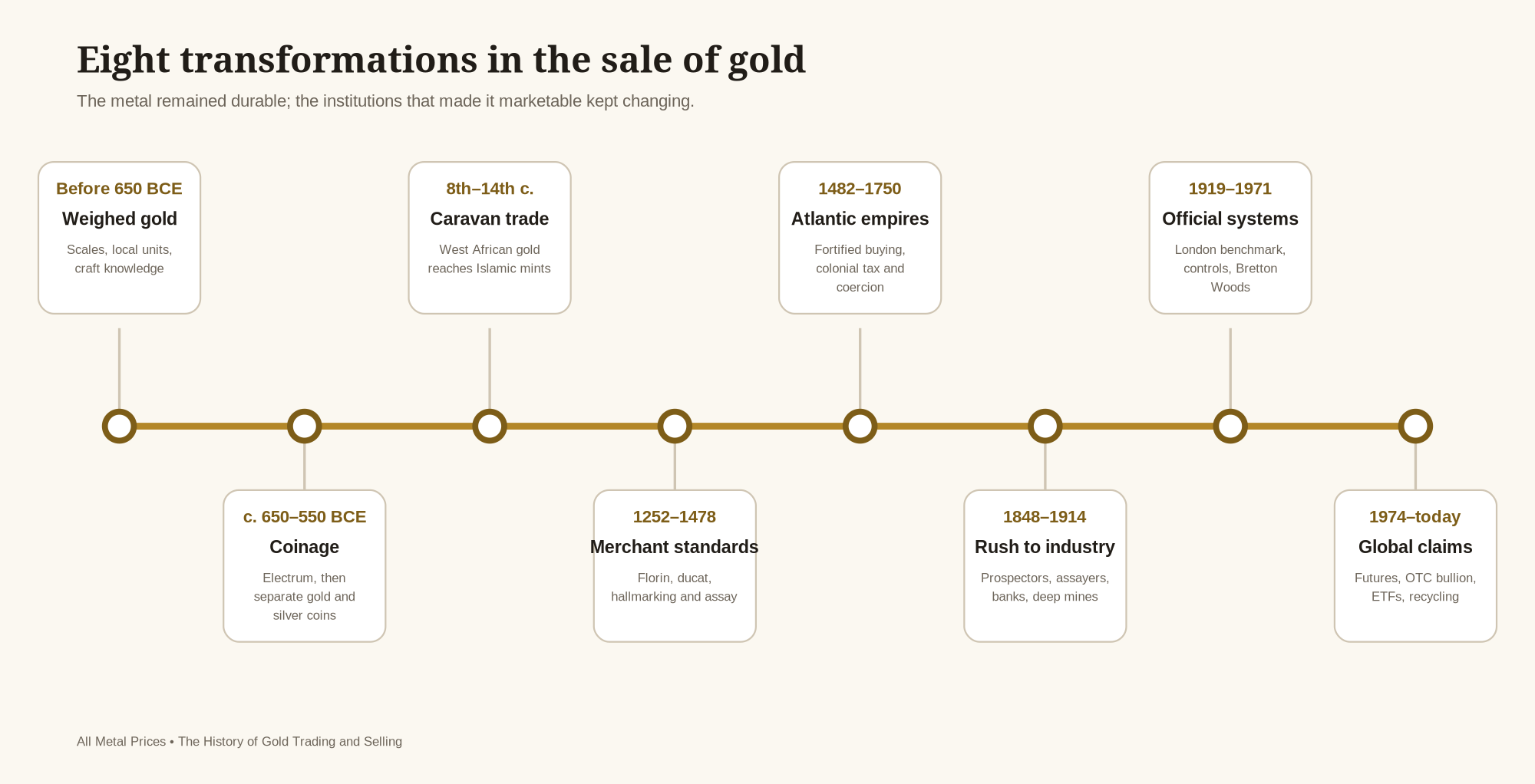
People were exchanging gold long before coins existed, but the earliest transactions were not modern cash sales. Gold moved through royal treasuries, temples, workshops, tribute systems, gifts, debt settlement, and trade, usually by weight. Coinage in western Anatolia during the seventh and sixth centuries BCE made gold easier to recognize and transfer because a political authority stamped a measured piece. Medieval mints, money changers, and assay offices then built wider markets around trustworthy weight and fineness. From the eighth century onward, West African gold supplied trans-Saharan commerce and Islamic coinage; from the late fifteenth century, Atlantic empires redirected and coerced gold flows on an even larger scale. Nineteenth-century gold rushes briefly created large populations of small sellers, but deep industrial mining soon concentrated production in corporations. The international gold standard turned mints and central banks into standing buyers at official rates. After that system broke apart between 1914 and 1971, gold became increasingly market-priced in major financial centers and traded through bullion dealers, futures exchanges, funds, refineries, jewelry markets, and recycling networks. What changed most was not the metal. It was the machinery of trust around the sale.
Key findings
- Gold was marketable before it was money. Its earliest exchange depended on weight, workmanship, political control, and local accounting rather than a universal price.
- Coinage reduced verification costs but did not eliminate assay. A stamp transferred some responsibility from the immediate seller to the minting authority.
- The gold trade was never a single market. Mine-frontier prices, mint values, wholesale bullion prices, jewelry values, and collector prices have always differed.
- Coercion belongs inside the commercial history. Tribute, enslavement, compulsory purchase, confiscation, licensing, and discriminatory law shaped who could sell and who captured the proceeds.
- Modern liquidity rests on standards. Good Delivery rules, clearing, custody, benchmark prices, futures specifications, and responsible-sourcing records make large-scale trading possible.
- A seller is paid for an acceptable form of gold, not for chemistry alone. Weight and purity establish fine-gold content; location, urgency, documentation, quantity, and bargaining power determine the realized price.
Gold selling at a glance
| Period | Typical form offered for sale | Common buyer or receiver | Main test of value | Typical pricing mechanism |
|---|---|---|---|---|
| Before coinage | Dust, nuggets, rings, scrap, worked objects | Palace, temple, merchant, craft specialist | Weight, appearance, local expertise, sometimes refining | Negotiated exchange ratio or debt valuation |
| Early coinage | Electrum or gold coin, bullion for minting | Mint, tax office, soldier, merchant, money changer | Stamp, weight standard, reputation, occasional assay | Official tariff plus market discount or premium |
| Medieval long-distance trade | Dust, ingots, foreign coin, jewelry, plate | Caravan merchant, ruler, mint, goldsmith, banker | Scales, touchstone, assay, known coin type | Bargaining, exchange rates, mint terms, seigniorage |
| Colonial Atlantic economy | Mine gold, dust, taxed bars, remittances | Licensed trader, foundry house, treasury, exporter | Official assay, tax stamp, chain of custody | Crown price or tax regime, legal and illicit discounts |
| Gold-rush era | Nuggets, dust, privately assayed bars | Merchant, bank, express company, assay office, mint | Assay certificate, bar stamp, mint acceptance | Distant mint value minus risk, transport, and refining |
| Classical gold standard | Standard coin and eligible bullion | Mint, central bank, bullion house | Mint standard, bar assay, accepted refiner | Legally fixed conversion rate plus shipping and finance costs |
| Post-1971 market | Bars, coins, doré, scrap, allocated or unallocated claims, futures, ETF shares | Refiner, dealer, exchange member, bank, fund market maker | Assay, product specification, custody record, exchange rules | Spot and forward markets, benchmarks, futures prices, retail spreads |
A chronology of the gold market
- Third and second millennia BCE: Egyptian and Nubian gold enters royal, temple, workshop, gift, and private-property systems; Mesopotamian exchange demonstrates the commercial power of standardized weights.
- Late seventh to sixth centuries BCE: Electrum and then distinct gold and silver coinages develop in Lydia and neighboring Greek cities.
- Sixth century BCE onward: Persian gold darics and later Greek, Roman, Kushan, Byzantine, and other imperial coins link precious-metal sales to taxation and military finance.
- Eighth to fourteenth centuries CE: Trans-Saharan caravans connect West African production with North African and Mediterranean demand for gold coinage.
- 1252 and 1284: Florence introduces the florin and Venice the ducat, two highly trusted commercial gold coins.
- 1300 onward: English hallmarking law formalizes third-party testing of precious-metal wares; comparable assay traditions develop elsewhere.
- Fifteenth to eighteenth centuries: Atlantic trade, Elmina, Brazilian mining, and colonial fiscal systems redirect large gold flows while expanding coercive labor and monopoly control.
- 1848 onward: California, Australian, and other gold rushes multiply small sellers and create demand for private assay offices, banks, express firms, and public mints.
- 1886 onward: Witwatersrand deep mining helps shift the dominant seller from the prospector to the capital-intensive corporation.
- Late nineteenth century: The classical gold standard links currencies through official convertibility and makes London the central bullion and credit hub.
- September 12, 1919: The first formal London gold fixing creates a recurring benchmark for wholesale transactions.
- 1933-1934: The United States restricts private monetary gold use and transfers monetary gold to the Treasury under Roosevelt's gold program.
- 1944-1971: Bretton Woods links major currencies to the dollar and the dollar to gold for official foreign holders at $35 per fine troy ounce.
- August 15, 1971: The United States suspends official dollar-gold convertibility.
- December 31, 1974: U.S. restrictions on private gold ownership end, and COMEX gold futures begin trading.
- 2002-2004: The Shanghai Gold Exchange opens; gold-backed exchange-traded products expand in Australia, London, and the United States.
- Twenty-first century: Gold trades continuously through physical, OTC, futures, fund, central-bank, jewelry, and recycling channels, while provenance becomes a formal market-access requirement.
Introduction: a history of the transaction, not merely the metal
A gold sale appears simple only after the difficult questions have been settled. A seller presents an object. A buyer decides what it is, how much gold it contains, whether the seller has the right to transfer it, how quickly it can be resold, and what margin is needed to cover the remaining uncertainty. The familiar arithmetic - weight multiplied by purity multiplied by price - is the last step, not the first.
That distinction matters because gold did not become commercially important merely by being yellow, scarce, durable, and resistant to corrosion. Those physical qualities made it attractive, but societies still had to build ways of comparing one piece with another. A nugget from a riverbed, an alloyed bracelet, a foreign coin, a refinery bar, and a share in a gold-backed trust can all represent gold. They are not equally easy to sell. Each sits inside a different system of measurement, law, reputation, custody, and settlement (Powell 1996; von Reden 2010; O'Callaghan 1993).
The phrase selling gold also needs a wider historical meaning than a modern retail transaction. A miner exchanging dust for provisions, a merchant carrying bullion to a mint, a ruler delivering tribute, a goldsmith buying old plate, a mine shipping doré to a refiner, and an investor closing a futures position are transferring different kinds of claims. Some are voluntary bargains. Others occur under taxes, monopolies, discriminatory licenses, confiscation orders, or systems of forced labor. Treating all of them as equivalent market exchanges would erase the institutions that decided who could own gold and who received its surplus (Russell-Wood 1984; Loy-Wilson 2017; Eichengreen 1992).
Four recurring problems organize the story.
Purity comes first. Native gold is rarely chemically pure, and deliberate alloying or plating can make an object appear more valuable than it is. The buyer needs a credible estimate of fine-gold content.
Measurement comes next. A quoted price is meaningless without an accepted unit and a trustworthy scale. The long history of shekels, grains, pennyweights, tolas, troy ounces, grams, and local weight systems is part of the history of the sale, not an antiquarian side note.
Liquidity is the third problem. Gold may be valuable in principle yet difficult to convert at a fair price in a remote camp, under an export ban, or in an unfamiliar form. A standardized coin or accredited bar can command more than an unmarked lump containing the same fine weight because the next buyer will accept it more readily.
Legitimacy is the fourth. A piece can be genuine gold and still be stolen, smuggled, untaxed, conflict-linked, sanctioned, or produced through abusive labor. Ancient marks, medieval hallmarks, customs seals, refinery records, and modern due-diligence audits address different versions of the same commercial anxiety: will the next buyer regard this transfer as valid? (Goldsmiths' Company 2022; OECD 2016; LBMA 2021).
The central argument of this paper is straightforward. Gold's liquidity grew as verification moved away from face-to-face judgment and into layered institutions: standard weights, mints, assay offices, recognized coins, refineries, vaults, exchanges, clearing systems, benchmark administrators, and supply-chain programs. This was not a clean march toward efficiency. Every solution shifted risk rather than eliminating it. A stamped coin could be clipped. A fixed official price could collapse under war. An unallocated account could avoid moving bars while creating a claim on a dealer. An ETF could simplify access while separating most shareholders from physical redemption. The enduring history is not a story of gold escaping institutions. It is a story of institutions repeatedly remaking what counts as saleable gold.
1. Before coins: gold as weighed wealth
The first gold transactions sit at the edge of what the surviving evidence allows historians to describe. Archaeology preserves objects and mining traces more readily than bargains. Administrative texts record deliveries, wages, debts, and inventories but rarely resemble a dealer's invoice. It is safer, therefore, to speak of transfer and valuation before speaking of a recognizable spot market.
Egypt, Nubia, and royal control
Ancient Egypt offers the clearest early evidence of gold's political and material importance. Deposits in Nubia and Egypt's Eastern Desert supplied a metal associated with divine radiance, royal authority, funerary equipment, diplomacy, and elite display. The crown organized mining expeditions and controlled substantial flows, yet gold was not confined to the palace. Non-royal people owned jewelry, artisans worked the metal, and pieces moved through gifts, inheritance, temple activity, reward, and private possession (Schorsch 2017; Metropolitan Museum of Art 2018).
A modern reader can easily mistake abundance in elite burials for proof that gold functioned as ordinary money. It usually did not. Grain, labor obligations, and other commodities were more important to daily accounting. Gold's economic force lay in its concentration of value and its usefulness in high-status transfers. A bracelet or ring could be both ornament and reserve; a worked object could be broken, remelted, or weighed again. The boundary between merchandise and money remained porous.
Nubia's role also complicates the old image of Egypt as an isolated source of civilization and demand. The region south of Egypt contained important deposits and acted as a corridor for luxury goods. Trade, diplomacy, warfare, tribute, and imperial occupation all moved gold northward. A transaction at the production frontier could therefore be embedded in political relationships that looked nothing like a free bargain between equal owners (Metropolitan Museum of Art 2018).
Mesopotamia and the commercial discipline of weight
Mesopotamia contributes a different part of the story. Silver, rather than gold, was generally the more important monetary metal and unit of account, but Mesopotamian practice shows how a metal becomes commercially legible before coinage. Debts and prices could be expressed in weight units. Irregular pieces were weighed, and payment was accepted as substance rather than as a token whose face value displaced its metal content. Gold could be valued against silver and other goods, with the ratio varying by place, period, fineness, and circumstance (Powell 1996).
This substance-oriented system required equipment and expertise. A scale had to be balanced. The weights had to be trusted. The material might need to be cut, sampled, or refined. A palace or temple could maintain scribes, standards, and specialist workers; a smaller participant depended more heavily on reputation and local power. The buyer who controlled the scale or the accepted weight standard possessed an advantage that is still visible in modern scrap transactions.
Credit further blurred the line between sale and settlement. Gold might not be exchanged for goods at the same moment. It could discharge an earlier obligation, secure a loan, or move through an account relationship. What mattered was the receiver's confidence that the metal could later satisfy another claim. The essential commercial achievement of the ancient weight system was not a universal gold price. It was the ability to turn a physical object into an agreed quantity (Powell 1996; von Reden 2010).
The first persistent discount: uncertainty
Weighed exchange created a pattern that has never disappeared. A seller offering an unfamiliar lump bore the cost of proving what it contained. A buyer who expected to test, transport, refine, and resell it quoted below the value of known fine gold. The difference was not necessarily fraud. It compensated for time, skill, loss in processing, and the risk of error. But the discount also reflected bargaining power. A seller who needed food or debt relief immediately could not wait for a more favorable venue.
This is the oldest durable lesson in the history of selling gold: the highest theoretical value belongs to verified fine gold in the market where it is most liquid. The amount actually received depends on the path required to get there.
2. Coinage: placing an authority between buyer and seller
Coinage changed gold commerce because it bundled several pieces of information into a portable object. A coin announced a denomination, an issuing authority, and an expected standard. That did not make every coin honest or every user credulous. It made repeated exchange faster by allowing the reputation of a mint to stand between strangers.
Electrum and the problem that produced a solution
The earliest coinages emerged in western Anatolia during the late seventh and early sixth centuries BCE. Many were made from electrum, a gold-silver alloy that could occur naturally but whose gold content varied. Variation created a pricing problem: two pieces of the same weight could contain different amounts of gold. A stamped type gave users a reason to accept a piece without performing a full chemical analysis each time, although the stamp could guarantee a tariff or issuing authority more readily than it could reveal exact composition (Le Rider 2001; von Reden 2010; British Museum n.d.-a).
Under Croesus of Lydia, coinage developed toward distinct gold and silver issues. The celebrated Croesid types, with confronting lion and bull foreparts, joined standardized metal to a recognizable political brand. That transition mattered commercially. A seller no longer offered only a quantity of alloy; the seller offered a product that users associated with a mint standard. The authority could profit through seigniorage and could require its own coin for taxes or payments, reinforcing demand (British Museum n.d.-b; Le Rider 2001).
Coinage is sometimes described as the invention of money, which is too broad. Units of account, credit, weighed metal, and other payment media were much older. Its real innovation was narrower and more practical: it manufactured pieces designed for repeated transfer.
Empires, taxes, and military pay
Persian darics, Greek staters, Roman aurei, Byzantine solidi, Kushan gold coins, and later Islamic dinars tied gold circulation to the fiscal reach of states and empires. Armies needed pay that could travel. Tax systems drew metal back toward treasuries. Mints converted bullion, old coin, and captured wealth into politically recognizable pieces. A gold coin was therefore both a commodity and a fiscal instrument (von Reden 2010; Reserve Bank of India n.d.-a).
The seller changed as well. Someone bringing bullion to a mint was not bargaining with a shopkeeper over a single ornament. The person entered a regulated conversion process: metal was weighed and tested, fees or seigniorage were deducted, and coin was returned or credited. Rulers, meanwhile, could alter standards, close mints, prohibit export, or tariff foreign coin. The market for gold became inseparable from the market for sovereign credibility.
Why money changers survived the coin
No stamp eliminated wear, clipping, counterfeiting, debasement, or political fragmentation. Foreign coins crossed jurisdictions where their official denomination had no automatic force. Money changers compared types, weighed suspect pieces, tested surfaces, and quoted exchange rates. A well-known coin could trade at a premium because it saved the next holder time; a worn or unfamiliar coin could be discounted even when its remaining gold content was respectable (Spufford 1988).
The commercial logic resembles a modern branded bar. The metal provides a floor of value, while the recognized issuer or refiner reduces verification costs. If confidence in the brand fails, the object falls back toward melt value and fresh assay.
3. Gold across Eurasia: coins, bullion, and regional monetary systems
A history centered only on Egypt, Lydia, Rome, and London would mistake one route for the world. Gold crossed Eurasia through overlapping systems in which silver, copper, textiles, spices, credit instruments, and tax demands often mattered more in daily exchange. Its role varied. In one region gold coin was common high-value money; in another it was chiefly hoarded, ornamented, presented, or imported as bullion.
India: a market that repeatedly absorbed precious metal
The Indian subcontinent developed one of the world's most diverse coinage traditions. Early documented punch-marked coins were mainly silver, but later dynasties issued gold in substantial and artistically distinctive forms. Kushan and Gupta gold coinages linked royal imagery, taxation, military expenditure, and long-distance commerce. Medieval states issued gold, silver, copper, and mixed-metal coins in changing relationships; the Delhi Sultanate's attempts at standardization show how closely coin policy followed market ratios and fiscal needs (Reserve Bank of India n.d.-a; Reserve Bank of India n.d.-b).
India's importance to the history of selling gold does not rest on coin types alone. For long periods, export demand for Indian textiles and other goods drew precious metal into the subcontinent. Bullion entered through Red Sea, Persian Gulf, overland, and later European-company routes. Money changers and bankers tested foreign coin, converted metal, arranged bills of exchange, and connected merchant credit to state mints. Under the Mughal Empire, the monetary economy depended heavily on imported precious metal, and the mint stood between foreign bullion and domestic currency (Haider 1996).
This pattern changes the meaning of a "world gold market." Metal could carry a discount in a producing region and a premium in a consuming region. The difference paid for transport, insurance, finance, duties, and risk, but it also reflected regional demand. Gold did not possess one frictionless global price. It moved toward places where buyers valued its monetary, social, or religious uses most highly.
Gold coin without everyday gold pricing
Even where rulers issued impressive gold coin, ordinary prices might still be stated in silver or copper units. Gold served high-value settlement, political display, military payment, saving, or long-distance trade. This layered monetary structure persisted for centuries. It warns against assuming that the presence of gold coins meant that a farmer, craft worker, or market shopper routinely negotiated in gold.
For sellers, the relevant question was not simply whether gold was "money." It was which form the local market recognized. A foreign coin might be sold by weight. An imperial coin might pass at a tariff. A piece of jewelry might be valued for workmanship in one transaction and melted in the next. The market category followed the buyer's intended use.
4. The trans-Saharan trade: selling gold through a chain of intermediaries
From roughly the eighth century, annual caravan traffic tied West African gold-producing regions to North African commercial towns and the wider Islamic monetary world. Gold was the major high-value commodity moving north; Saharan salt and manufactured goods were important in the opposite direction. Demand from mints and cities gave the trade its monetary pull, while camel transport made the crossing possible at scale (Metropolitan Museum of Art 2000; Garrard 1982).
There was no single "West African seller"
The phrase hides the structure that made the trade work. Miners and communities near the goldfields did not ordinarily negotiate with a mint master in Cairo or Córdoba. Metal passed through local markets, rulers, brokers, merchant partnerships, caravan organizers, desert-edge towns, financiers, money changers, and refiners. At each stage it could be divided, combined, melted, weighed, taxed, pledged, or exchanged for another commodity.
That chain created liquidity while distributing information unevenly. Participants near production knew local yields, seasonal conditions, and political risks. Merchants at the northern end knew coin demand, exchange rates, and the terms offered by urban buyers. The price at the mine frontier could therefore be far below the value of coin struck from the same metal. Transport costs explain part of the gap. Bargaining power and access to information explain another part (Garrard 1982; Nixon, Rehren, and Guerra 2011).
Tadmekka and the manufacture of a saleable form
Archaeological work at Tadmekka in present-day Mali has provided unusually concrete evidence of the trade's middle stages. Coin molds and metallurgical remains indicate that gold was processed into forms suited to wider exchange in the early Islamic period. This is important because written accounts often dwell on rulers, caravan cities, and spectacular quantities. Commerce depended just as much on the ordinary work of melting, portioning, weighing, and making metal acceptable beyond the place where it was obtained (Nixon, Rehren, and Guerra 2011).
The route did not simply transport a finished commodity. It manufactured marketability. A quantity of local gold became easier to finance and resell as it acquired a known weight, a familiar form, and the endorsement of traders whose reputations traveled farther than the original producer's.
Political power at the market's choke points
The wealth of Ghana and later Mali was connected to the ability to protect, tax, and channel trade. Rulers did not need to dig every gram personally to profit from gold. Control over routes, market access, tribute, and security could be as valuable as direct ownership of mines. The celebrated pilgrimage of Mansa Musa in the fourteenth century made this power visible because his spending and distribution of gold affected local expectations and values in the cities he visited. The episode is often simplified into the claim that he permanently "crashed" the gold price. The safer conclusion is that a ruler could mobilize enough metal to disturb regional markets, showing how integrated and politically sensitive the trade had become (Metropolitan Museum of Art 2000; Garrard 1982).
Gold dust as money in Akan and Asante commerce
Farther south, Akan and Asante trading systems developed a sophisticated material culture around gold dust. Merchants used balances, scoops, boxes, and cast brass weights to measure small quantities. The weights drew from multiple metrological traditions while their forms carried local proverbs, social messages, and political symbolism. Measurement equipment was therefore both practical and cultural (Bortolot 2003).
A dust transaction required close attention. Tiny differences mattered. The parties needed a shared understanding of the weight standard and confidence that the scale was honest. A payment medium that appears "raw" to a modern observer was supported by a highly organized technology of exchange. Standardization did not always arrive as a round coin bearing a king's portrait.
5. Medieval and early modern Europe: mints, merchant coins, and the assay office
Europe's high medieval commercial expansion revived gold coinage on a scale that supported long-distance trade, taxation, diplomacy, and elite consumption. The most successful coins did more than contain gold. They established long reputations for consistency.
The florin and ducat as trusted commercial products
Florence introduced the gold florin in 1252. Venice followed with the ducat in 1284. Their relatively stable weight and fineness made them useful far beyond the territories that issued them. Merchants could recognize the designs, compare exchange quotations, and settle high-value obligations across a politically fragmented continent. Local silver and billon coinages might change, but a trusted gold type could preserve its commercial identity for generations (Spufford 1988; Bacharach 1973).
The achievement was institutional rather than magical. Florence and Venice had strong incentives to defend the reputation of coins used by their merchants. A city that quietly reduced fineness could earn a short-term mint profit and lose a long-term commercial advantage. Stable coin became a form of public branding.
Counterfeits and imitations were evidence of success as well as danger. Other issuers copied respected types because users already understood them. Money changers then had to distinguish official issues, acceptable imitations, worn pieces, and outright fraud. The market rewarded familiarity but still required judgment.
What happened when bullion reached a mint
Mints connected heterogeneous metal to standardized money. Merchants, rulers, churches, and private holders brought bullion, foreign coin, old plate, or tax receipts. The mint assayed and weighed the material, deducted fees and seigniorage, and returned coin or account value. Terms varied. Some mints were open to private metal; others favored official supplies or imposed restrictive conditions.
This conversion created two prices that should not be confused. The mint price described what an authority paid or returned for bullion under its rules. The market price reflected what merchants would pay after considering coin demand, exchange rates, transport, and alternative mints. When one jurisdiction overvalued a metal relative to another, arbitrage could draw coin across borders to be melted and restruck.
Bills of exchange did not make gold irrelevant
Medieval merchants increasingly settled obligations through bills of exchange and book credit, reducing the need to move coin for every transaction. Yet paper claims rested on networks of correspondents who could ultimately deliver accepted money. Gold's role shifted from constant physical circulation to reserve, settlement, and high-value payment. The existence of sophisticated credit did not replace bullion markets; it made the location and timing of bullion movement more selective (Spufford 1988).
A merchant selling gold was often also trading foreign exchange. The value of a ducat in one city depended on local units of account, the condition of the coin, expected remittance routes, and the credit of counterparties. The gold market was already a market in information.
Hallmarking: third-party proof for jewelry and plate
Bullion and coin were only one side of gold commerce. Goldsmiths sold objects whose price included design, labor, status, and metal. A buyer could not easily determine whether a finished cup, chain, or ring met the claimed standard without damaging it. Hallmarking developed as an answer to that asymmetry.
In England, a statute of 1300 required precious-metal wares to meet standards and be tested and marked. The Goldsmiths' Company traces its formal regulatory role to that law, and a permanent assay office at Goldsmiths' Hall dates to 1478. Maker's marks, fineness marks, assay-office marks, and later date letters allocated responsibility and created a record that traveled with the object (Goldsmiths' Company 2022; Sheffield Assay Office n.d.).
Hallmarking did not determine the final sale price. It reduced one part of the buyer's uncertainty. A hallmarked piece could still be unfashionable, damaged, stolen, or worth more as art than as melt. But the mark narrowed the dispute over metal content. It was an early, durable form of consumer protection and an ancestor of modern certification systems.
The enduring choice: object value or melt value
By the early modern period, a gold object could enter several markets. A collector or court buyer might pay for rarity and craftsmanship. A pawnbroker might lend against conservative metal value. A goldsmith might buy the piece to reuse intact. A refiner might care only about recoverable fine gold. The same object could receive radically different bids because each buyer intended a different next transaction.
That distinction remains central to selling inherited jewelry and coins today. The first question is not merely "How much gold is in it?" It is "What market is this object actually in?"
6. Atlantic expansion and colonial gold: brokerage, taxation, and force
Portuguese ships reaching the West African coast in the fifteenth century did not discover an idle resource waiting for a European market. They encountered established producers, rulers, brokers, and inland routes. The fortress at Elmina, founded in 1482, gave Portugal a defended coastal purchasing point and a base from which to claim monopoly privileges. It did not give Portuguese officials direct command of the mines. Gold still reached the coast through African commercial and political networks, and coastal buyers had to offer goods, credit, alliances, and security on terms that local intermediaries would accept (Metropolitan Museum of Art n.d.; Bortolot 2003).
A new outlet, not the beginning of the trade
Atlantic shipping redirected part of the flow that had previously moved north across the Sahara. Producers and inland merchants could sometimes choose among routes, although the range of choices narrowed or widened with war, tolls, state policy, and access to transport. European rivalry eventually added Dutch, English, Danish, Swedish, and Brandenburg interests to the coast. The bids were commercial; the forts behind them made clear that commerce could be enforced.
The later history of Elmina cannot be separated from the Atlantic slave trade. A site established for gold became a major node in the imprisonment and export of enslaved people. Gold and enslaved captives were not merely substitutes on a merchant's inventory. They belonged to an expanding Atlantic system in which warfare, commercial finance, plantation demand, and fortified exchange reinforced one another. Any history that describes a larger gold market without naming the coercion that supported it mistakes volume for freedom.
Brazil's foundry houses: when the state controlled marketability
The discoveries in Minas Gerais during the late seventeenth century shifted the center of Portuguese gold extraction across the Atlantic. Mining settlements drew in merchants, food suppliers, transport workers, officials, free migrants, and large numbers of enslaved Africans. The Portuguese crown claimed the quinto, traditionally a fifth of production, and developed foundry houses where gold was to be melted, assayed, taxed, and converted into officially marked bars. Legal marketability depended on passing through a fiscal checkpoint (Boxer 1962; Russell-Wood 1984).
The foundry-house system shows how a government could intervene before a private sale rather than merely tax the proceeds afterward. Dust circulating without an official mark might be treated as evidence of evasion. A miner or trader therefore had two linked decisions: whom to sell to and whether to enter the legal chain. The official route offered recognized documentation but imposed tax and delay. Smuggling promised a higher immediate return while adding confiscation, transport, and counterparty risk.
Gold's physical characteristics made enforcement difficult. Dust and small pieces could be concealed, mixed, or moved through informal credit. Authorities responded with inspections, road controls, registration, and periodic campaigns against illicit circulation. Sellers responded by using trusted agents and routes. Studies of eighteenth-century Brazilian shipments show that personal reputation and repeated relationships helped merchants manage theft, under-reporting, loss at sea, and disputes over remittances. The chain of custody was social before it was digital (Costa, Rocha, and Araújo 2011).
The sale price concealed the labor regime
Much of the gold leaving Brazil had been produced by enslaved workers who could not claim ownership of the output or bargain over its sale. Mine owners, merchants, contractors, and the crown divided the proceeds within a legal order that treated the laborer as property. Colonial accounting could record a purchase, tax, assay, shipment, and remittance with great precision while excluding the people whose work created the metal.
That fact changes the meaning of “the seller.” In a freeholder's transaction, the producer and seller may be the same person. In a coerced mining system, legal title belongs to someone who did not perform the extraction. The distinction recurs in later industrial mining, where wage workers also do not own output, although the underlying labor relationship is not identical. Commercial records identify the party entitled to transfer gold; they do not by themselves tell us who bore the human cost of producing it.
Gold from the Americas and the problem of melting history
Gold had deep ritual, political, and artistic histories in the Americas before European conquest. Spanish and Portuguese colonial regimes recast many objects as bullion. Tribute, seizure, mining, and the melting of worked pieces transformed culturally specific artifacts into taxable metal. A vessel, ornament, or sacred object could lose its visible identity in the crucible and reappear as coin or bar (Pillsbury 2020).
This is one reason bullion history can be deceptively clean. Refining makes heterogeneous material chemically uniform. The resulting bar may reveal fineness and weight while concealing whether its inputs came from mine output, inherited objects, temple wealth, legal trade, theft, or conquest. Modern provenance systems address the same structural problem with documentation: assay can establish what the metal is, but not how it entered the market.
7. Gold rushes and the industrialization of the seller
The nineteenth-century rushes created an unusual commercial scene: a great many people briefly possessed gold before a mature local market existed. California after 1848 is the clearest example. Prospectors recovered dust and nuggets that could buy provisions almost immediately, yet an ounce in a mining camp was not economically identical to an ounce delivered to a mint. Someone still had to weigh it, estimate fineness, guard it, transport it, insure it, refine it, and convert it into a form accepted elsewhere (Rohrbough 1997; Brands 2002).
Why a miner received less than “the gold price”
Camp merchants purchased gold because it was compact and widely desired, but their bids incorporated uncertainty. Natural gold contains varying amounts of silver and other material. Scales might be inaccurate. A parcel could include sand or amalgam. The buyer also faced robbery, shipment delay, price or exchange risk, and the opportunity cost of capital tied up on the journey to an assay office or mint.
The discount between local bid and distant mint value paid for those risks and for the buyer's profit. It could be reasonable, exploitative, or both, depending on competition and the miner's urgency. A prospector who needed food that evening had less negotiating leverage than a bank able to consolidate many parcels and wait for settlement. The gold rush did not erase the middleman. It made the middleman's information and logistics unusually valuable.
Assay offices, private mints, banks, and express companies
Private assayers and mints answered the frontier's central trust problem by turning inconsistent dust into stamped bars and coins. Their marks represented a claim about weight and fineness. A well-regarded stamp could circulate beyond the office because later buyers were willing to rely on the assayer's capital and reputation. Poorly managed or dishonest firms lost that privilege.
Banks and express companies added custody and distance. They accepted deposits, shipped bullion, issued drafts, carried remittances to families, and linked camps to San Francisco and eastern financial centers. Public mints eventually supplied an official conversion channel. These institutions did not merely surround the gold economy; they were the means by which a discovery became liquid wealth (Brands 2002; Rohrbough 1997).
A useful way to picture the chain is:
Prospector → local buyer → assayer or bank → secured transport → refinery or mint → coin, bar, or financial credit
Every arrow carried a fee, delay, and risk. Competition could reduce the total deduction, but no institution could make processing and transport costless.
Australia: liquidity under discriminatory law
The Australian rushes also generated networks of gold buyers, banks, escorts, assay offices, and colonial mints. Gold exports financed imports and helped colonial governments build infrastructure. Access to the market, however, was distributed through a racial order. Chinese miners faced special taxes, movement restrictions, violence, and seizure. Sophie Loy-Wilson's study of New South Wales documents how the language used to justify exclusion could mask the direct appropriation of gold from Chinese workers (Ville 2014; Loy-Wilson 2017).
Possession alone did not guarantee the right to reach a buyer, travel safely, or receive legal protection. The capacity to sell depended on citizenship, race, policing, and local power. That lesson belongs in economic history because insecurity alters price. A seller exposed to confiscation or mob violence cannot bargain on the same terms as a protected bank.
From shallow diggings to deep industrial mines
The image of the independent prospector became less representative as mining moved into ore bodies that required heavy machinery and continuous capital. The Witwatersrand discoveries after 1886 demanded deep shafts, ventilation, pumping, explosives, milling, and chemical recovery. Companies raised money in financial markets, hired engineers and managers, organized migrant labor, and sold through refining and banking networks tied to London (Van-Helten 1982; Richardson and Van-Helten 1984).
The identity of the seller changed. The worker underground received wages. The company owned the ore and future production. Banks might lend against expected output; shareholders traded claims on profits; refiners and bullion houses handled physical delivery. Gold could be financially sold before the metal emerged from the mine through forward arrangements or corporate securities.
Industrial organization increased predictable supply while concentrating control. South African gold became central to the international monetary system, yet the industry's cost structure rested on racialized labor controls and political force. A rising output graph alone does not capture the market being built. The corporation's ability to deliver standardized gold to London depended on a labor regime that sharply restricted the people doing the mining.
The gold rush as a recurring market pattern
Later rushes differed in geology and law, but the commercial sequence often repeated:
- A discovery draws people faster than formal institutions can arrive.
- Gold begins circulating locally as an improvised payment medium.
- Buyers apply wide discounts because purity, security, and transport are uncertain.
- Assayers, banks, refineries, and government offices standardize the output.
- Larger firms consolidate claims and capital as accessible deposits decline.
- The seller shifts from individual miner to organized enterprise.
This pattern explains why “finding gold” and “selling gold” are separate historical events. Discovery creates potential value. Institutions decide how much of that value reaches the discoverer.
8. The gold standard and the making of a London bullion market
Related institutional history: This section follows gold as a traded product. For the reserve, convertibility, custody and official-buying side of the same period, read the history of central banks and precious metals.
Under a gold standard, a currency was defined in relation to a quantity of gold and monetary authorities stood ready, subject to the system's particular rules, to convert eligible claims or bullion at a legal rate. The arrangement is sometimes described as though every transaction occurred at one fixed world price. In practice, official parity sat inside a commercial network of mints, central banks, bullion dealers, shippers, insurers, and foreign-exchange markets (Gallarotti 1995; Flandreau 2004).
From the guinea to a formal gold currency
Britain's path was gradual. In 1717, Master of the Mint Isaac Newton recommended a valuation that set the guinea at twenty-one shillings. The relationship undervalued silver relative to gold and contributed to silver coin leaving circulation, helping Britain move de facto toward gold. The Coinage Act of 1816 established a formal gold standard centered on the sovereign, although convertibility and circulation were disrupted during wartime and resumed under later arrangements (Royal Mint Museum n.d.; Bank of England 2019).
The nineteenth-century international system emerged through national choices rather than a single founding conference. Bimetallic regimes tied legal values of gold and silver; market ratios moved. Germany's turn to gold after unification, Britain's financial influence, changing metal supplies, and policy choices in France and elsewhere helped make gold the dominant anchor by the 1870s (Flandreau 2004).
What an official parity meant to a seller
An official rate did not guarantee that every object could be handed over at full value. Mints and monetary authorities accepted specified coin or bullion. The seller still had to meet standards of fineness, form, and ownership, and might bear charges for assay or coinage. A remote parcel of doré remained less liquid than a recognized bar in London.
Foreign-exchange rates normally moved within limits set by the cost of shipping gold between financial centers. When an exchange rate crossed a “gold point,” it became profitable to settle by exporting or importing metal. Freight, insurance, packing, interest, and handling determined the width of the band. Gold therefore moved not because a textbook equality failed, but because arbitrageurs compared the full cost of two settlement routes.
Countries that maintained convertibility could gain credibility with creditors. Bordo and Rockoff famously described adherence as a kind of “good housekeeping” signal. The commitment could lower borrowing costs, but it also limited policy. A central bank losing gold might raise interest rates or contract credit to defend parity, even when domestic employment and prices were already weak (Bordo and Rockoff 1996; Gallarotti 1995).
Why London became the center
London combined several advantages: the Bank of England, global trade finance, marine insurance, merchant banks, specialist bullion dealers, refineries, vaults, and sterling's international role. Colonial and mining output could be financed before shipment, insured in transit, refined after arrival, and sold or credited through connected firms. A transaction did not always require a bar to move immediately. Trusted account relationships allowed ownership claims to be netted and transferred while physical movement occurred when settlement demanded it (LBMA n.d.-a; O'Callaghan 1993).
This market rewarded bars that could pass from one professional holder to another without repeated full assay. The ancestry of modern Good Delivery practice lies in that need. A refiner's mark, bar dimensions, recorded fineness, and recognized chain reduced the buyer's verification burden. Standardization increased fungibility: the next participant could focus on price and credit rather than reopening every metallurgical question.
Mining companies sold into a fixed-price world
For a producer, the gold standard could feel less like a market opportunity than a cost constraint. Gold's monetary value was legally anchored while wages, equipment, transport, and ore grades changed. Profitability therefore depended on extracting more gold per unit of cost. South African producers developed political influence and relationships with London banks, but they could not simply raise the gold price when costs climbed (Van-Helten 1982).
That tension intensified during World War I. Inflation raised operating expenses while the prewar sterling price remained fixed. Producers wanted a purchasing mechanism responsive to market conditions. Their pressure formed part of the background to the postwar London fixing.
September 12, 1919: a benchmark becomes a market institution
The first formal London gold fixing took place on September 12, 1919. Representatives of leading bullion firms met to find a price at which aggregate buy and sell orders could be balanced. The procedure gave mines, banks, jewelers, governments, and other users a recurring reference beyond private bilateral quotes (LBMA n.d.-b).
A benchmark does not make every sale occur at the benchmark. It provides a common starting point. Location, bar status, credit terms, quantity, and timing still create premiums or discounts. That difference is crucial today: a published gold price is evidence about the wholesale market, not a promise that any buyer will pay the same amount for a ring, coin, small bar, or undocumented scrap.
9. War, depression, and the state as compulsory buyer
World War I exposed the political foundations of convertibility. Governments restricted exports, discouraged redemption, concentrated reserves, and financed military spending on terms incompatible with the prewar system. Gold coin disappeared from ordinary circulation. In several countries, law and patriotic campaigns pulled privately held metal toward the treasury (Eichengreen 1992).
The failed return to prewar normality
The 1920s restoration tried to recover the credibility of gold while carrying the debts, changed price levels, and political expectations left by war. Britain returned at the prewar parity in 1925. The chosen rate placed pressure on domestic prices and wages, and Britain suspended gold convertibility in September 1931. Other countries left at different times or adopted controls, producing currency blocs rather than a unified system (Eichengreen 1992; Bank of England 2019).
The interwar crisis made reserve sales politically charged. A central bank losing gold might be expected to tighten credit, deepening recession. Rumors of devaluation encouraged holders to seek gold before rules changed. The attempt to preserve a fixed legal promise could thus accelerate the demand that made the promise harder to keep.
The United States, 1933-1934
In 1933, the Roosevelt administration restricted private monetary gold ownership and required specified gold coin, bullion, and certificates to be delivered through authorized channels, subject to exemptions and evolving rules. The Gold Reserve Act, signed January 30, 1934, transferred monetary gold to the U.S. Treasury and gave the federal government control over its monetary use. The official dollar price was subsequently set at $35 per fine troy ounce (Federal Reserve History n.d.-a).
For affected holders, the government was not a bidder competing in an open market. It determined which possession was lawful and on what terms monetary gold would be surrendered. Jewelry and certain industrial or collectible forms were treated differently, which made classification decisive. Two objects with similar chemistry could have different legal lives.
The episode illustrates a limit to gold's reputation as universally liquid. Liquidity depends on permission as well as demand. A substance can be valuable, portable, and desired while the lawful market for it is tightly controlled.
Official channels did not end private gold culture
Restrictions did not erase jewelry, dentistry, industrial consumption, foreign trading, coin collecting, or illicit ownership. They redirected the center of the U.S. market toward licenses, exemptions, fabricators, official reserves, and overseas prices. Dealers and households learned that the category assigned to an object—monetary bar, numismatic coin, fabricated jewelry, industrial input—could matter as much as its assay.
This legal taxonomy would remain important through the Bretton Woods era. Gold was still globally traded, but access differed sharply among central banks, licensed firms, citizens of different countries, and holders of different forms.
10. Bretton Woods: an official gold market surrounded by private ones
Delegates meeting at Bretton Woods in July 1944 designed a monetary order in which gold stood behind the dollar rather than directly behind every participating currency. Members maintained exchange-rate parities against the U.S. dollar; the United States undertook to convert official foreign dollar holdings into gold at $35 per fine troy ounce. The commitment applied at the official level. It was not a general redemption right for households (Federal Reserve History n.d.-b).
The narrow seller at the center of the system
At the core, the eligible seller was a foreign monetary authority presenting dollars to the United States. Around that official window sat many other markets. Mines sold new production. Jewelers and manufacturers bought metal. Private holders traded where national laws permitted. London dealers quoted a market price. Some governments required domestic producers to sell through official agencies or surrender foreign exchange.
This division matters because the phrase “gold was fixed at $35” is incomplete. The official conversion price governed a particular institutional promise. Private prices could diverge when demand, controls, and confidence changed. Access determined which price a holder could realize.
The reserve-currency contradiction
As trade and finance expanded after World War II, the world demanded dollar reserves. Supplying them meant persistent U.S. external deficits and a growing stock of dollar claims held abroad. Over time, those claims became large relative to U.S. gold reserves. The system needed dollars to function and simultaneously risked weakening confidence that those dollars could be converted at the official price (Federal Reserve History n.d.-c).
Gold sales became signals about the dollar. A central bank converting dollars into gold expressed a portfolio preference and reduced the reserve backing available for others. Private purchases could communicate similar doubts, even when the buyer had no access to the Treasury window.
The London Gold Pool and the two-tier market
In the 1960s, the United States and several European central banks coordinated sales through the London Gold Pool to keep the private London price near the official level. The pool supplied metal when demand pressed upward and replenished holdings when conditions allowed. It was an effort to make a market outcome support an official monetary promise.
The defense failed under sustained pressure. In March 1968, the pool collapsed and the London market closed temporarily. Authorities accepted a two-tier arrangement: official monetary transactions would continue at $35, while the private market could find its own price. The same gold now had two institutional values, separated by eligibility and law (LBMA n.d.-d; Federal Reserve History n.d.-c).
August 15, 1971
President Richard Nixon suspended the dollar's convertibility into gold for foreign monetary authorities on August 15, 1971. Later negotiations changed exchange-rate parities but did not restore durable gold conversion. By 1973, major currencies were moving toward floating rates. Gold had ceased to serve as the formal anchor of the central international monetary promise (Federal Reserve History n.d.-c).
The change did not “free” gold from institutions. It changed which institutions mattered. Dealer credit, futures exchanges, vault accounts, benchmark administrators, funds, refineries, and national import rules would take over functions once concentrated at mint and treasury windows.
11. After 1971: futures, OTC bullion, ETFs, and Asian exchanges
The post-Bretton Woods market widened the number of available claims. A participant could sell a bar, a coin, mine production, a forward promise, an unallocated account balance, a futures contract, a fund share, or a security issued by a mining company. These instruments respond to the same underlying metal, but they are not interchangeable in law or risk.
December 31, 1974: U.S. ownership and futures trading
Federal restrictions on private U.S. gold ownership were lifted effective December 31, 1974, ending roughly four decades in which citizens' access to monetary bullion had been heavily constrained. On the same date, gold futures began trading on the Commodity Exchange in New York, later part of COMEX (U.S. Mint n.d.; CME Group n.d.).
A futures contract allowed a producer, refiner, dealer, fabricator, or investor to lock in or speculate on a standardized future price. Most positions could be offset financially before delivery. The seller of a contract was therefore selling price exposure, not necessarily handing over a bar that day. Exchange rules, margin, clearing, position management, and approved delivery specifications replaced the immediate face-to-face assay.
For miners, forward and futures selling made revenue more predictable. Hedging could protect a project against a price decline, support financing, or match future production to obligations. It could also limit gains when prices rose and create liquidity pressure when margin moved against the position. The commercial question shifted from “What will this parcel fetch?” to “How much future output should be committed, through which instrument, and against what risks?”
The London over-the-counter market
London remained predominantly an over-the-counter, or OTC, market. Dealers negotiate spot, forward, swap, option, lease, and deposit transactions, often for settlement “loco London.” The phrase identifies the place and conventions of delivery rather than the mine from which the metal came (LBMA n.d.-e; O'Callaghan 1993).
Many wholesale balances are unallocated. The client has a contractual claim on a bullion dealer for a quantity of gold rather than title to specific numbered bars. Unallocated accounts are efficient for trading and settlement because balances can be transferred without moving identified objects. The efficiency comes with dealer credit exposure.
Allocated holdings are different. Particular bars are set aside for the client, with bar numbers, weights, and assays recorded. The client bears custody fees and receives a more direct property claim. A seller must know which interest is being transferred: a specific asset, a general account claim, or a derivative obligation.
Good Delivery and the wholesale bar
The LBMA Good Delivery system specifies requirements for bars and the refiners whose products can enter the main London settlement chain. Technical dimensions, weight ranges, markings, fineness, production capability, quality control, and the refiner's standing all matter. The current list functions as a gate to the most liquid wholesale market (LBMA n.d.-c).
A bar outside the system may contain perfectly good gold. It may still need sampling, reassay, remelting, or re-refining before a professional buyer will accept it as equivalent to standard inventory. The discount reflects processing and uncertainty rather than an assertion that the atoms are inferior.
Good Delivery is best understood as portable institutional memory. The mark tells the next buyer that a recognized refiner produced the bar under audited procedures and that the product fits settlement conventions. It compresses an otherwise expensive investigation into a standardized object and record.
The benchmark after the old fixing
The London fixing evolved over the twentieth century. The traditional gold fixing name and process ended in March 2015 and was replaced by the LBMA Gold Price, an electronic auction-based benchmark administered under a modern regulatory framework. The benchmark is published at set times and used in contracts, valuation, and settlement (LBMA n.d.-f).
No benchmark eliminates basis differences. A dealer in Manila, Mumbai, Dubai, New York, or Shanghai starts with a global reference and then accounts for currency, local inventory, taxes, import rules, transport, fabrication, payment method, and desired margin. The “world gold price” is therefore a center of gravity rather than a universal checkout price.
Gold-backed exchange-traded products
The first gold-backed exchange-traded product launched in Australia in 2003. SPDR Gold Shares began trading in the United States on November 18, 2004 and became the first U.S.-traded gold ETF. Its structure enabled investors to buy and sell exchange-listed shares designed to reflect bullion value, less expenses, while authorized participants connected the share market to large wholesale gold creation and redemption (Securities and Exchange Commission 2009; State Street Global Advisors n.d.).
An ordinary shareholder sells shares to another market participant. The shareholder generally does not arrive at a vault and redeem a small holding for coins. The fund share is liquid because exchange trading, market makers, custody arrangements, and the authorized-participant mechanism keep its price linked to underlying assets.
ETFs lowered several frictions: personal storage, physical delivery, retail bar premiums, and the need to test a purchased object. They introduced others: management expenses, trading spreads, legal terms, custodian dependence, and possible divergence between share price and net asset value. The investor acquired convenient exposure, not the experience of holding a particular bar.
Shanghai and the more continuous global market
The Shanghai Gold Exchange was established in 2002 under the approval of China's State Council and became a central venue for physical gold trading in China. Its development, alongside Chinese banking, refining, jewelry demand, and domestic benchmark products, gave Asian physical trade a larger role in price formation (Shanghai Gold Exchange n.d.).
Gold now moves through overlapping time zones. Asian physical demand and premiums shape trading before London becomes fully active; London dominates major OTC flows; New York futures add deep exchange liquidity. Currency markets run alongside all three. A seller's local-currency result can change even when the dollar gold price is flat because the exchange rate has moved (Sjaastad and Scacciavillani 1996).
The market is global but not placeless. Import quotas, capital controls, taxes, festival demand, refinery capacity, bar preferences, and shipping bottlenecks can produce persistent local premiums or discounts. Arbitrage narrows differences only when participants can legally and profitably move metal and money.
Financialization did not detach price from physical supply
Mine production, recycling, central-bank transactions, jewelry fabrication, technology use, bar-and-coin demand, and investment flows continue to interact. Futures and OTC markets transmit expectations rapidly; physical tightness still appears through lease rates, delivery demand, inventory shifts, and local premiums.
Gold's behavior as a hedge or safe haven varies by period, market, and time horizon. Academic research finds conditional rather than automatic protection. A seller should therefore distinguish the historical fact that gold has preserved value across many regimes from the investment claim that it must rise during every inflation, crisis, or market decline (Baur and Lucey 2010; O'Connor et al. 2015).
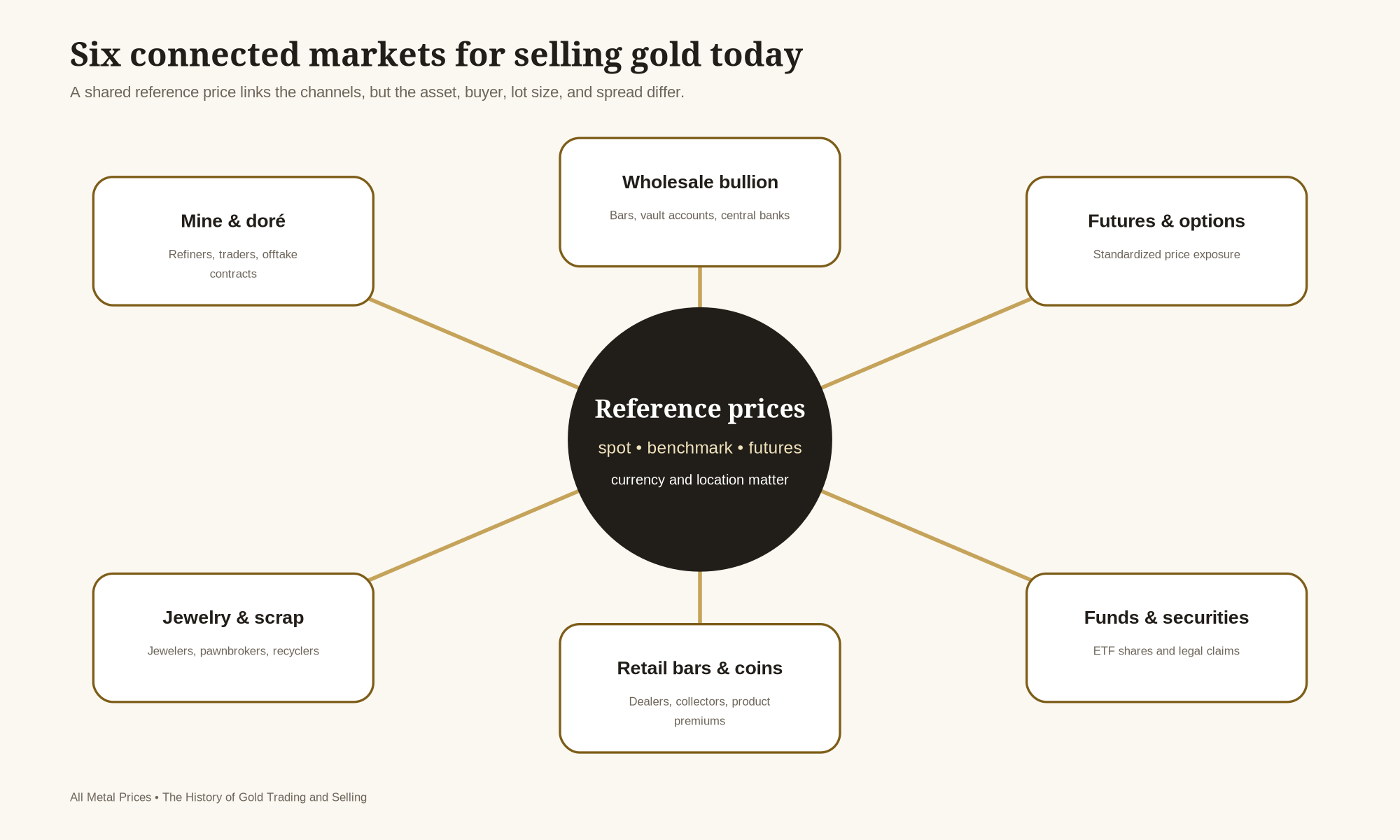
12. How gold is sold today: six connected markets
The contemporary gold market is often presented as one enormous pool with a single spot price. A more accurate picture has at least six connected channels. Metal and claims move among them, but each has different participants, standards, lot sizes, and margins.
| Market channel | What the seller transfers | Typical counterparty | Main source of price difference |
|---|---|---|---|
| Mine and doré | Partly refined mine output, often under an offtake or refining contract | Refiner, trader, streaming or royalty counterparty | Assay settlement, payable percentage, refining charges, transport, financing |
| Wholesale bullion | Good Delivery bars or recognized kilobars; allocated or unallocated account claims | Bullion bank, dealer, refiner, institution, central bank | Location, credit, bar status, tenor, liquidity |
| Futures and options | Standardized contractual exposure | Exchange clearing system and market participants | Futures basis, margin, contract month, delivery optionality |
| Funds and securities | ETF or trust shares; sometimes tokenized or other legal claims | Exchange buyer, market maker, authorized participant | Trading spread, fees, tracking, legal and custody structure |
| Retail investment | Coins, small bars, medals, numismatic products | Dealer, collector, auction house, private buyer | Fabrication, brand, condition, rarity, authentication, inventory |
| Jewelry and scrap | Wearable objects, dental or industrial scrap, mixed lots | Jeweler, pawnbroker, cash-for-gold buyer, aggregator, refiner | Karat uncertainty, stones, labor value, lot size, recovery cost, urgency |
Mine output and doré settlement
Many mines produce doré bars rather than 99.99 percent investment products. Doré contains gold and silver in proportions determined by the ore body and process. The mine ships it under security to a refiner. Sampling and assay establish the payable fine content; the contract determines treatment charges, metal deductions, provisional payment, final settlement, and how assay differences are resolved.
The mine is not simply paid “spot times ounces.” It may receive an advance based on provisional assay, then a balance after final results. Refining, transport, insurance, finance, and contractual payable terms affect proceeds. Large producers may hedge, enter long-term refining contracts, or sell through specialized traders.
Artisanal and small-scale miners often stand farther from that institutional route. Metal may pass through local collectors, traders, exporters, and regional refiners. Each stage solves problems of aggregation, cash provision, transport, and legal documentation while taking a margin. Where licensing and banking access are weak, informal buyers can become the only source of immediate liquidity.
Wholesale bars and bullion accounts
Institutional buyers favor standardized bars and recognized settlement locations. A large Good Delivery bar is efficient for London clearing but impractical for most households. Kilobars are common in parts of Asia. Central banks, funds, refineries, jewelers, and bullion banks choose forms that match their custody and fabrication needs.
A wholesale quote identifies more than metal. “Gold in London for spot settlement” differs from a bar that must be shipped to another country, converted to a preferred size, or cleared through customs. Credit also matters. A claim against a highly rated dealer may trade differently from an unfamiliar counterparty's promise even when both refer to the same nominal ounces.
Retail bars and coins
Small bars and legal-tender bullion coins contain a retail product premium. Minting, packaging, distribution, marketing, fraud prevention, inventory finance, and dealer service all cost money. In a strong retail buying wave, shortages can widen premiums even when the wholesale spot market remains orderly.
When the owner sells back, the premium may shrink, disappear, or—during a local shortage—partly persist. Recognized products in good condition usually receive stronger bids because dealers can resell them without melting. Obscure bars may be discounted until tested. Collectible coins require a separate numismatic assessment; selling a rarity solely for melt can destroy much of its value.
Jewelry, pawning, and recycling
Jewelry belongs to both the gold market and the market for design. At the original retail sale, price may include craftsmanship, brand, stones, tax, and store margin. A cash-for-gold buyer usually bids on recoverable metal, not the former retail receipt. A specialist estate jeweler or auction may pay more when design, maker, provenance, or gemstones have secondary-market demand.
Pawning is not a sale unless the borrower defaults. It is a secured loan in which the lender values the object conservatively, charges interest or fees, and keeps possession during the loan. Historically, pawnbroking gave households a way to mobilize gold without permanently giving up ownership. It remains economically distinct from selling, even when the initial valuation looks similar.
Recycling is a major source of supply because gold can be refined repeatedly without losing its elemental properties. The World Gold Council estimated the above-ground stock at about 220,700 tonnes at the end of 2025, with roughly two-thirds of all historically mined gold produced since 1950. Almost all of that stock remains in some form and can potentially return to market when price, need, fashion, or policy changes (World Gold Council 2026a).
Central-bank sales
Central banks sell for reserve-management, policy, liquidity, or portfolio reasons rather than household cash needs. Transactions may occur through other official institutions, dealers, auctions, or coordinated programs. The size and signaling effect of official sales can affect market expectations even when the physical quantity is modest relative to the total above-ground stock.
Official gold is usually already in recognized bar form and secure custody. The central question is execution: how to transfer a large position without unnecessarily moving price, revealing strategy too early, or disrupting relationships. The seller with the strongest apparent bargaining power can still face a market-impact cost.
Digital representations
Tokens, app balances, and other digital products may claim to represent vaulted gold. Their quality depends on the legal right being sold. Is the holder the owner of allocated metal, an unsecured creditor, a beneficiary of a trust, or merely exposed to a price index? Are bars independently audited? Can the claim be redeemed, in what minimum size, in which jurisdiction, and at what fee?
The history in this paper supplies a simple test: every new wrapper must answer the old questions of identity, verification, custody, liquidity, and lawful transfer. A digital interface can make a transaction fast. It cannot make the underlying property right unimportant.
13. How a gold buyer calculates an offer
The basic calculation is straightforward once the object has been correctly classified:
Estimated fine-gold weight = gross metal weight × gold fineness
Reference melt value = fine-gold weight in troy ounces × reference price per troy ounce
Offer = reference melt value − expected costs − risk allowance − buyer margin, plus any resale premium
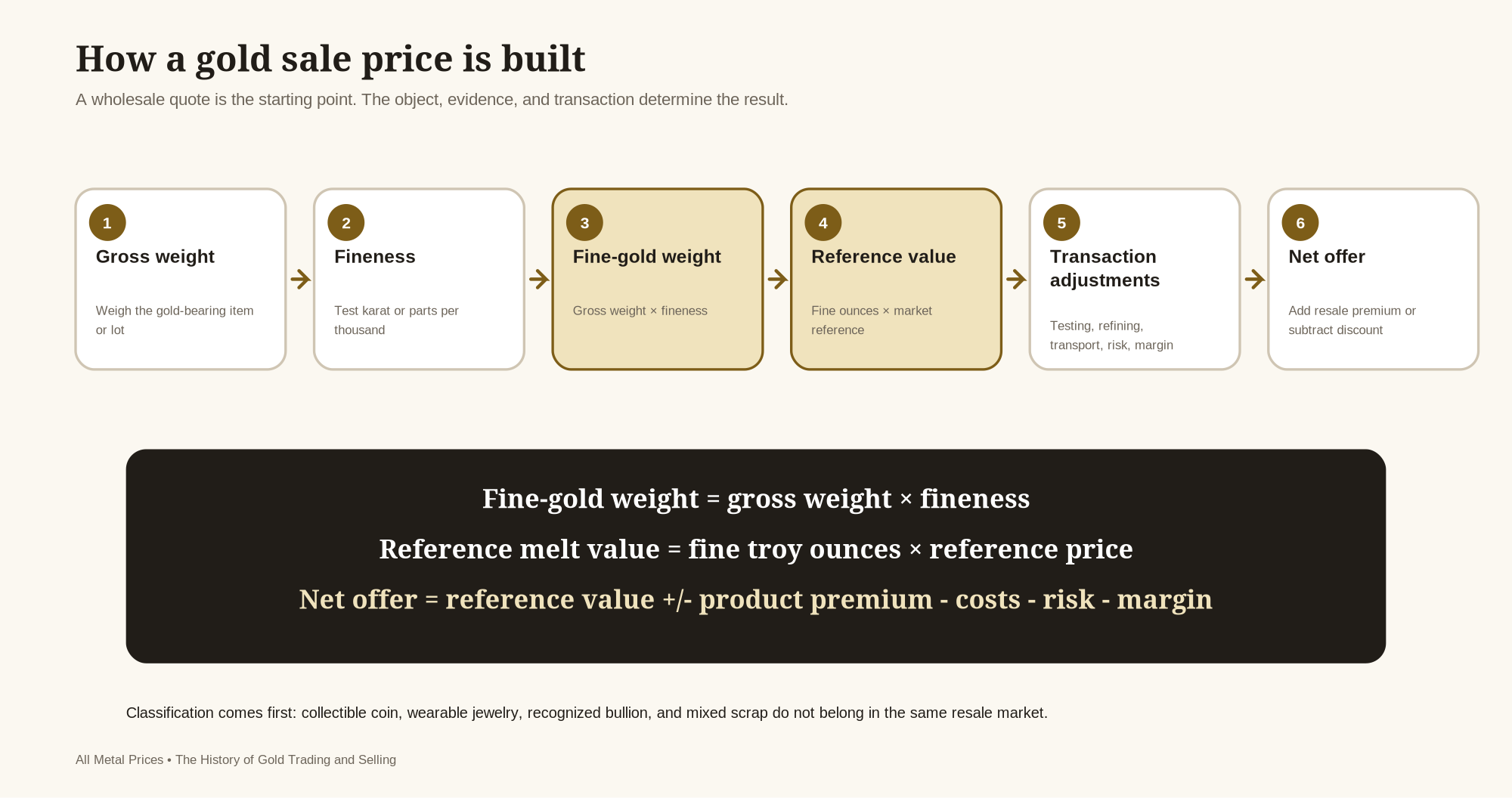
The difficulty lies in every term after gross weight.
Troy ounces, grams, karats, and fineness
Precious metals are commonly quoted in troy ounces. One troy ounce equals exactly 31.1034768 grams under the accepted conversion used in U.S. weights-and-measures guidance (National Institute of Standards and Technology 2026). A regular avoirdupois ounce used for many household goods is lighter, so the two should never be mixed.
Fineness states the fraction of the metal that is gold. A bar marked 999.9 is nominally 99.99 percent fine. Karat describes gold in twenty-four parts: 24 karat is treated as pure for trade description, 18 karat is 18/24 or 75 percent, and 14 karat is 14/24 or about 58.33 percent. National tolerances and marking rules matter, and a stamp is evidence rather than infallible proof (Federal Trade Commission 2024).
Worked melt-value example
Suppose a ring weighs 20.00 grams and tests at 18 karat, with no stones included in the weight.
- Fine-gold grams: 20.00 × 0.750 = 15.00 grams.
- Fine-gold troy ounces: 15.00 ÷ 31.1034768 = 0.48227 troy ounces.
- At a hypothetical reference price of USD 2,500 per troy ounce, reference melt value is 0.48227 × 2,500 = USD 1,205.68.
That figure is not a guaranteed cash offer. The buyer may deduct refining loss, assay cost, price exposure, payment charges, overhead, and margin. Another buyer may add value if the ring has a desirable maker, design, or resale market. The right comparison is between net written offers for the same object and testing method, not between a wholesale screen price and a retail buyer's bid.
Why stones and non-gold parts matter
Gross jewelry weight may include gemstones, springs, solder, clasps, steel watch components, or dirt. A buyer calculating melt value needs net gold-bearing weight and a realistic assay. Removing stones can reduce weight and may damage the object. Stones that appeared expensive at the original retail purchase may have little secondhand value unless they are identifiable, graded, and marketable.
A transparent buyer should explain whether stones are returned, separately valued, or included at zero. Ambiguity in the weighing procedure is a common source of disagreement.
Testing methods and their limits
Visual inspection and hallmarks are fast screening tools. A touchstone and acid test can estimate karat at the surface. Electronic conductivity devices and X-ray fluorescence can provide non-destructive readings, although plating, geometry, calibration, and surface composition can mislead. Fire assay is highly accurate but destructive and more suitable for representative samples or refinery lots.
For a small retail item, the cost of the most rigorous test may be disproportionate. Buyers therefore combine methods and price residual uncertainty. For a mine shipment or wholesale bar, formal sampling protocols and assay exchange become contractual necessities.
Spot price, benchmark price, and realized price
“Spot” ordinarily refers to professional market value for near-term settlement in a specified wholesale context. A benchmark such as the LBMA Gold Price records a defined auction outcome. A futures price relates to delivery in a specified month under exchange rules. None is automatically the cash price for every physical object.
The realized price may differ because of:
- Location: metal in a deficit market can command a premium; metal behind export controls can be trapped at a discount.
- Form: an accepted bar is cheaper to resell than mixed filings or an unverified necklace.
- Lot size: small transactions carry more labor and payment cost per gram.
- Timing: a buyer exposed to fast price movement may widen the spread.
- Settlement: immediate cash, bank transfer, consignment, auction, and delayed refinery settlement have different risks.
- Documentation: recognized invoices, hallmarks, bar lists, and provenance reduce uncertainty.
- Urgency: a seller who can compare bids usually fares better than one who must close immediately.
- Alternative value: collectible, artistic, branded, or historical value can exceed melt.
These deductions are not all proof of unfair dealing. They are also not self-justifying. Competition and disclosure determine whether the spread reasonably reflects service and risk or exploits the seller's lack of information.
A practical rule inherited from history
Before accepting an offer, identify the market category. A nineteenth-century miner lost value by selling assayed gold as uncertain dust. A modern owner can make the same mistake by selling a rare coin into a scrap stream or by assuming a damaged mass-market chain retains its original retail markup. Classification comes before calculation.
14. Provenance, responsible sourcing, and the limits of assay
Refining solves the metallurgical problem and creates a historical one. Once gold from many sources has been melted together, its physical origin is difficult or impossible to recover from the finished bar. Documents must carry the information that chemistry no longer shows.
From “Is it pure?” to “Where did it come from?”
Modern institutional buyers ask whether gold may be connected to conflict finance, serious human-rights abuses, bribery, fraudulent origin, money laundering, sanctions evasion, environmental harm, or illegal mining. The OECD Due Diligence Guidance provides a risk-based framework for mineral supply chains from conflict-affected and high-risk areas. LBMA's Responsible Gold Guidance translates due-diligence expectations into requirements for refiners within its assurance system (OECD 2016; LBMA 2021).
The practical work includes identifying suppliers, understanding ownership and transport routes, assessing geographic and counterparty risk, monitoring transactions, keeping records, responding to warning signs, and obtaining independent assurance. A refiner may know that an incoming lot is 92 percent gold and still be unable to accept it because the seller cannot establish a credible origin.
Market access can improve conduct—or drive trade underground
Due diligence works partly through access. A supplier that cannot satisfy the documentation requirements of a major refiner may lose the best-paying lawful outlet. That pressure can encourage formalization and better controls. It can also have an unintended effect: if compliance costs are impossible for small producers, output may move toward informal buyers who ask fewer questions and pay less.
Artisanal and small-scale gold mining supports millions of livelihoods and is an important source of production, but many sites operate with limited finance, fragmented records, and exposure to criminal taxation or mercury pollution. Programs supported by the United Nations seek to reduce mercury use and improve formal market access rather than treating all small-scale production as inherently illegitimate (UNEP 2023; OECD 2016).
The policy problem is not solved by a slogan such as “zero risk.” A credible system must distinguish manageable risk from prohibited conduct, improve traceability, protect whistleblowers and communities, and avoid pushing vulnerable miners into more opaque chains.
Recycled gold is not automatically risk-free
Recycling is sometimes presented as a complete ethical answer because no new ore is mined at the moment of resale. Yet recycled streams can be used to disguise recently mined or stolen material. Cash purchases, false invoices, rapid melting, and cross-border movement can break the link between object and origin.
Responsible sourcing therefore applies to recycled as well as mined gold. Dealers need controls proportionate to risk: seller identification, transaction monitoring, stolen-property checks, record retention, and scrutiny of implausible volumes or routes. “Recycled” describes the metal's claimed category. It should not end the inquiry.
Documentation has become part of the commodity
A wholesale bar now carries at least three kinds of value:
- Physical value: fine-gold content.
- Institutional value: acceptance within a recognized refining, vaulting, and settlement network.
- Documentary value: evidence that the supply chain meets legal and responsible-sourcing expectations.
An undocumented bar can be chemically sound and commercially impaired. This is the modern form of a very old rule: gold travels farther when a trusted claim travels with it.
15. What changed—and what did not
The history of selling gold contains genuine breakthroughs. Coinage made standardized pieces recognizable. Hallmarks protected claims about finished wares. Assay offices and mints connected frontier output to national money. The telegraph and steamship shortened price and transport delays. The gold standard linked official convertibility across borders. Futures separated price transfer from immediate physical delivery. ETFs placed a bullion-linked security inside ordinary brokerage accounts. Supply-chain audits added origin and conduct to the definition of acceptable gold.
Yet four commercial problems survived every innovation.
1. Verification
The buyer must establish what is being transferred. Ancient scales measured a piece; a mint stamp guaranteed a coin; a modern bar list identifies serial numbers; an ETF prospectus defines a shareholder's legal interest. Better technology shifts the trust problem rather than abolishing it.
2. Liquidity
Gold is highly liquid only in the right form and place. A Good Delivery bar in a London vault, a one-ounce bullion coin in an active dealer network, a damaged necklace, and a remote mine's doré are all gold. They cannot all be sold with the same speed, cost, or documentation.
3. Bargaining power
Urgency and alternatives determine who captures the spread. The isolated prospector, the indebted household, the licensed monopoly buyer, the large central bank, and the market-making bullion dealer enter transactions with very different choices. Transparent reference prices help, but they do not equalize the parties.
4. Legitimacy
The market needs a reason to believe that the seller may lawfully transfer the gold and that the next buyer may safely accept it. In different periods, legitimacy came from royal authority, mint law, hallmarks, tax stamps, receipts, title documents, sanctions screening, or responsible-sourcing audits. Gold's durability makes this social record especially important: the metal outlives the circumstances in which it was acquired.
Reader note: This is a historical and market-structure reference, not personalized financial, tax, or legal advice. Current prices, laws, taxes, and dealer terms vary by jurisdiction and date.
Frequently asked questions about the history of selling gold
When did people first start selling gold?
There is no single first documented cash sale. Gold circulated in Egypt, Nubia, Mesopotamia, and neighboring regions during the third and second millennia BCE through gifts, tribute, workshop supply, property transfers, debt settlement, and exchange. Those transactions commonly relied on weight and local units of account rather than coin. It is safer to say that gold was exchanged for value long before coined money than to assign one invented date to “the first sale” (Schorsch 2017; Powell 1996).
Was gold used as money before coins?
Yes, but “used as money” can mean several things. Gold could serve as a store of wealth, a high-value payment, a unit for settling accounts, or an input priced in another monetary unit. Many early economies used weighed silver more routinely while gold remained politically or ritually important. A commodity can perform some monetary functions without circulating as standardized coin.
Who invented gold coins?
The earliest widely recognized coinage emerged in western Anatolia in the late seventh century BCE, initially in electrum, a natural or manufactured gold-silver alloy. Lydia is central to the history, but Greek cities in the region also participated in early coinage. King Croesus, ruling in the sixth century BCE, is associated with an influential reform that issued separate, carefully refined gold and silver coins. Saying that one person simply “invented money” obscures this regional development (Le Rider 2001; British Museum n.d.-a; British Museum n.d.-b).
Why were old gold coins sometimes sold by weight?
A coin's stamp was only as trustworthy as the issuer, condition, and buyer's familiarity. Foreign, clipped, worn, counterfeit, debased, or demonetized coins could be weighed and assayed as bullion. Even a respected coin might trade at a premium or discount relative to its official tariff when exchange rates or metal values changed.
How did medieval merchants test gold?
They used scales, touchstones, comparison needles, visual expertise, melting, and formal assay. Money changers also relied on knowledge of coin types and issuers. For finished jewelry and plate, hallmarking placed a third-party mark on tested wares, reducing the need for every buyer to damage the object to check fineness (Goldsmiths' Company 2022).
What was the role of West Africa in the historic gold market?
West African production supplied major trans-Saharan flows from at least the early Islamic centuries and supported demand for coinage in North Africa and the Mediterranean. The trade moved through layered networks of miners, local traders, rulers, caravan merchants, brokers, and mints. Later Atlantic buyers redirected part of the flow to coastal routes. West Africa was not a passive source; African political and commercial institutions shaped access and terms (Garrard 1982; Metropolitan Museum of Art 2000).
Did the gold standard mean everyone could sell gold at one fixed price?
No. The standard defined monetary conversion under specific laws and eligible forms. Shipping, assay, coinage, finance, exchange rates, and location still mattered. Retail jewelry and unfamiliar bullion did not automatically receive a mint's full rate. “Fixed price” describes the official parity, not an identical net offer to every person holding a gold object.
Why did the United States restrict private gold ownership in 1933?
The Roosevelt administration acted during a banking and monetary emergency to stop gold outflows, centralize monetary reserves, and change the dollar's gold relationship. Rules issued in 1933 required delivery of specified monetary gold, and the Gold Reserve Act of 1934 transferred monetary gold to the Treasury. Exemptions and classifications mattered, so jewelry and certain collectible or industrial forms were not treated exactly like monetary bars and coin (Federal Reserve History n.d.-a).
When did gold begin trading freely in the modern United States?
The modern transition occurred in stages. The United States ended dollar convertibility into gold for foreign monetary authorities on August 15, 1971. Statutory restrictions on private ownership ended effective December 31, 1974, the same date on which New York gold futures began trading. “Freely” still does not mean unregulated; commodities, securities, taxation, anti-money-laundering rules, and consumer-protection law continue to apply (Federal Reserve History n.d.-c; U.S. Mint n.d.; CME Group n.d.).
What is the difference between spot price and the amount a gold seller receives?
Spot is a wholesale market reference for specified settlement conventions. A seller's net amount reflects fine-gold content and then testing, refining, transport, inventory, payment, fraud, market, and resale costs. A recognized bullion coin may retain a product premium. A rare coin or signed jewel may be worth more than metal. Mixed scrap may receive less. The quote and the object belong to connected but different markets.
Why do gold buyers pay different percentages of melt value?
They have different costs, resale routes, risk tolerances, and margins. A refiner buying a large, well-documented lot can operate on a narrow spread. A storefront processing one broken chain has higher labor and overhead per gram. Competition, seller urgency, assay confidence, payment speed, and local demand also matter. Comparing at least two transparent net offers is more informative than comparing advertised percentages that use different assumptions.
Is old jewelry worth only its gold content?
Sometimes, but not always. Mass-produced or damaged pieces commonly enter the recycling market. Signed jewelry, antique workmanship, important provenance, desirable gemstones, and recognized design can command more through a specialist dealer or auction. The safest sequence is to identify maker and collectible interest before authorizing destructive testing or melting.
Is recycled gold traceable?
It can be traceable when records connect the seller, object, aggregator, refiner, and output. The metal itself does not preserve an easy physical record after melting and mixing. That is why responsible-sourcing systems require due diligence for recycled streams rather than assuming that “recycled” automatically means low risk (OECD 2016; LBMA 2021).
Does all gold ever mined still exist?
Nearly all of it is believed to remain in some form because gold is highly durable and can be remelted repeatedly. The World Gold Council's August 2026 estimate placed total above-ground stock at about 220,700 tonnes at the end of 2025. Some gold has been dispersed in tiny quantities, lost, or made uneconomic to recover, so “all” should not be taken literally (World Gold Council 2026a).
What is the most important lesson for a modern seller?
Determine what you own before choosing where to sell it. Establish net weight, likely fineness, hallmark or mint identity, collectible or artistic value, stone value, documentation, and the buyer's testing and settlement method. History repeatedly shows that an acceptable classification and trusted evidence can be worth almost as much as access to the metal itself.
Research method and scope
This paper follows transactions rather than attempting a complete history of mining, jewelry, monetary theory, or the gold price. It prioritizes primary institutional material, museum scholarship, peer-reviewed research, and major academic monographs. Dates and legal claims are stated narrowly where rules changed over time. The article distinguishes official prices from realized prices, physical metal from financial claims, and voluntary sellers from legal owners whose output rested on coerced labor.
The result is necessarily selective. Important regional histories—including Southeast Asian, Japanese, Middle Eastern, Andean, and twentieth-century informal markets—deserve dedicated studies. They are not compressed here into token paragraphs merely to claim universal coverage.
Conclusion
Gold became easier to trade because generations of institutions learned how to make a claim about it travel. The scale allowed two parties to agree on weight. The touchstone and assay spoke to fineness. The coin moved responsibility toward a mint. The hallmark protected the buyer of a finished object. The foundry-house stamp satisfied a colonial treasury. The assayer's bar connected a mining camp to a distant bank. Good Delivery linked refineries, vaults, and wholesale settlement. Futures and funds turned price exposure into standardized contracts and shares. Due-diligence files now carry facts that no chemical test can recover.
The history is not a straight progression toward fairness. Standardization often reduced fraud and widened trade; it also empowered states, monopolies, colonial authorities, and financial gatekeepers. New liquidity created opportunities for miners and households while preserving discounts rooted in distance, urgency, and unequal information. At several points, the lawful seller was not the person who did the work of extraction.
A modern screen can display a gold price in milliseconds. That number is only the opening term of a transaction. The amount actually received still depends on the same four forces that shaped ancient and medieval exchange: verification, liquidity, bargaining power, and legitimacy. Gold has endured because it can survive repeated melting. Its market has endured because societies repeatedly rebuilt the trust required to sell it.
About the author
The All Metal Prices Research Desk produces source-based reference material on precious-metal pricing, market structure, and history. This article distinguishes primary institutional evidence from historical interpretation and provides a full bibliography so readers can verify its claims.
Bibliography
Bacharach, Jere L. 1973. “The Dinar versus the Ducat.” International Journal of Middle East Studies 4 (1): 77–96. https://doi.org/10.1017/S0020743800027288.
Bank of England. 2019. “The Gold Standard.” Bank of England KnowledgeBank. https://www.bankofengland.co.uk/knowledgebank/what-is-the-gold-standard.
Baur, Dirk G., and Brian M. Lucey. 2010. “Is Gold a Hedge or a Safe Haven? An Analysis of Stocks, Bonds and Gold.” Financial Review 45 (2): 217–29. https://doi.org/10.1111/j.1540-6288.2010.00244.x.
Bordo, Michael D., and Hugh Rockoff. 1996. “The Gold Standard as a ‘Good Housekeeping Seal of Approval.’” Journal of Economic History 56 (2): 389–428. https://doi.org/10.1017/S0022050700016491.
Bortolot, Alexander Ives. 2003. “Gold in Asante Courtly Arts.” Heilbrunn Timeline of Art History. New York: Metropolitan Museum of Art. https://www.metmuseum.org/essays/gold-in-asante-courtly-arts.
Boxer, C. R. 1962. The Golden Age of Brazil, 1695–1750: Growing Pains of a Colonial Society. Berkeley: University of California Press.
Brands, H. W. 2002. The Age of Gold: The California Gold Rush and the New American Dream. New York: Doubleday.
British Museum. n.d.-a. “Coin.” Electrum coin minted in Phocaea. Collection online. Accessed August 23, 2026. https://www.britishmuseum.org/collection/object/C_RPK-p121A-3-Coo.
British Museum. n.d.-b. “Coin.” Gold stater of Croesus, minted in Lydia. Collection online. Accessed August 23, 2026. https://www.britishmuseum.org/collection/object/C_1877-0201-1.
CME Group. n.d. “Historical First Trade Dates.” Accessed August 23, 2026. https://www.cmegroup.com/company/cme-group-history/first-trade-dates.html.
Costa, Leonor Freire, Maria Manuela Rocha, and Tanya Araújo. 2011. “Social Capital and Economic Performance: Trust and Distrust in Eighteenth-Century Gold Shipments from Brazil.” European Review of Economic History 15 (1): 1–27. https://doi.org/10.1017/S1361491610000225.
Eichengreen, Barry. 1992. Golden Fetters: The Gold Standard and the Great Depression, 1919–1939. New York: Oxford University Press.
Federal Reserve History. n.d.-a. “Gold Reserve Act of 1934.” Accessed August 23, 2026. https://www.federalreservehistory.org/essays/gold-reserve-act.
Federal Reserve History. n.d.-b. “Creation of the Bretton Woods System.” Accessed August 23, 2026. https://www.federalreservehistory.org/essays/bretton-woods-created.
Federal Reserve History. n.d.-c. “Nixon Ends Convertibility of U.S. Dollars to Gold and Announces Wage/Price Controls.” Accessed August 23, 2026. https://www.federalreservehistory.org/essays/gold-convertibility-ends.
Federal Trade Commission. 2024. “Buying Platinum, Gold, and Silver Jewelry.” Consumer Advice. https://consumer.ftc.gov/articles/buying-platinum-gold-silver-jewelry.
Flandreau, Marc. 2004. The Glitter of Gold: France, Bimetallism, and the Emergence of the International Gold Standard, 1848–1873. Oxford: Oxford University Press.
Gallarotti, Giulio M. 1995. The Anatomy of an International Monetary Regime: The Classical Gold Standard, 1880–1914. New York: Oxford University Press.
Garrard, Timothy F. 1982. “Myth and Metrology: The Early Trans-Saharan Gold Trade.” Journal of African History 23 (4): 443–61. https://doi.org/10.1017/S0021853700021290.
Goldsmiths’ Company. 2022. “The History of Hallmarking.” March 7, 2022. https://www.thegoldsmiths.co.uk/hallmarking-stories/the-history-of-hallmarking.
Haider, Najaf. 1996. “Precious Metal Flows and Currency Circulation in the Mughal Empire.” Journal of the Economic and Social History of the Orient 39 (3): 298–364. https://doi.org/10.1163/1568520962601180.
Le Rider, Georges. 2001. La naissance de la monnaie: Pratiques monétaires de l’Orient ancien. Paris: Presses Universitaires de France.
London Bullion Market Association (LBMA). 2021. Responsible Gold Guidance. Version 9. Finalized November 2021. https://www.lbma.org.uk/publications/responsible-gold-guidance-v9.
London Bullion Market Association (LBMA). n.d.-a. “Origins of the London Bullion Market.” Accessed August 23, 2026. https://www.lbma.org.uk/market-standards/origins-of-the-london-bullion-market.
London Bullion Market Association (LBMA). n.d.-b. “The First Gold Fixing.” Accessed August 23, 2026. https://www.lbma.org.uk/wonders-of-gold/items/the-first-gold-fixing.
London Bullion Market Association (LBMA). n.d.-c. “Good Delivery Current List—Gold.” Accessed August 23, 2026. https://www.lbma.org.uk/good-delivery/gold-current-list.
London Bullion Market Association (LBMA). n.d.-d. “March 1968 and the London Gold Fixing.” Accessed August 23, 2026. https://www.lbma.org.uk/wonders-of-gold/items/march-1968-and-the-london-gold-fixing.
London Bullion Market Association (LBMA). n.d.-e. “About Loco London.” Accessed August 23, 2026. https://www.lbma.org.uk/market-standards/about-loco-london.
London Bullion Market Association (LBMA). n.d.-f. “LBMA Gold Price.” Accessed August 23, 2026. https://www.lbma.org.uk/prices-and-data/lbma-gold-price.
Loy-Wilson, Sophie. 2017. “Coolie Alibis: Seizing Gold from Chinese Miners in New South Wales.” International Labor and Working-Class History 91: 28–45. https://doi.org/10.1017/S0147547916000338.
Metropolitan Museum of Art. 2000. “The Trans-Saharan Gold Trade (7th–14th Century).” Heilbrunn Timeline of Art History. https://www.metmuseum.org/essays/the-trans-saharan-gold-trade-7th-14th-century.
Metropolitan Museum of Art. 2018. “The Land of Nubia.” Heilbrunn Timeline of Art History. https://www.metmuseum.org/toah/hd/nubi/hd_nubi.htm.
Metropolitan Museum of Art. n.d. “Arts of Africa: Inside the Exhibition.” Accessed August 23, 2026. https://www.metmuseum.org/exhibitions/arts-of-africa/inside-the-exhibition.
National Institute of Standards and Technology. 2026. “Precious Metals Conversion Information.” Office of Weights and Measures. Updated November 21, 2025. Accessed August 23, 2026. https://www.nist.gov/pml/owm/metric-si/unit-conversion/precious-metals-conversion-information.
Nixon, Sam, Thilo Rehren, and Maria Filomena Guerra. 2011. “New Light on the Early Islamic West African Gold Trade: Coin Moulds from Tadmekka, Mali.” Antiquity 85 (330): 1353–68. https://doi.org/10.1017/S0003598X00062104.
O’Callaghan, Gary. 1993. The Structure and Operation of the World Gold Market. IMF Occasional Paper 105. Washington, DC: International Monetary Fund.
O’Connor, Fergal A., Brian M. Lucey, Jonathan A. Batten, and Dirk G. Baur. 2015. “The Financial Economics of Gold—A Survey.” International Review of Financial Analysis 41: 186–205. https://doi.org/10.1016/j.irfa.2015.07.005.
Organisation for Economic Co-operation and Development (OECD). 2016. OECD Due Diligence Guidance for Responsible Supply Chains of Minerals from Conflict-Affected and High-Risk Areas. 3rd ed. Paris: OECD Publishing. https://doi.org/10.1787/9789264252479-en.
Powell, Marvin A. 1996. “Money in Mesopotamia.” Journal of the Economic and Social History of the Orient 39 (3): 224–42. https://doi.org/10.1163/1568520962601225.
Pillsbury, Joanne. 2020. “Gold in the Ancient Americas.” Heilbrunn Timeline of Art History. New York: Metropolitan Museum of Art. July 2020. https://www.metmuseum.org/essays/gold-in-the-ancient-americas.
Reserve Bank of India. n.d.-a. “Ancient India Coinage.” RBI Monetary Museum. Accessed August 23, 2026. https://rbi.org.in/currency/museum/c-ancient.html.
Reserve Bank of India. n.d.-b. “Medieval India Coinage.” RBI Monetary Museum. Accessed August 23, 2026. https://rbi.org.in/currency/museum/c-medieval.html.
Richardson, Peter, and Jean-Jacques Van-Helten. 1984. “The Development of the South African Gold-Mining Industry, 1895–1918.” Economic History Review 37 (3): 319–40. https://doi.org/10.1111/j.1468-0289.1984.tb00335.x.
Rohrbough, Malcolm J. 1997. Days of Gold: The California Gold Rush and the American Nation. Berkeley: University of California Press.
Royal Mint Museum. n.d. “Isaac Newton and the Guinea.” Accessed August 23, 2026. https://www.royalmintmuseum.org.uk/journal/people/isaac-newton-and-the-guinea/.
Russell-Wood, A. J. R. 1984. “Colonial Brazil: The Gold Cycle, c. 1690–1750.” In The Cambridge History of Latin America, vol. 2, edited by Leslie Bethell, 547–600. Cambridge: Cambridge University Press.
Schorsch, Deborah. 2017. “Gold in Ancient Egypt.” Heilbrunn Timeline of Art History. New York: Metropolitan Museum of Art. https://www.metmuseum.org/essays/gold-in-ancient-egypt.
Securities and Exchange Commission. 2009. “SPDR Gold Shares Key Facts.” Filed under Securities Act Rule 433, Registration No. 333-167132. https://www.sec.gov/Archives/edgar/data/1222333/000095012309063812/y02616f2fwp.htm.
Shanghai Gold Exchange. n.d. “Overview.” Accessed August 23, 2026. https://en.sge.com.cn/eng_about_Overview.
Sheffield Assay Office. n.d. “History of Hallmarking.” Accessed August 23, 2026. https://www.assayoffice.co.uk/about-us/history-of-hallmarking/.
Sjaastad, Larry A., and Fabio Scacciavillani. 1996. “The Price of Gold and the Exchange Rate.” Journal of International Money and Finance 15 (6): 879–97. https://doi.org/10.1016/S0261-5606(96)00045-9.
Spufford, Peter. 1988. Money and Its Use in Medieval Europe. Cambridge: Cambridge University Press.
State Street Global Advisors. n.d. “SPDR Gold Shares (GLD).” Accessed August 23, 2026. https://www.ssga.com/us/en/intermediary/etfs/spdr-gold-shares-gld.
United Nations Environment Programme (UNEP). 2023. “Ending the Toxic Trail of Small-Scale Gold Mining.” August 16, 2023. https://www.unep.org/news-and-stories/story/ending-toxic-trail-small-scale-gold-mining.
U.S. Mint. n.d. “Historical Timeline of the U.S. Mint.” Accessed August 23, 2026. https://www.usmint.gov/learn/history/timeline.
Van-Helten, J. J. 1982. “Empire and High Finance: South Africa and the International Gold Standard, 1890–1914.” Journal of African History 23 (4): 529–48. https://doi.org/10.1017/S0021853700021344.
Ville, Simon. 2014. “Colonial Enterprise.” In The Cambridge Economic History of Australia, edited by Simon Ville and Glenn Withers, 202–21. Cambridge: Cambridge University Press.
von Reden, Sitta. 2010. Money in Classical Antiquity. Cambridge: Cambridge University Press.
World Gold Council. 2026a. “How Much Gold Has Been Mined?” August 18, 2026. https://www.gold.org/goldhub/data/how-much-gold.
Related guides and calculators
Apply the history to a current question
This history explains how the market developed. To value an item, use a current reference price, verified weight and purity, and comparable buyer terms.