
Abstract
Palladium has one of the strangest commercial biographies of any precious metal. Gold and silver were exchanged for millennia before chemists understood them as elements. Palladium entered public commerce in the opposite order: it appeared for sale in London in 1803 as an anonymous “new silver,” before its discoverer, William Hyde Wollaston, publicly identified himself or fully disclosed how he had separated it from platinum ore. The first palladium market was therefore not a mint, mine, or exchange. It was a controlled sales experiment built around secrecy, samples, handbills, scientific argument, and a specialist shop.
From that unusual beginning, palladium became a metal whose value depended less on ornament than on industrial function. Nineteenth-century sellers dealt in tiny quantities recovered during platinum refining. Twentieth-century production grew mainly as a by-product of nickel, copper, and platinum-group-metal mining in Russia, South Africa, Canada, and the United States. The spread of automotive catalytic converters after the mid-1970s turned carmakers and catalyst manufacturers into the dominant demand center. A metal once sold by the dram became a strategic input priced by global mine concentration, emissions rules, substitution between platinum-group metals, recycling flows, inventories, sanctions risk, and the production plans of the automobile industry.
This paper follows the transaction rather than merely the element. It explains what sellers actually offered—powder, sponge, salts, fabricated products, bars, coins, futures, ETF shares, jewelry, dental alloys, industrial residues, and spent catalytic converters—and why each form received a different price. It also traces the institutions that made palladium saleable: specialist refiners, assay laboratories, the London Platinum and Palladium Market, Good Delivery standards, futures exchanges, government mints, hallmarking offices, custodians, recyclers, and responsible-sourcing auditors. The central conclusion is practical. There is no single “palladium price” available to every holder. A benchmark values standardized wholesale metal. What a seller receives depends on fine-metal content, product form, assay quality, recovery yield, provenance, location, quantity, financing, and the buyer’s next market.
Text alternatives for the diagrams
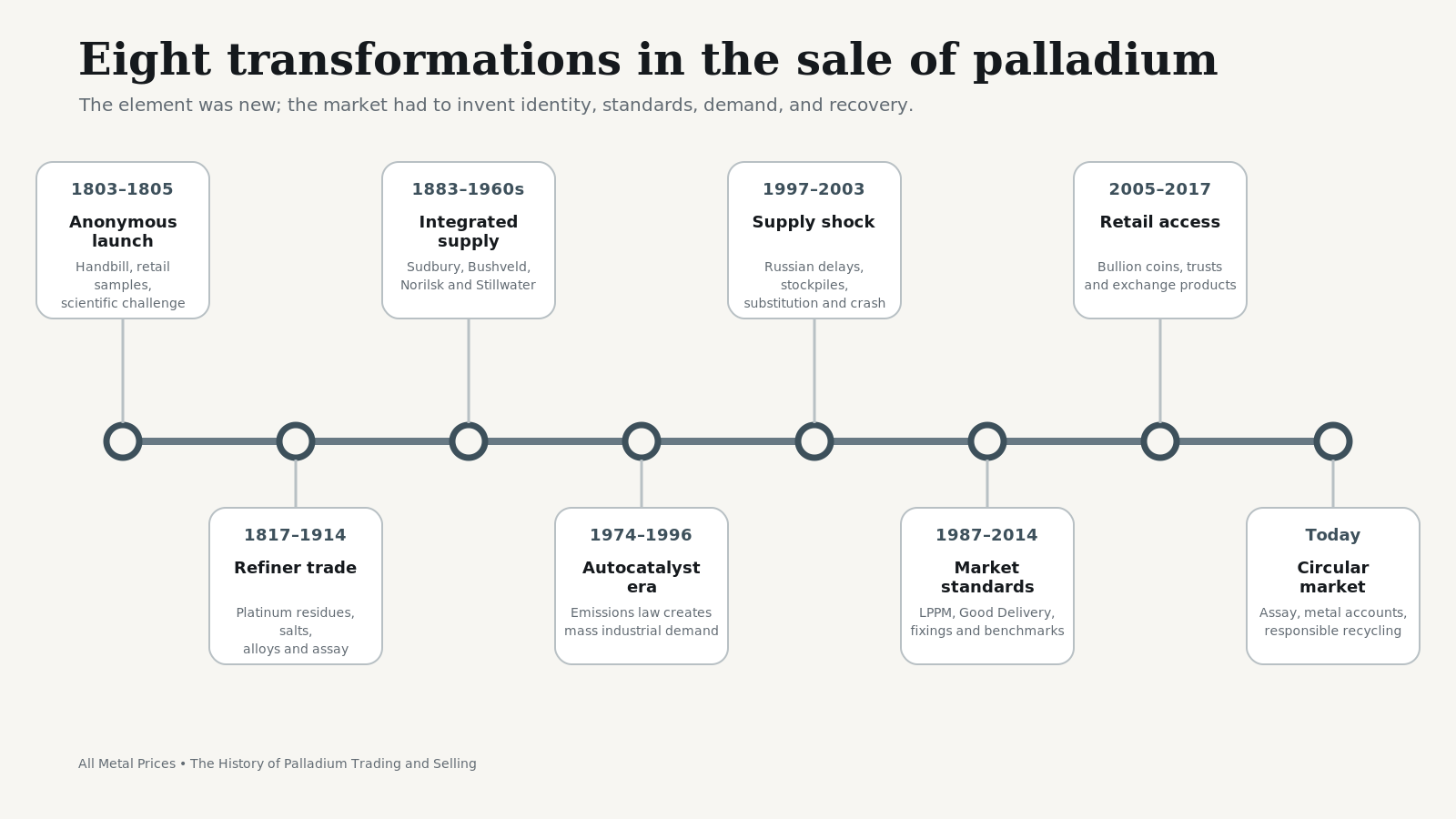
Figure 1: eight transformations in the sale of palladium
- 1803-1805, anonymous launch: a handbill, retail samples, and scientific challenge introduced palladium.
- 1817-1914, refiner trade: palladium was recovered from platinum residues, salts, and alloys, with assay central to trade.
- 1883-1960s, integrated supply: Sudbury, the Bushveld Complex, Norilsk, and Stillwater linked palladium to larger multi-metal mining systems.
- 1974-1996, autocatalyst era: emissions law created mass industrial demand.
- 1987-2014, market standards: the LPPM, Good Delivery rules, price fixings, and benchmarks defined standardized wholesale routes.
- 1997-2003, supply shock: Russian delivery delays and stockpiling were followed by substitution and a price crash.
- 2005-2017, retail access: bullion coins, trusts, and exchange-traded products added retail and financial routes.
- Today, circular market: assay, metal accounts, and responsible recycling return recovered metal to the market.
Figure 2: modern palladium selling markets
Primary supply enters as mine concentrate and refinery feed, often priced within multi-metal economics. Secondary supply enters as converters, catalyst, jewelry, dental, and manufacturing scrap. Both physical streams move to a smelter or refiner for sampling, assay, recovery, and settlement as plate, ingot, or sponge.
From refining, physical metal can move to the wholesale market, where LPPM benchmarks, OTC spot and forwards, and Good Delivery custody are relevant. Wholesale metal supplies industrial users such as autocatalyst, chemical, electronics, hydrogen, dental, and medical users. Industrial demand becomes fabricated products including sponge, salts, wire, bars, coins, jewelry, and specialty alloys. Financial markets create futures and exchange-traded-product shares for hedging, investment, basis, and financing. At end of life, collection and identification return recoverable material to a refiner, closing the recycling loop.
Figure 3: how a palladium sale price is calculated
- Identify the product: coin or bar, jewelry or dental alloy, converter, or industrial feed.
- Establish settlement weight: distinguish gross from net weight and account for moisture, stones, shell, or carrier material.
- Measure fine metal: use fineness or assay and account for any credited platinum or rhodium.
- Apply commercial terms: recovery or payable rate, benchmark and price date, location, and currency.
- Deduct charges: treatment, refining, freight, finance, tax, testing, and dealer spread.
- Compare net cash: payment date, dispute rights, and counterparty risk still matter.
The diagram summarizes the formula: net payment equals the sum of settlement weight multiplied by assay, payable rate, and agreed metal price, minus every charge.
The answer in one paragraph
Palladium began to be sold in London in 1803, when William Hyde Wollaston anonymously offered a newly isolated metal as “palladium” or “new silver” through a Soho mineral dealer. Scientific controversy forced him to reveal his method in 1805. For most of the nineteenth century, palladium remained a scarce specialist product recovered while refining platinum and used in limited chemical, dental, instrument, and alloy applications. Its supply base changed as platinum-group metals were recovered from Russian placer deposits, Canadian nickel-copper ores, South Africa’s Bushveld Complex, Siberian nickel-copper deposits, and Montana’s Stillwater Complex. Its demand base changed even more dramatically after catalytic converters entered mass-produced automobiles in the 1970s. By the late twentieth century, most palladium was being bought as an industrial catalyst input rather than as jewelry or money. London dealers formalized standards and price discovery; futures, exchange-traded products, and bullion coins opened financial and retail routes; recyclers turned end-of-life catalytic converters into a major secondary supply. Today palladium is sold through several linked but unequal markets, and the amount paid for a converter, ring, coin, bar, sponge lot, or futures position cannot be inferred from a headline spot price alone.
Key findings
- Palladium's first public appearance was a sale, not a scientific announcement. Wollaston used anonymous retail distribution to test whether a new metal could survive scrutiny while protecting a profitable refining process.
- It has usually been a co-product or by-product. Palladium supply responds to the economics of nickel, copper, platinum, rhodium, and other metals as well as to the palladium price itself.
- Automotive regulation created the modern market. Catalytic converters transformed palladium from a specialist material into a globally strategic commodity.
- The palladium market is physically small and geographically concentrated. This makes export delays, mine disruptions, sanctions, inventory decisions, and substitution unusually important to price.
- Wholesale standards do not describe most consumer sales. Loco London plates and ingots, retail one-ounce coins, jewelry, industrial scrap, and catalytic converters are different products with different costs and discounts.
- Assay and sampling are commercial events. A seller of heterogeneous scrap is paid for the analyzed and recoverable palladium in a representative sample, not for the gross weight of the object.
- Recycling is not an afterthought. Spent autocatalysts have become a large, technically demanding secondary source, creating markets for collectors, decanners, samplers, smelters, refiners, and metal-account settlement.
- Provenance now affects liquidity. Good Delivery status, responsible-sourcing audits, sanctions screening, anti-theft controls, and documentation can determine whether metal is acceptable to the highest-value market.
Palladium selling at a glance
| Market or period | What the seller offers | Typical buyer | How value is verified | How the price is formed |
|---|---|---|---|---|
| London, 1803–1805 | Small samples of a purported new metal | Chemist, collector, experimental user | Chemical tests, physical properties, reputation of intermediaries | Posted asking price followed by scientific dispute and private negotiation |
| Nineteenth-century specialist trade | Palladium metal, salts, alloys, laboratory material | Refiner, instrument maker, dentist, chemist | Refiner certificate, gravimetric analysis, experimental performance | Cost of separation plus scarcity, purity, and application value |
| Mine and refinery supply | Concentrate, matte, sponge, powder, plate, ingot | Refiner, fabricator, catalyst manufacturer, bank | Mass balance, sampling, assay, accepted refinery brand | Contract formula tied to benchmark or negotiated metal account |
| Automotive manufacturing | Sponge, salts, catalyst compounds, fabricated washcoat inputs | Catalyst maker and automaker | Tight chemical specification, quality control, approved supplier | Benchmark-linked contract, lease or consignment terms, hedging, volume commitments |
| Loco London wholesale market | Unallocated claim or accredited 1–6 kg plate/ingot | Bank, dealer, industrial user, investor | Good Delivery refiner, 99.95% minimum fineness, markings, custody records | Twice-daily benchmark, OTC spot/forward price, lease rates, location and credit |
| Futures and exchange products | Standardized futures contract or trust share | Exchange participant or securities investor | Exchange rules, clearing, warehouse/custody system, published NAV | Continuous bids and offers, basis to physical metal, fees and financing |
| Retail bullion | Coin or small bar, usually .9995 fine | Bullion dealer, collector, private investor | Mint/refiner identity, weight, fineness, packaging and condition | Spot reference plus or minus retail premium, inventory and dealer spread |
| Jewelry and dental scrap | Alloyed object, filings, sweeps, crowns, manufacturing residue | Specialist precious-metal buyer or refiner | Hallmark where relevant, XRF screening, melt and laboratory assay | Recoverable metal value less refining, treatment, risk, and settlement costs |
| Catalytic-converter recycling | Whole converter, decanned ceramic, milled powder, or bulk lot | Collector, decanner, processor, smelter, refiner | Serial/catalog estimate or representative sample and assay | Expected or assayed PGM content × payable rate × settlement price, less charges |
A chronology of the palladium market
- By about 1700: Brazilian miners know a pale gold-palladium alloy as ouro podre, “worthless” or “rotten” gold; the element itself remains unrecognized.
- 1802–1803: William Hyde Wollaston separates palladium while refining South American platinum ore in a secret commercial partnership.
- April 1803: Handbills advertise palladium or “new silver” for sale at a mineral shop in Gerrard Street, Soho.
- 1803: Richard Chenevix purchases and tests the material, then argues that it is an artificial platinum-mercury alloy rather than a new element.
- February 1805: Wollaston publicly claims the discovery and describes palladium and other substances found with platinum.
- 1817 onward: Percival Norton Johnson builds an assaying and refining business that becomes Johnson Matthey, one of the central firms in the platinum-group-metal trade.
- 1819 onward: Rich platinum placer deposits in the Ural Mountains enlarge the raw-material base from which palladium can be recovered.
- Late nineteenth to early twentieth century: Nickel-copper mining at Sudbury and later other sulfide operations creates by-product PGM streams.
- 1924: Discovery and development of the Merensky Reef establish the Bushveld Complex as a foundational source of platinum-group metals.
- 1930s–1950s: Soviet development of Norilsk, initially through the Gulag forced-labor system, builds a vast nickel-copper industry whose by-products include palladium.
- 1974–1975: Automobile manufacturers begin mass adoption of noble-metal catalytic converters to meet U.S. emissions standards.
- 1979: London and Zurich dealers agree on standardized specifications and provenance for acceptable platinum and palladium deliveries.
- 1986: Commercial production begins at the Stillwater mine in Montana after discovery of the J-M Reef in 1974.
- 1987: The London Platinum and Palladium Market is formally constituted.
- 1989: London platinum and palladium quotations become full fixings.
- 1997–2001: Russian export uncertainty and strong automotive demand drive extreme palladium volatility; the price approaches $1,100 per troy ounce in early 2001.
- 2001–2003: Exports resume, users substitute and thrift palladium, automakers reduce inventories, and the price collapses from its peak.
- 2005: The Royal Canadian Mint introduces the Palladium Maple Leaf bullion coin.
- 2009–2010: A U.S.-listed physically backed palladium trust is formed; compulsory palladium hallmarking begins in the United Kingdom for qualifying articles.
- 2010: The Nobel Prize in Chemistry recognizes Heck, Negishi, and Suzuki for palladium-catalyzed cross-coupling.
- 2014: New LBMA Platinum and Palladium Price benchmarks replace the old fixing process under LME administration.
- 2017: The United States Mint releases the first American Palladium Eagle bullion coin.
- 2020–2022: Tight supply, strong gasoline-vehicle catalyst demand, pandemic disruptions, and geopolitical risk propel palladium to record nominal prices before a sharp retreat.
- April 2022: The LPPM suspends two Russian state-owned refiners from its Good Delivery lists following Russia’s invasion of Ukraine.
- Late 2025: Platinum and palladium futures begin trading on China’s Guangzhou Futures Exchange, widening exchange-based price discovery.
- July 1, 2026: ICE Benchmark Administration becomes administrator of the LBMA Platinum and Palladium Price auctions and benchmarks.
Introduction: the precious metal that was launched like a new product
Most histories of metals begin underground. Palladium's commercial history begins in a shop window.
In April 1803, London readers encountered handbills offering a substance called palladium, described as a new silver. The material could be purchased from Mrs. Forster, a dealer in minerals at 26 Gerrard Street in Soho. Its maker was not named. No mine was identified. No recognized mint, assay office, or learned society stood behind it. A buyer was being asked to pay for a claim: that a small quantity of unfamiliar white metal represented a distinct natural substance with useful properties (Griffith 2003; Usselman 2015).
The anonymous seller was William Hyde Wollaston, a physician turned experimental scientist who had entered a secret partnership with Smithson Tennant to refine crude platinum. Wollaston had discovered a way to produce malleable platinum and, while separating the chemically complicated residue, isolated palladium and rhodium. Keeping the process private had obvious economic value. Refined platinum could be fabricated and sold. New by-products might make the business more profitable. Premature publication could invite competitors before the technique and the market were secure (Usselman 2015).
This episode is more than a colorful discovery story. It exposes the parts of a metal sale that are usually hidden once a market matures. A name had to be created. Samples had to be made. A distributor had to be chosen. A price had to be posted. Buyers needed a reason to believe that the material was real, stable, and reproducible. When the French-born Irish chemist Richard Chenevix bought some and concluded that palladium was merely a platinum-mercury alloy, the dispute became a crisis of product identity. If the buyer was right, the anonymous seller was not offering an element at all (Chenevix 1803; Wollaston 1805).
Modern palladium commerce has exchanged the Soho handbill for extensive infrastructure. A wholesale bar can carry the refiner's assay stamp, serial number, fineness, date, and weight. A futures contract is cleared through an exchange. A physically backed trust publishes custody and valuation arrangements. An autocatalyst lot is milled, sampled, assayed, and settled against a metal account. Yet the underlying questions remain recognizable. What exactly is being transferred? Who verifies it? What uncertainties remain with the buyer? How quickly can the buyer resell or use it? Which price applies to this form, in this location, at this time?
Palladium is especially useful for answering those questions because it never became a universal monetary metal. There was no long age of palladium coinage, no palladium standard, and no enormous stock of inherited household plate. Its market was built around technical uses and concentrated sources. That makes the link between physical function and price unusually visible.
The metal is also a warning against treating commodity markets as flat abstractions. The majority of primary palladium is not mined from a pure palladium ore in response to a simple palladium price signal. It emerges alongside nickel, copper, platinum, rhodium, gold, and other metals. The majority of demand is tied to emissions-control systems whose metal loadings are designed years before a vehicle is sold. Recycling supply depends on the age of the vehicle fleet, scrap collection, theft controls, processing capacity, and the lag between scrappage and final refining. The headline price is the point where these slow physical systems meet fast expectations.
A history of selling palladium must therefore move among laboratory benches, mine plans, automobile regulations, refinery accounts, wholesale dealing rooms, scrap yards, assay laboratories, and securities markets. It must also distinguish evidence from marketing. “Rare” does not automatically mean valuable; palladium has been cheap when demand failed to absorb supply and extraordinarily expensive when users feared a shortage. A one-ounce coin does not give its holder access to the same terms as an industrial buyer of accredited sponge. A catalytic converter is not worth its gross weight multiplied by a spot price. A hallmark can verify fineness without guaranteeing that a jeweler or refiner will pay a premium.
The aim of this paper is not to predict the next palladium price. It is to explain how the mechanisms for discovering, proving, and realizing value were built—and how a seller can identify the market in which a particular piece of palladium actually belongs.
1. Before palladium had a name: hidden metal and mistaken value
Palladium existed in human hands long before anyone knew it was there. The distinction between physical possession and commercial recognition is crucial. A society can mine, work, reject, or exchange an alloy without isolating every element it contains.
Brazilian ouro podre
The Royal Society of Chemistry notes that Brazilian miners were aware by about 1700 of a naturally occurring gold-palladium alloy they called ouro podre, usually translated as “worthless gold” or “rotten gold.” The label captures a market judgment rather than a chemical analysis. Material that looked like poor-quality gold, resisted familiar treatment, or diluted the expected color could be a nuisance even if one of its components would later command a high price (Royal Society of Chemistry n.d.).
This reversal is common in the history of by-products. Value appears only when three things coincide: the element can be identified, it can be separated at acceptable cost, and someone has a use for it. Before those conditions, additional chemistry can make an ore less saleable rather than more valuable. Palladium did not wait underground for a correct price. It passed through older markets under the wrong name.
The same problem surrounded platinum from Spanish America. European refiners encountered platina as a stubborn material associated with alluvial gold. It was difficult to melt with ordinary furnaces and could complicate gold processing. Fraudsters could also use platinum to adulterate gold because the metals had similar density. Colonial authorities therefore sometimes treated platinum as contamination or a counterfeiting risk. Only improved chemical separation and fabrication created a stable European market for it and, indirectly, for the palladium hidden within crude platinum (McDonald and Hunt 1982; Usselman 2015).
The raw material was already a bundle of future products
The platinum ore Wollaston obtained was not a simple metal. It was a natural concentrate containing platinum-group elements and other substances that behaved differently under acids and precipitating agents. The commercial challenge was to unbundle it. One fraction could become malleable platinum; another contained palladium; residues led Tennant to iridium and osmium; Wollaston later isolated rhodium. A parcel purchased as “platina” therefore contained several future product lines, but only a refiner with the right process could realize them (Wollaston 1805; Usselman 2015).
That pattern still governs the economics of platinum-group metals. A mine sells or transfers a concentrate containing a basket of metals. The smelter and refiner allocate value after sampling, assaying, recovery, and contractual deductions. The seller is not paid merely for rock that contains palladium. Payment depends on whether the palladium can be measured, recovered, credited, and sold.
Discovery did not create immediate liquidity
Scientific recognition is often narrated as an instant transformation from unknown substance to valuable commodity. Palladium's early record is less tidy. Wollaston could isolate small quantities, but potential users had little experience with the metal. Its properties were not yet standardized. There was no regular mine supply, no accepted purity mark, no quoted wholesale price, and no established fabrication industry. The metal could be rare and still difficult to sell.
Early scarcity also made testing awkward. A skeptical chemist might consume a meaningful share of the available stock while trying to determine what it was. Reproducibility depended on access to crude platinum ore and mastery of a complicated sequence of dissolutions and precipitations. Palladium's first buyers were therefore not ordinary consumers. They were participants in the verification process.
2. 1803–1805: Wollaston's anonymous sale and the first palladium controversy
A handbill instead of a paper
Wollaston named the metal after Pallas, the asteroid discovered in 1802. Rather than first presenting a paper to the Royal Society, he arranged to sell the material. Contemporary advertisements offered palladium at a fixed price through the Gerrard Street shop. The exact motives remain a subject of historical interpretation, but commercial secrecy, a desire to establish priority without disclosing the process, and an interest in testing demand all fit the documentary record (Griffith 2003; Usselman 2015).
The method was ingenious and risky. By circulating a named material, Wollaston created evidence that he possessed it before rivals. By withholding his identity and procedure, he protected the refinery. But anonymity weakened trust. Buyers could not judge the seller's competence or ask how the product had been made. The claim had to survive entirely through the specimen.
The shop itself mattered. Mineral dealers served collectors, lecturers, scientists, instrument makers, and wealthy amateurs. They were commercial nodes in the scientific world. Mrs. Forster's premises gave the new metal a route to precisely the people most likely to test, discuss, and publicize it. The first palladium distribution network was narrow but well targeted.
Chenevix buys the product
Richard Chenevix purchased palladium, experimented on it, and reported to the Royal Society in 1803 that the supposed new metal was a combination of platinum and mercury. He believed he could reproduce it. His conclusion was wrong, but it was not irrational. The anonymous launch gave him no production history to inspect, and the chemistry of platinum-group elements was poorly mapped. His paper carried the authority that the handbill lacked (Chenevix 1803).
The dispute illustrates a recurring feature of commodity markets: product identity can be the main price risk. A buyer of a counterfeit bar, misrepresented catalyst, plated object, or nonrepresentative scrap sample is not merely wrong about a percentage. The buyer may have acquired a different product altogether. Palladium's first controversy was an assay dispute conducted through experimental chemistry.
Wollaston initially responded indirectly. He offered a monetary reward to anyone who could make a specified quantity of palladium by Chenevix's proposed method. No successful claimant emerged. The wager was both scientific challenge and market defense. It shifted attention from plausible explanation to reproducible production.
Public disclosure in 1805
In February 1805, Wollaston revealed himself and presented “On the Discovery of Palladium; with Observations on Other Substances Found with Platina” to the Royal Society. The paper described the separation and properties of palladium and addressed the controversy. Publication converted private process knowledge into a public claim that other chemists could evaluate (Wollaston 1805).
The sequence matters:
- Wollaston acquired a complex raw material.
- He developed a secret refining process.
- He isolated a by-product and named it.
- He placed samples on sale through a specialist retailer.
- A buyer challenged the product's identity.
- A public reward tested the rival explanation.
- The seller disclosed his identity and method.
- Scientific consensus made the product category durable.
In modern language, palladium passed from proprietary discovery through limited release, hostile third-party testing, and eventual standardization. The episode did not create a mass market, but it established the essential commercial fact that palladium was separable, repeatable, and distinct.
Why the first sale still matters
The handbill is sometimes treated as an eccentric footnote. It deserves a central place in the history of selling metals because it exposes how new commodities are made. Nature supplied atoms, not a recognized SKU. The market required a name, an identifiable material, a method of production, and a community willing to accept the distinction.
It also complicates the moral contrast between “pure science” and trade. Wollaston was a respected scientist and a commercially astute process developer. His secrecy financed experimentation; his scientific standing eventually supported the product; the controversy forced disclosure. Palladium's discovery was simultaneously analytical chemistry, intellectual priority, manufacturing, and sales strategy.
3. The nineteenth century: a metal in search of regular customers
After the discovery dispute was settled, palladium did not immediately become a major precious metal. Supply remained minute, separation was difficult, and uses were specialized. The early market resembled a custom-material business more than a bullion market.
Refiners as the gatekeepers
A holder of crude platinum could not simply pick out palladium grains and sell them. Recovery required repeated chemical treatment and expertise in separating elements with related behavior. This placed refiners between source and user. Their role included purchasing or toll-processing feedstock, bearing process risk, assaying intermediate products, and finding outlets for minor metals.
Wollaston's partnership demonstrated the commercial advantage of process knowledge. Later firms institutionalized it. Percival Norton Johnson established an assaying business in London in 1817. The enterprise that became Johnson Matthey built its reputation around precious-metal assaying, refining, fabrication, and financial reliability; in 1852 Johnson and Matthey were appointed official assayers and refiners to the Bank of England (Bank of England Museum n.d.; Johnson Matthey n.d.). Although the Bank's monetary concern was gold and silver, the firm's wider capabilities made it an important intermediary for platinum-group metals.
The refiner's brand solved several problems at once. A purchaser did not need to reconstruct every chemical step if an established firm guaranteed purity. A producer could receive credit for multiple metals in one feed. A fabricator could order metal in a useful form rather than processing ore. Reputation became a portable assay.
Russian platinum enlarges the feedstock base
Rich platinum placer deposits were discovered in the Ural Mountains beginning around 1818–1819. Within a few years, Russia became the dominant source of newly mined platinum. The Russian state even struck platinum coins between 1828 and 1845, an experiment made possible by the unusual local abundance of the metal (GIA 2019; McDonald and Hunt 1982).
For palladium, the important point is not that Russian miners developed a pure palladium industry. Ural platinum concentrates contained other platinum-group elements. Larger flows of crude platinum gave refiners more material from which minor metals could be recovered. Palladium supply expanded as a consequence of another metal's market.
This dependence limited responsiveness. If demand for palladium rose, output could not necessarily be increased by opening a conventional palladium vein. Recovery depended on the amount and composition of platinum feed, the incentive to separate minor constituents, and the refiner's technical capacity. The by-product problem was present from the start.
Uses were technical, fragmented, and sometimes temporary
Nineteenth-century palladium found outlets in laboratory chemistry, alloys, instruments, watch components, dentistry, and decorative applications. Palladium salts also attracted attention. The metal's ability to absorb hydrogen and its catalytic behavior would become scientifically important, but many applications were too small to create deep liquidity.
Dental alloys eventually became a meaningful market because palladium could contribute corrosion resistance and useful mechanical properties to precious-metal formulations. Instrument makers valued stable electrical contacts and specialized alloys. Jewelers experimented with palladium's white color. Yet these buyers cared about fabricated performance, not merely ounces. A wire, foil, salt, or alloy could be worth more than the metal content because preparation and specification were central to the sale.
The absence of a broad monetary role had two consequences. First, there was no standing mint demand that converted arbitrary palladium into coin at a known rate. Second, there was no enormous public stock of old palladium objects available for recycling. Supply and demand both remained industrially narrow.
Quotation was difficult
Gold dealers could refer to coin standards, mint prices, and internationally familiar bars. Palladium transactions were more likely to be bilateral. A price had to cover feedstock acquisition, chemical labor, losses, inventory time, and the risk that no buyer would appear. Small lots and uncertain demand made spreads wide.
This helps explain why “precious” and “liquid” are not synonyms. Palladium was scarce, chemically distinctive, and difficult to produce, but a seller could still struggle to find a competitive bid. Market depth arrived only when industrial users needed regular, standardized deliveries.
4. From placer grains to integrated mining: how palladium acquired a global supply chain
The modern palladium market was not created by a single “palladium rush.” It grew inside large mining and metallurgical systems built for several metals at once. That origin still shapes supply. Producers decide whether to mine an ore body by considering the revenue from the entire metal basket, the cost of moving and processing enormous quantities of rock, and the capital required for concentrators, smelters, base-metal refineries, and precious-metal refineries.
The economics of a by-product metal
A by-product is not free. Once ore is mined for nickel, copper, platinum, or another principal product, additional palladium recovery can improve revenue. But the metal must survive concentration and smelting, be tracked through intermediate streams, and be separated at a specialist refinery. Recovery circuits, inventories, and assay systems require capital. Contract terms determine which party receives the credit.
The supply response is therefore indirect. A high palladium price may encourage better recovery, processing of stockpiles, recycling, or development of palladium-rich deposits. It may not persuade a nickel producer to increase loss-making nickel output. Conversely, a strong copper or nickel market can bring additional palladium to market even when palladium itself is weak. Research on by-product metals shows why technologically important minor metals can have constrained or counterintuitive supply responses (Nassar et al. 2015).
The metal basket also complicates cost comparisons. A mine may report a low net cost for palladium after crediting nickel, copper, gold, rhodium, or platinum revenue. Another operation may describe costs per combined ounce of platinum and palladium. Neither figure means that palladium can be produced independently at the stated amount.
Sudbury: palladium inside nickel-copper mining
The Sudbury Basin in Ontario developed into one of the world's great nickel-copper districts after construction of the Canadian Pacific Railway exposed mineralization in the 1880s. Inco and Falconbridge built integrated mining and smelting businesses around the base metals. Platinum-group elements, gold, silver, cobalt, and other materials entered the revenue stream as recoverable co-products or by-products (Canadian Encyclopedia 2006).
Sudbury illustrates the long chain between ore and saleable palladium. Mines produce sulfide ore; concentrators make mineral concentrates; smelting and converting separate much of the waste and iron; base-metal refining removes nickel and copper; precious-metal residues travel through further chemical separations. Vale describes Sudbury concentrates as PGM-rich material containing both palladium and platinum, sold alongside the district's nickel products (Vale 2023).
At each stage, ownership and valuation can change. A miner may own the concentrate and pay a toll. A smelter may purchase it under a contract that specifies payable percentages, treatment charges, refining charges, penalties, and settlement dates. Precious-metal content may be provisionally estimated and later finalized after umpire assays. The palladium sale is an accounting sequence supported by physical custody.
The Bushveld Complex: reef mining and a multi-metal basket
South Africa's Bushveld Complex contains the world's largest concentration of platinum-group-element resources. Its economically important horizons include the Merensky Reef, the UG2 chromitite, and the Platreef. The Merensky Reef was identified in 1924, and mining subsequently developed along its extensive outcrop. UG2 became increasingly important as processing technology and metal prices made its chromite-rich ore economic (Cawthorn 2010; Maier, Barnes, and Groves 2013).
Bushveld ores contain different ratios of platinum, palladium, rhodium, ruthenium, iridium, gold, nickel, and copper. The value of a mined tonne therefore changes when relative metal prices change. A palladium rally can improve the basket price without making the operation a “palladium mine” in the simple sense. Likewise, a weak rhodium or platinum price can undermine mine economics even when palladium remains valuable.
South African production also carries a social history that commodity summaries often compress into a country total. The industry was built through migrant labor, racially structured land and labor policies, and compounds that separated workers from families. Post-apartheid mining remains entangled with wage conflict, community expectations, safety, electricity reliability, water, and the distribution of mineral rents. The 2012 killing of striking workers at Marikana made clear that refined ounces cannot be understood apart from the labor system that produces them. A responsible history of palladium selling must include the conditions under which ownership is transformed from ore in the ground to metal on an invoice (Capps 2012; Bezuidenhout and Buhlungu 2011).
Norilsk: nickel-copper scale, state power, and palladium concentration
The Norilsk-Talnakh district in the Russian Arctic contains enormous nickel-copper sulfide deposits rich in palladium and other platinum-group metals. Soviet authorities began building the Norilsk industrial complex in the 1930s. Its early mines, smelters, railways, and city were constructed substantially through the Norillag forced-labor camp system. The first salable nickel was produced in 1939; later development of the Talnakh deposits and new metallurgical plants expanded output dramatically (Nornickel 2023; Gregory and Lazarev 2003).
The human cost cannot be treated as background scenery. Prisoners worked in extreme cold, hunger, danger, and political repression. The resulting industrial base became a strategic Soviet supplier. Palladium recovered from its nickel-copper streams entered world markets through a state-controlled system whose production and inventory information was often opaque.
After the Soviet Union collapsed, privatization and corporate restructuring created Nornickel. The company has remained the world's largest single producer of palladium in many recent years. This concentration gives events at one mining-metallurgical system global significance. Flooding, smelter maintenance, export licensing, sanctions, logistics, and corporate inventory decisions can alter expectations far beyond Russia (Nornickel 2025).
Norilsk also demonstrates that “mine supply” is not the same as newly mined metal sold in the same year. Producers can build or release refined inventories. Governments can hold strategic stocks. Intermediate material can wait in processing circuits. Market participants who cannot observe those stocks precisely may react sharply to rumors or administrative delays.
Stillwater: a primary PGM district in the United States
The Stillwater Complex in Montana is unusual in the U.S. market because it supports primary platinum-group-metal mining rather than recovery only from base-metal ores. The J-M Reef was discovered in 1974. Production at the Stillwater mine began in 1986, and the East Boulder mine followed in 2002. The ore is palladium-rich relative to platinum. Concentrates are smelted and base metals refined at Columbus, Montana, before final precious-metal refining (Sibanye-Stillwater 2026a).
Stillwater became commercially important during periods of concern about Russian supply. It offered automakers a domestic source and entered long-term supply relationships. Yet it also shows the limits of geographical diversification. Underground mining is capital intensive, grades vary, labor and energy costs matter, and a single district cannot replace the combined scale of Russia and South Africa.
The company later added a major autocatalyst recycling operation, placing primary and secondary material in the same metallurgical network. That combination is economically logical: both streams ultimately require sampling, smelting, refining, and metal sales.
Geography became a pricing variable
By the late twentieth century, palladium supply was globally connected but highly concentrated. Russia contributed a large palladium-rich nickel by-product stream; South Africa supplied a broad PGM basket; North American operations added smaller volumes; recycling increasingly returned metal from old vehicles. The resulting market could not be understood by counting mines alone.
A buyer had to ask:
- Which metals drive each producer's mine plan?
- How much refined inventory sits between production and sale?
- Can concentrate, matte, sponge, and finished metal move across borders?
- Which refineries are accredited and acceptable to counterparties?
- How long does metal remain in the processing pipeline?
- Can users substitute platinum or reduce loadings before new mine capacity arrives?
These questions converted geology into commercial risk. Palladium's price came to include not just scarcity, but the fragility of the routes through which a multi-metal ore becomes an accepted delivery.
5. Making a market through use: dentistry, electronics, chemistry, and hydrogen
Before the automobile dominated demand, palladium acquired a portfolio of smaller technical markets. Their diversity helped establish fabrication and refining expertise, even though none alone created the scale of the later autocatalyst industry.
A useful white metal
Palladium is dense, malleable, corrosion resistant, and naturally white. It can be alloyed with gold, silver, copper, platinum, and other metals. It has stable electrical properties and remarkable catalytic behavior. Hydrogen can diffuse through heated palladium, and finely divided palladium promotes hydrogenation and dehydrogenation reactions (Royal Society of Chemistry n.d.).
Those properties matter commercially because buyers rarely want an abstract element. They want a material that performs inside a device or process. Purity, particle size, surface area, alloy composition, hardness, and form can matter as much as gross weight.
Dentistry and medical alloys
Palladium entered dental alloys as dentists and laboratories sought corrosion-resistant materials with suitable casting behavior and mechanical properties. It could supplement or replace portions of more expensive gold and platinum in crowns, bridges, and related work. Dental demand linked palladium prices to healthcare practices, alloy standards, and the collection of dental scrap.
The resulting secondary market is distinctive. A removed crown may contain palladium, gold, silver, platinum, copper, tin, indium, or other metals. Its color gives only weak guidance. A refiner may use X-ray fluorescence for screening but rely on melt and laboratory assay for final settlement. Small dental lots can be pooled because individual pieces are too heterogeneous and low in mass to justify a full assay on their own.
Electrical contacts and electronics
Palladium and its alloys became useful in electrical contacts, connector systems, thick-film circuits, and multilayer ceramic capacitors. The electronics market rewarded consistency and cleanliness. A contaminated powder that still contained a high percentage of palladium might be unsuitable without further refining.
Miniaturization changed demand per device. Manufacturers could reduce the amount of palladium in a component, substitute base metals where performance allowed, and redesign around price. This “thrifting” is a central feature of industrial precious-metal demand. High prices do not only suppress purchases; they provoke engineering work that permanently changes the amount of metal required for the same function.
Electronics also created difficult recycling streams. Palladium may be present in low concentrations across circuit boards, plated contacts, pastes, and production residues. Collectors therefore sell batches, not recognizable pure objects. The buyer values expected recoverable content after concentration and processing.
Chemical catalysis
Palladium catalysts found increasing use in hydrogenation, dehydrogenation, petroleum processing, and organic synthesis. A catalyst creates value by accelerating a reaction without being consumed in the same proportion as a reagent, but real industrial catalysts degrade, become contaminated, or are lost. This produced two related businesses: supplying fresh catalyst and recovering palladium from spent catalyst.
Many catalyst customers do not simply buy metal outright. They may own the palladium and pay a fabricator to convert it into a catalyst; lease metal; maintain a metal account with a refiner; or receive credit when spent catalyst is returned. The commercial relationship separates the value of the palladium from the manufacturing service.
The 2010 Nobel Prize in Chemistry, awarded to Richard Heck, Ei-ichi Negishi, and Akira Suzuki for palladium-catalyzed cross-coupling in organic synthesis, recognized a scientific development with enormous pharmaceutical and materials relevance. The prize did not create the market, but it dramatized how a tiny quantity of palladium could enable products worth many times the metal itself (Nobel Prize 2010).
Hydrogen purification
Palladium's selective permeability to hydrogen supported membranes and purification systems. Again, the saleable product was often an engineered alloy or device rather than commodity metal. Fabrication skill could outweigh raw-material value, while scrap recovery required knowledge of the substrate and alloy.
The industrial customer's advantage
These markets gave large users forms of bargaining power unavailable to casual sellers. A manufacturer could specify purity, negotiate fabrication charges, hedge price, lease metal, return process scrap, and compare refiners. It might pay a benchmark-linked metal price but recover value at the end of the product cycle.
A household seller sees the other side. A dental object or electronic component reaches a buyer without a continuous metal account, often in a tiny lot, and with uncertain composition. The difference between wholesale and retail pricing is not necessarily proof of deception. It reflects different information, volume, recovery cost, and access. Abuse is possible, but the correct comparison is between offers for the same service and settlement basis—not between a refinery quote and an exchange headline.
6. The catalytic-converter revolution
No event changed the palladium market more than the adoption of automotive catalytic converters. It converted emissions law into metal demand and made the automobile supply chain the center of palladium price formation.
Regulation creates a new buyer
The United States tightened limits on hydrocarbons, carbon monoxide, and nitrogen oxides under the Clean Air Act framework. For 1975 model-year vehicles, manufacturers adopted catalytic converters on a mass scale. EPA records describe oxidation converters containing platinum and/or palladium; by the early 1980s, three-way systems commonly added rhodium to control nitrogen oxides as well (U.S. Environmental Protection Agency 1986, 1991).
The catalyst does not resemble a bar. A ceramic or metallic honeycomb substrate is coated with a high-surface-area washcoat containing dispersed platinum-group metals. Exhaust gases pass over the active surface. Palladium helps convert pollutants into less harmful gases, particularly in gasoline-engine systems.
Demand therefore depended on several variables at once:
- the number and type of vehicles produced;
- emissions standards in each jurisdiction;
- engine size, fuel type, and operating conditions;
- catalyst design and metal loading per vehicle;
- the relative prices and technical performance of palladium, platinum, and rhodium;
- the rate at which engineers could thrift or substitute metals.
The automotive industry became the principal PGM consumer by 1979, according to the USGS. That date marks more than demand growth. It marks the point at which public environmental regulation, vehicle engineering, and precious-metal supply became structurally linked (USGS n.d.).
Leaded gasoline and the catalyst ecosystem
Catalytic converters required changes beyond the converter itself. Lead additives poison catalyst surfaces. The transition to unleaded gasoline was therefore part of the system that made automotive PGM demand possible. Oxygen sensors, electronic engine control, fuel formulation, and inspection rules all affected catalyst performance.
The market consequence was durable demand backed by law. A jeweler could switch fashions; an automaker had to certify that a vehicle met emissions standards. Once a catalyst formulation entered a vehicle program, changing it involved testing, supplier qualification, and regulatory consequences. This gave approved PGM suppliers predictable volume—but also encouraged users to manage price risk far in advance.
Why palladium gained share
Early catalyst formulations used combinations of platinum, palladium, and rhodium. Over time, improvements in catalyst technology increased palladium's suitability for gasoline vehicles. Relative prices also mattered. When palladium was cheaper than platinum, substituting palladium could reduce cost. Once many manufacturers made that switch, palladium demand became less flexible in the short run.
This is one reason price relationships among the PGMs can reverse. The metals are chemically related but not perfect substitutes. A manufacturer cannot instantaneously replace every gram without redesign, testing, and production changes. Substitution occurs with a lag. During that lag, a metal can become extremely expensive even while a potential substitute is cheaper.
The seller changes from refiner to risk manager
Supplying automakers required more than producing metal. Contracts could include annual volumes, delivery schedules, price averaging, consignment, metal leasing, and recycling credits. Producers and fabricators managed inventories to ensure uninterrupted manufacturing. Futures and OTC forwards became tools for hedging.
The physical form was commonly sponge or chemical compound suited to catalyst manufacture. London Good Delivery plates supported financial settlement and liquidity, but industrial metal might move through accounts rather than repeated melting into investment bars. A refiner could credit palladium to a customer's account and fabricate it without the customer ever taking possession of a plate.
Vehicle production creates a delayed recycling wave
Every catalyst-equipped vehicle also became future feedstock. The palladium installed in a new car might return ten, fifteen, or more years later after scrappage. This created a long lag between demand and secondary supply. A period of high vehicle production can support recycling years after the original sales boom; weak new-vehicle production reduces future scrap availability only gradually.
The metal is not recovered simply by removing a converter. Collectors identify and aggregate units. Processors may decan the ceramic substrate, mill it into homogeneous powder, and take representative samples. Smelters collect the PGMs into a metal phase; refiners separate palladium, platinum, and rhodium. The delay from vehicle retirement to refined metal can be months.
Catalysts turn scrap yards into commodity participants
Before autocatalysts, most private owners encountered palladium through jewelry or dentistry. The converter placed a small, valuable PGM inventory under millions of vehicles. Salvage yards, repair shops, dismantlers, insurers, law-enforcement agencies, and thieves suddenly had an interest in palladium prices.
This decentralized ownership created a difficult valuation problem. Two converters of similar size can contain very different amounts of palladium. Metal loadings vary by vehicle, model year, market, engine, and emissions standard. Visual appearance is not a reliable assay. Catalog buyers use serial numbers and historical data; assay buyers settle bulk lots after processing. A seller comparing only “price per converter” can misunderstand what is being offered.
7. From bilateral dealing to a formal London palladium market
Industrial growth required a reference market. Buyers needed a price for contracts and inventory; banks needed a basis for lending and hedging; refiners needed standards that made metal acceptable beyond their immediate customers.
London before formalization
London's bullion houses had long dealt in gold and silver. Platinum and palladium trading developed alongside those businesses during the twentieth century, usually over the counter: one principal dealing directly with another. There was no single exchange order book that represented every physical transaction. Dealers quoted spot, forward, lease, and location terms based on their inventories, customer flows, and credit relationships (LPPM n.d.a).
The London Platinum Quotation began in 1973 as a twice-daily indication for spot platinum. Palladium trading grew as automotive demand expanded. In 1979, leading London and Zurich dealers agreed to standardize the specifications and provenance of metal they would accept as Good Delivery. The London Platinum and Palladium Market was formally established by deed in 1987, and full platinum and palladium fixings followed in 1989 (LPPM n.d.a).
What Good Delivery actually does
A wholesale market is more liquid when the buyer does not need to re-assay every plate before accepting it. The LPPM therefore maintains lists of refiners whose products meet technical, financial, and responsible-sourcing requirements. Under the November 2023 rules, a Good Delivery palladium plate or ingot must weigh between 1 and 6 kilograms, have minimum fineness of 99.95 percent, and carry a serial number, refiner's assay stamp, fineness, the designation “PD” or “PALLADIUM,” manufacture date, and weight (LPPM 2023).
These specifications do not make every compliant-looking bar genuine. The refiner, custody history, and market records matter. Nor do the standards imply that a 100-gram retail bar is defective. They define a particular wholesale delivery product designed for international acceptability.
Good Delivery status is also a continuing relationship. The LPPM monitors listed refiners, requires assay capability, and can move a refiner to a former list. An applicant must demonstrate operating history, annual refining production, financial standing, and successful test pieces. The system transfers trust from an isolated transaction to an institution that can be audited and sanctioned.
Allocated and unallocated metal
Wholesale palladium can be held in allocated or unallocated form. With allocated metal, the customer owns specific identified plates or ingots. With an unallocated account, the customer has a contractual claim on a provider for a quantity of palladium but not title to specified bars. Unallocated trading is efficient because positions can be transferred by book entry. It also introduces counterparty exposure.
This distinction affects what is sold. An allocated holder may sell specific metal and release it from a vault. An unallocated holder transfers a claim. A futures trader may close a financial position without moving physical palladium. A retail coin owner has direct possession but may face wider transaction costs. All can be described as “selling palladium,” yet the legal objects differ.
The benchmark evolves
The old fixing process was replaced on December 1, 2014 by the LBMA Platinum Price and LBMA Palladium Price benchmarks under London Metal Exchange administration. Effective July 1, 2026, ICE Benchmark Administration took over the auctions and benchmarks. The LPPM describes them as global benchmark prices for unallocated platinum and palladium delivered in London (LPPM 2014, 2026a).
A benchmark is a reference, not a universal cash offer. A mine contract may use the monthly average with a quotational-period adjustment. A refiner may settle a scrap lot at a chosen fixing after assay. A dealer may quote spot less a spread. A retail coin may trade above spot when inventory is scarce and below spot when dealers have too much stock.
Lease rates and physical tightness
Palladium can be borrowed. An industrial user may lease metal rather than purchase it outright; a holder may lend inventory for a return. Lease rates can rise when immediately deliverable metal is scarce even if longer-term supply appears adequate. Location also matters: palladium in the wrong form, vault, or jurisdiction may not relieve a nearby shortage quickly.
This helps explain periods when price, lease rate, and futures structure send different signals. A market can possess metal in aggregate and still experience a squeeze in an acceptable, deliverable category.
8. The Russian supply shock and the palladium boom-and-bust of 1997–2003
Palladium's most instructive historical price episode began with a mismatch between slow industrial commitments and uncertain supply. It ended with substitution, inventory liquidation, and one of the most famous commodity procurement failures in corporate history.
Export administration becomes market risk
During the 1990s, Russia supplied a large share of world palladium from current production and state inventories accumulated in the Soviet period. Exporting the metal required administrative approvals. Delays, political disputes, and uncertainty about stock levels made annual deliveries difficult to predict. Market participants could see strong automotive demand but could not reliably observe how much Russian metal would be released or when.
Palladium had previously traded for long periods around $100–$150 per troy ounce. As automakers increased palladium loadings and shifted formulations away from platinum, supply interruptions became more consequential. Prices rose through the late 1990s and approached $1,100 per ounce in early 2001 (Butler 2006; USGS 2003).
The rise was not irrational simply because it later reversed. Factories could not stop for lack of a metal that represented a small share of a vehicle's retail price. A buyer facing an uncertain supply interruption may rationally pay far above long-run production cost for the next available ounce. The mistake is to assume that emergency value will persist after inventories, substitutes, and supply routes adjust.
Stockpiling changes demand from flow to surge
Automakers and catalyst manufacturers built stocks to protect production. Stockpiling converts anticipated future use into current demand. It can therefore tighten the market it is intended to defend against. Rising prices validate the fear of shortage; procurement teams buy more; producers and traders become reluctant to release inventory; lease rates and nearby prices strengthen.
Ford became the best-known example. The company accumulated a large precious-metal inventory, primarily palladium, near the peak. When the market turned, Ford recorded an approximately $1 billion write-down. Contemporary reporting and USGS accounts linked the loss to the falling value of the stockpile and the company's subsequent reduction of palladium requirements (White 2002; USGS 2003).
The episode is sometimes reduced to “Ford bought high.” That misses the operational logic and the governance failure. Buying insurance against a line stoppage can be sensible. The critical questions are how much insurance, at what price, under which demand forecast, and with what coordination between purchasing, engineering, treasury, and senior management. Ford's engineers were developing catalyst formulations that used substantially less palladium while purchasing accumulated metal based on a more rigid view of future need. Commodity risk was not isolated from technology risk.
Substitution is slow—until it is not
High prices accelerated efforts to thrift palladium and substitute platinum where feasible. New catalyst designs reduced loadings. Russian exports resumed. South African and North American supply expanded. Users released excess stocks. By early 2003, palladium had lost most of its peak value (Butler 2006).
This pattern has recurred in less extreme form:
- a metal is cheap relative to a substitute;
- engineers redesign around it;
- demand becomes concentrated;
- supply disruption reveals short-run inflexibility;
- price rises far above the substitute;
- engineering and procurement reverse direction;
- the new design arrives after a lag;
- the formerly scarce metal faces weaker demand and inventory sales.
The relevant market horizon is therefore not one number. Palladium can be indispensable in the next quarter and replaceable over a five-year vehicle-design cycle.
What the episode taught sellers
Producers learned that a high spot price can disappear before new mine capacity is built. Recyclers learned that scrap values tied to yesterday's catalog or purchase price can create losses when settlement occurs after a rapid decline. Industrial users learned to diversify suppliers and align hedging with actual consumption. Investors learned that concentrated supply supports both upside and volatility, not a permanent scarcity premium.
The episode also demonstrated the difference between a market price and realized revenue. A producer selling under long-term contracts or averaging periods might not capture the peak. A scrap collector who bought converters at peak estimates and settled after processing could lose money. An automaker with physical inventory could record a loss even if the metal still served an operational purpose. Timing, accounting treatment, and contractual quotation periods mattered as much as the chart.
9. Futures, forwards, and the financialization of palladium
Palladium became a financial asset without ceasing to be an industrial material. The financial instruments did not replace the physical market; they allowed different participants to transfer price risk, finance inventory, and gain exposure without handling sponge or bars.
OTC forwards and producer contracts
Before exchange futures became widely accessible, dealers and industrial users could agree privately on future delivery or cash-settlement terms. A mine might sell forward part of expected production. A catalyst maker could lock the cost of metal needed for a customer program. A refiner could hedge the period between buying scrap and final settlement.
OTC contracts are flexible. The parties can choose quantity, date, location, form, averaging period, and credit terms. That flexibility creates counterparty risk and makes prices less transparent than an exchange screen. Large, creditworthy institutions have an advantage because they can access tighter spreads and more sophisticated structures.
Exchange futures
Palladium futures standardized part of the transaction. The current CME contract represents 100 troy ounces and is quoted in U.S. dollars per troy ounce. Exchange clearing reduces bilateral credit exposure, daily margining realizes gains and losses, and warehouse rules define deliverable metal (CME Group 2026a).
A futures price is not automatically the same as the spot price. It reflects financing, storage, lease conditions, time to delivery, and expectations. The difference is called the basis. A recycler using a futures hedge must consider whether the contract price moves closely enough with the actual settlement price of the scrap lot. A converter contains a basket of palladium, platinum, and rhodium; hedging only palladium leaves other metal and assay risks open.
Most futures positions are closed or rolled rather than held to physical delivery. That does not make them fictitious. The possibility of delivery and the activity of arbitrageurs link the contract to acceptable physical metal. During stress, however, differences in location, bar form, accreditation, and timing can widen.
Why a futures hedge is not a guaranteed selling price
Suppose a collector buys a bulk lot of converters and shorts palladium futures based on estimated content. Four risks remain:
- the assay may find less palladium than estimated;
- the lot may contain a different platinum-rhodium mix;
- refining losses and payable rates may differ from assumptions;
- the futures basis may move before final settlement.
The hedge covers a defined price exposure, not the truth of the sample. Good risk management separates quantity risk, assay risk, recovery risk, timing risk, and market risk.
China's exchange market
In late November 2025, platinum and palladium futures began trading on the Guangzhou Futures Exchange. Johnson Matthey reported that the launch helped draw investment attention and contributed to sharp price gains in December 2025. The new contracts added a China-centered venue to a market long anchored by London OTC dealing and New York futures (Johnson Matthey 2026).
The development matters because China is a major automotive and industrial market. A domestic exchange can connect local investors, fabricators, and users to price discovery in renminbi and local delivery structures. It can also create temporary price differences while arbitrage channels develop.
10. From industrial metal to investment product: bars, coins, and ETFs
Palladium's investment market arrived late and remained small compared with gold or silver. That is not surprising. The metal lacks an ancient monetary tradition, retail products can carry high fabrication premiums, and industrial demand dominates the physical balance. Yet investment products changed who could buy and sell exposure.
Small bars and the retail spread
Refiners and private mints produce palladium bars in sizes ranging from grams to kilograms. Small bars are convenient but expensive per ounce to fabricate, package, distribute, insure, and authenticate. Dealer inventories are thinner than for gold. Bid-ask spreads can therefore be wide, especially during volatile periods.
A retail seller should distinguish three values:
- fine-metal value: weight × fineness × reference price;
- product value: any premium for a recognized, scarce, or convenient bar;
- transaction value: the buyer's actual bid after inventory, verification, payment, and resale costs.
Original packaging can aid resale but should not replace testing. A reputable dealer may verify dimensions, mass, surface, magnetic behavior, electrical properties, ultrasonic response, or XRF readings depending on the product and risk.
Government bullion coins
Government mints gave palladium a recognizable retail form. Sierra Leone issued an early palladium commemorative in 1966, but regular modern bullion programs emerged much later. The Royal Canadian Mint introduced the Palladium Maple Leaf in 2005. The United States authorized a palladium American Eagle in 2010 and released the first bullion version in 2017; proof and other collector finishes followed. The U.S. coin contains one troy ounce of 99.95 percent palladium (Royal Canadian Mint 2006; United States Mint 2026).
A bullion coin carries two identities. Its metal value follows palladium. Its numismatic value depends on mintage, condition, design, demand, and authenticity. A low-mintage collector finish can trade far above melt; a scratched ordinary bullion coin may receive little more than a dealer's metal bid. Sellers should compare like with like rather than assuming every official coin commands the retail asking price seen online.
Legal-tender status does not mean spending the coin at face value is sensible. The denomination authenticates it as an official coin; it is far below the metal value.
Physically backed exchange-traded products
Exchange-traded products allowed investors to buy securities designed to reflect the price of palladium held in custody. In the United States, the ETFS Palladium Trust was formed in December 2009 and began the era of a U.S.-listed, physically backed palladium vehicle. Its successor filings describe an objective of reflecting physical palladium's price less expenses. Shares represent fractional interests in the trust, while authorized participants create or redeem large baskets against metal (ETFS Palladium Trust 2010; abrdn Palladium ETF Trust 2026).
This structure solves problems for the small investor: no personal assay, armored transport, vault rental, or dealer search. It creates others: management expenses, securities-market spread, custody arrangements, tax treatment, and the possibility that shares trade at a premium or discount to net asset value.
An ETF share is not a small warehouse receipt that every holder can redeem for one bar. Creation and redemption generally occur in large baskets through authorized participants. The retail investor usually exits by selling shares on an exchange.
Investment demand can remove industrial liquidity
Physically backed funds hold actual metal. Inflows can absorb available palladium; outflows can return it. The effect is strongest in a small market where annual investment changes are meaningful relative to mine and recycling supply.
Johnson Matthey reported substantial ETF buying of palladium during 2025, alongside firm industrial demand and constrained primary supply. This contributed to a market deficit and tighter liquidity. The same mechanism can reverse: fund liquidation becomes supply even though no mine has increased output (Johnson Matthey 2026).
Investment products do not make palladium “money”
Coins, bars, futures, and ETFs expand market access, but palladium still behaves differently from gold. Central banks do not hold it as a major reserve asset. Household recognition is lower. Retail liquidity is thinner. Industrial cycles and substitution carry greater weight. Investors are purchasing exposure to a scarce industrial precious metal, not a universal monetary reserve.
11. Palladium jewelry, hallmarking, and the difference between a ring and scrap
Palladium's white color, low density relative to platinum, corrosion resistance, and ability to form jewelry alloys created recurring attempts to establish it as a mainstream precious jewelry metal. Commercial success varied by period and region.
Earlier experiments and wartime substitution
Jewelry manufacturers experimented with palladium during the twentieth century, including periods when platinum use was constrained. Palladium could be used in white-gold alloys or as the principal metal in a ring. It offered a naturally white appearance without rhodium plating, but fabrication characteristics differed from familiar gold and platinum alloys. Training, soldering, casting behavior, and repair practices affected jeweler adoption.
The market never approached the scale or cultural depth of gold. That limited secondhand recognition. A seller could own a high-purity palladium ring that a general pawnshop was poorly equipped to test or resell.
China's early-2000s jewelry surge
Palladium jewelry demand rose sharply in China during the mid-2000s as manufacturers and retailers promoted it as an affordable white precious metal. Pipeline filling—metal used to stock manufacturers, wholesalers, and shops—can make a new market look stronger than end-consumer demand. When retail acceptance disappointed and prices moved, demand contracted. The episode showed how quickly a fashion-driven market can absorb and then release metal (Johnson Matthey 2009).
A sale recorded as “jewelry demand” is generally metal acquired by manufacturers, not necessarily final purchases by consumers in the same year. This distinction matters when interpreting market reports.
The British palladium hallmark
The United Kingdom gave palladium a stronger legal identity in 2009–2010. A voluntary legally recognized hallmark became available in July 2009, and from January 1, 2010 qualifying palladium articles weighing more than one gram required hallmarking when described and sold as palladium. Common fineness standards included 950 parts per thousand (Department for Business, Innovation and Skills 2010; Hallmarking Act 1973).
A complete UK hallmark identifies the sponsor, metal and fineness, and assay office. It tells a buyer that an independent assay office tested the article to a legal standard. It does not determine age, maker importance, design quality, condition, or market demand.
The British Hallmarking Council recorded more than 100,000 palladium articles hallmarked in each of the first two compulsory years. That was meaningful adoption but small beside established gold and silver volumes (British Hallmarking Council 2012).
Why a hallmarked ring may sell below spot
A 950 palladium ring contains 95 percent palladium by mass. The simple gross-metal calculation is:
gross palladium content = total weight × 0.950
But a refiner's offer may be lower because the lot is small, stones must be removed, the assay must be confirmed, the item must be melted or pooled, payment and compliance have costs, and the refiner needs a margin. A jewelry buyer who can resell the ring intact may pay more; a pawnshop with weak local demand may pay less.
The hallmark reduces uncertainty, but a refiner may still test the piece. Hallmarks can be forged, altered, or attached to a different object. Repairs and mixed-metal components can change actual content.
Object market versus melt market
A branded designer ring, antique object, or rare maker's piece can be worth more intact than as palladium. The correct selling sequence is therefore:
- identify marks and maker;
- determine whether the object has a collectible or retail resale market;
- obtain a precious-metal value as a floor, not an automatic destination;
- compare specialist jewelry, auction, dealer, and refining bids.
Destroying an object for assay can erase the very premium a collector would pay. Conversely, waiting for a nonexistent collector can waste time when the piece is ordinary scrap. The seller's task is to classify the object before choosing the buyer.
12. Recycling creates a second palladium industry
Palladium is chemically durable, but products containing it are not permanent. Cars are scrapped, catalysts deactivate, dental work is replaced, electronics become obsolete, and manufacturing generates residues. Recycling converts these dispersed inventories into new supply.
Secondary supply is not a single stream
Market reports commonly group automotive, jewelry, and electronics recycling as secondary supply. The flows are commercially different:
- autocatalysts: high-value, regulated scrap with variable PGM loadings;
- industrial catalysts: often owned or managed through closed-loop contracts with known process history;
- electronics: low concentrations in complex, hazardous assemblies;
- jewelry and dental: small heterogeneous lots, sometimes with hallmarks or known alloy specifications;
- manufacturing scrap: sweeps, filters, sludges, solutions, dust, and offcuts whose value depends on sampling and recovery.
Closed-loop recycling returns metal to the original industrial owner or sector. Open-loop recycling transfers ownership from an end-of-life holder into the general market. Johnson Matthey's market accounting treats recovered metal from end-of-life vehicles and aftermarket scrap as automotive secondary supply, while excluding some internal production scrap (Johnson Matthey 2026).
The converter collection chain
A catalytic converter may pass through several businesses before final refining:
- vehicle owner, repair shop, insurer, or dismantler;
- local collector or scrap yard;
- grading and catalog buyer;
- decanner or processor;
- sampler and assay laboratory;
- smelter;
- precious-metal refiner;
- bank, fabricator, or industrial user.
Each stage performs a service and takes a margin. More intermediaries can reduce the first seller's share, but aggregation is economically necessary. A single converter cannot be efficiently sampled and smelted alone.
Serial-number pricing
Many intact converters carry codes that can be matched to databases built from prior assays. A buyer estimates expected palladium, platinum, and rhodium content for that converter family, applies current prices and risk adjustments, and makes a unit bid.
Catalog pricing is fast and useful for small sellers. It is not an assay of the individual unit. Converters can be aftermarket replacements, damaged, partially emptied, contaminated, or incorrectly identified. Database values also depend on assumptions about metal prices and processing yields.
A transparent unit buyer should be able to explain whether the offer is fixed immediately, subject to inspection, or revised after downstream settlement.
Assay-based pricing
Large lots are commonly decanned and milled. The ceramic honeycomb is brittle and the PGM coating is not perfectly uniform. Milling creates a more homogeneous powder from which samples can be taken. Good sampling is the heart of the transaction.
A typical settlement sequence is:
- record gross incoming weight;
- remove steel shells and nonpayable material;
- determine dry net weight;
- mill and blend the ceramic;
- take sealed representative samples;
- determine moisture and assay PGM concentration;
- compare buyer, seller, and umpire results if needed;
- calculate contained ounces;
- apply contractual recovery or payable percentages;
- choose the agreed pricing dates;
- deduct treatment, refining, sampling, financing, and other charges;
- issue final metal or cash settlement.
XRF can screen material, but final commercial assays often use laboratory techniques such as fire assay followed by instrumental analysis, depending on the matrix and refinery. The essential issue is representativeness. A precise laboratory result on a biased sample produces a precisely wrong settlement.
The mass-balance formula
For one metal, the core calculation is:
contained palladium = dry net mass × palladium concentration
payable palladium = contained palladium × contractual payable percentage
gross palladium value = payable palladium × agreed palladium price
net settlement = gross value of all payable metals − charges, penalties, advances, interest, and taxes
The lot is almost always valued as a basket. A converter with modest palladium but high rhodium can be worth more than a palladium-rich unit when rhodium is expensive. Quoting only the palladium price hides this interaction.
Why recovery is below 100 percent
Not every atom in scrap reaches a saleable plate. Material is lost during collection, decanning, dust control, sampling, smelting, slag formation, refining, and handling. Some contracts state a payable percentage rather than an engineering recovery. That percentage allocates both expected loss and commercial margin.
A seller comparing refiners should look at the whole equation. A 98 percent payable with high treatment charges may be worse than 95 percent with low charges and better sampling. Fast provisional payment may carry financing cost. A low stated fee can be offset by unfavorable pricing dates.
Metal accounts and toll refining
Industrial customers often retain ownership of palladium through the refining process. The refiner returns ounces to a metal account after deducting agreed charges or losses. The customer can sell, lease, or refabricate those ounces. This is toll refining.
A cash-purchase model is simpler for small sellers: the buyer takes title and pays an agreed amount. The buyer then bears price and assay risk, which is reflected in the bid. Neither model is inherently superior. The key is knowing when title transfers and which party controls pricing.
Recycling can respond faster than mining—but not instantly
High prices encourage collection, reduce hoarding, and make lower-grade material economic. Yet the supply response has lags. Vehicles must reach end of life; legal title must be established; converters must be transported and processed; refining capacity can become congested. During the 2023–2024 downturn in vehicle scrappage and PGM prices, autocatalyst recycling recovered more slowly than many market forecasts expected. Johnson Matthey estimated palladium secondary supply at 3.135 million ounces in 2025, compared with primary supply of 6.589 million ounces, making recycling a major but not dominant source (Johnson Matthey 2026).
Recycling and environmental value
Recovering palladium from concentrated scrap generally avoids much of the mining, rock movement, and primary smelting associated with new production. It also keeps valuable metals in circulation. Recycling is not impact-free: processes consume energy and reagents, emit pollutants if poorly controlled, and generate residues that require management. Illegal converter removal adds social harm rather than environmental benefit.
The strongest circular system combines lawful collection, accurate sampling, high recovery, pollution control, documented ownership, and a route back into manufacture.
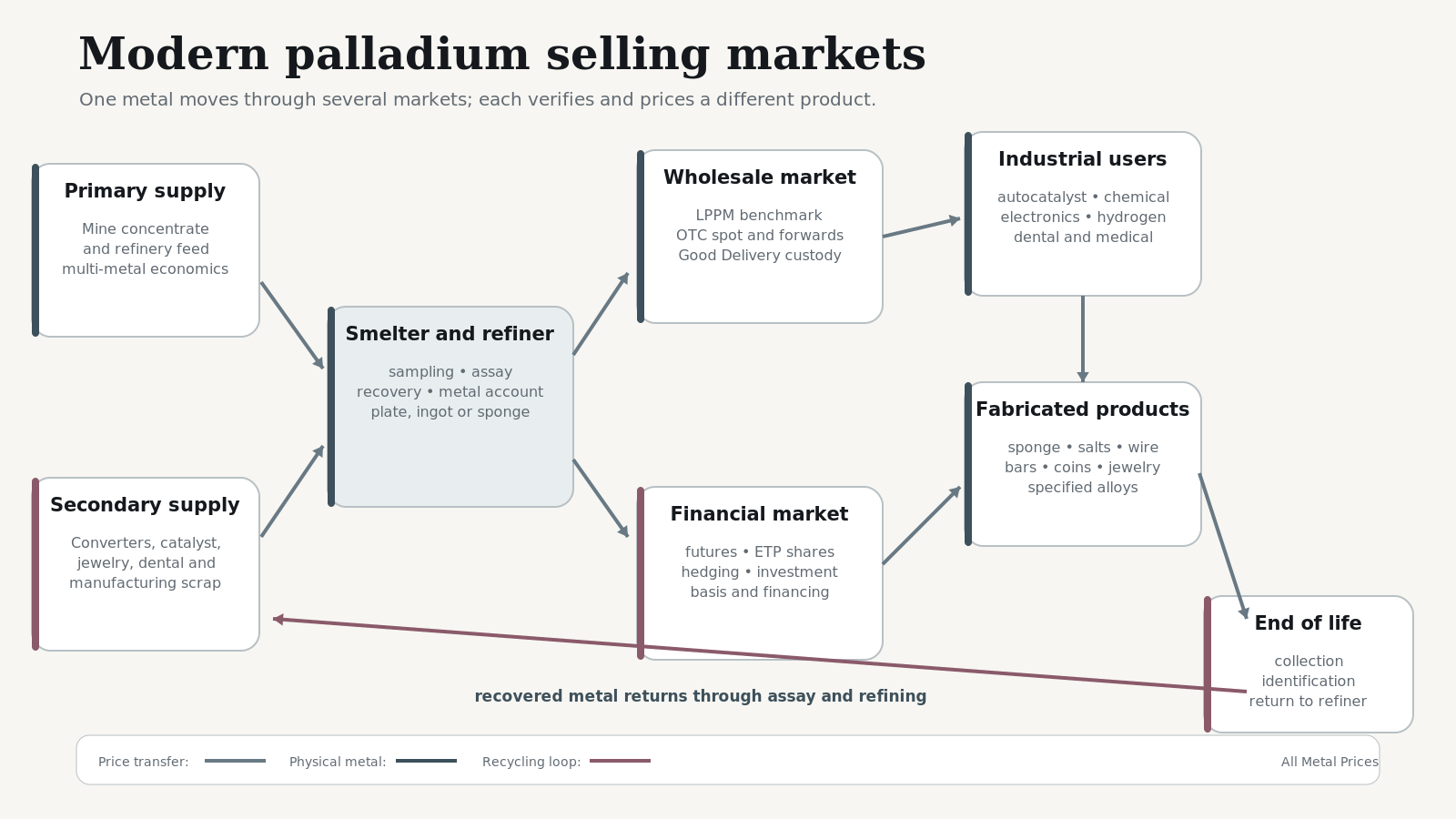
13. How a palladium sale price is calculated
The phrase “palladium price” hides several calculations. A benchmark answers a narrow wholesale question: what is an accepted quantity of palladium worth at a defined time and location? A real buyer must also decide how much palladium is present, whether it can be recovered, when the buyer will be paid, and what it costs to move the material into benchmark form.
Start with the unit
Precious metals are normally quoted per troy ounce. One troy ounce equals approximately 31.1035 grams. It is heavier than the ordinary avoirdupois ounce used for groceries. Confusing the two produces an error of almost 10 percent.
The conversion is:
fine troy ounces = fine grams ÷ 31.1034768
For a homogeneous bar or coin:
fine grams = gross weight in grams × fineness
A 31.1035-gram coin of .9995 fineness contains approximately 31.0879 grams, or 0.9995 fine troy ounce, of palladium. Market convention may describe it as a one-ounce palladium coin because the product specification guarantees at least the stated precious-metal content; sellers should read the mint specification rather than infer content from gross weight alone.
Reference price versus executable bid
A seller may encounter several reference prices:
- the LBMA Palladium Price benchmark for unallocated metal delivered in London;
- a current OTC spot quotation;
- the nearby CME futures price;
- a dealer's retail asking price;
- an ETF's indicative or published net asset value;
- a recycler's internal price sheet;
- a monthly average used in an industrial contract.
These prices are related but not interchangeable. Time stamps differ. A futures contract has a delivery month. A retail asking price includes a seller's premium. A scrap sheet may already include payable rates and expected refining costs.
The relevant question is not “Which number is highest?” It is “Which number matches the product, location, quantity, settlement date, and side of the market?”
Four common valuation paths
1. Recognized bullion coin or small bar
The buyer begins with fine-metal content and a live reference price. The bid is then adjusted for:
- recognition of the mint or refiner;
- authenticity and testing cost;
- condition and packaging;
- local resale demand;
- dealer inventory;
- shipping, insurance, and payment risk;
- any collectible premium;
- taxes and regulatory treatment.
A popular coin can sell above fine-metal value to another investor. An obscure small bar may be purchased at a discount even when genuine. A damaged package should not destroy metal value, but it may remove the premium paid by collectors who prefer sealed products.
A simplified dealer bid is:
bullion bid = fine ounces × spot reference + recoverable product premium − dealer costs and margin
The product premium can be positive, zero, or negative.
2. Palladium jewelry or dental alloy
The buyer must determine alloy composition. A hallmark or manufacturer's specification provides evidence, but heterogeneous or repaired items may require testing. Stones, steel springs, solder, and nonmetal parts are deducted.
A simplified refining bid is:
jewelry bid = net metal weight × assayed palladium fraction × payable rate × settlement price − lot charges
Other payable metals are added. A palladium-white-gold alloy may contain enough gold to dominate the valuation. Dental alloys can contain several precious and base metals.
A buyer offering an immediate fixed price usually builds assay and price risk into the spread. A refiner offering final settlement after assay may show a higher theoretical payable but take longer and impose explicit fees.
3. Catalytic converter
For one intact converter, the buyer usually uses a serial-number catalog or a model-based estimate. The offer reflects expected palladium, platinum, and rhodium content; the chance of misidentification or damage; downstream processing; and price risk until settlement.
For a bulk lot, valuation should move toward assay:
net basket value = Σ (dry mass × assay concentration for each PGM × payable rate × agreed price) − all charges
The summation matters. Palladium cannot be valued in isolation from platinum and rhodium. A buyer may hedge each metal differently or not at all.
The converter shell's gross weight is almost irrelevant to PGM value. Most of the mass is steel and ceramic. The precious metals are dispersed in tiny concentrations across a large surface area.
4. Industrial catalyst, powder, sponge, or residue
A known-grade new palladium sponge lot can trade close to wholesale terms if it comes from an accepted producer, meets specification, has full documentation, and is large enough. A spent chemical catalyst or refinery residue can require extensive sampling and process testing.
Common adjustments include:
- moisture;
- nonpayable carrier or substrate;
- minimum assay charge;
- treatment and refining charge;
- recovery or payable percentage;
- deleterious elements;
- lot size;
- financing during the assay period;
- metal return versus cash settlement;
- quotation period;
- transport and hazardous-material compliance.
A worked bullion example
Assume a seller has a recognized 1 troy ounce, .9995 palladium coin. This example uses a purely illustrative spot reference of $1,000 per troy ounce, not a live quotation.
Fine content:
1.0000 gross troy ounce × 0.9995 = 0.9995 fine troy ounce
Gross fine-metal value:
0.9995 × $1,000 = $999.50
Suppose a dealer has strong demand and bids spot plus a $20 product premium, then deducts $14 for testing, payment, and margin:
$999.50 + $20 − $14 = $1,005.50 bid
Another dealer with excess inventory might bid 3 percent below gross metal value:
$999.50 × 0.97 = $969.52 bid
Both can be rational at the same market price. The difference is product demand and dealer position, not the palladium content.
A worked catalytic-converter lot example
Assume a processor has 1,000 kilograms of dry, milled ceramic. The laboratory reports:
- palladium: 1,200 grams per metric tonne;
- platinum: 450 grams per metric tonne;
- rhodium: 180 grams per metric tonne.
Because the lot is one metric tonne, contained palladium is 1,200 grams:
1,200 ÷ 31.1034768 = 38.581 fine troy ounces of palladium
At a 95 percent palladium payable:
38.581 × 0.95 = 36.652 payable ounces
At the illustrative $1,000 price:
36.652 × $1,000 = $36,652 gross payable palladium value
Platinum and rhodium are calculated separately and added. Treatment, sampling, refining, financing, transport, and any advance are then deducted.
Changing one assumption can move the result materially. If the true palladium concentration is 1,100 rather than 1,200 grams per tonne, contained palladium falls by 3.215 ounces. At $1,000, that is $3,215 before payable deductions. This is why a dispute over sample preparation can be more important than a small change in spot price.
Price date risk
Scrap transactions can use several pricing methods:
- price locked when the lot is purchased;
- price fixed when the material arrives;
- price selected after assay;
- average of daily benchmarks over a quotation period;
- seller-directed pricing within a window;
- metal returned to an account, leaving the seller to sell later.
Each allocates risk differently. An immediate lock offers certainty but may use an estimated quantity. Pricing after assay improves quantity certainty but leaves market exposure open. A quotation-period average reduces the importance of one day's spike.
A contract should specify the benchmark, AM or PM auction where relevant, currency, time zone, pricing dates, holiday rules, and what happens if the benchmark is unavailable.
Payable percentage versus fee
Buyers often advertise a high percentage of spot. The percentage may apply to:
- gross weight;
- estimated content;
- assayed contained metal;
- recoverable metal;
- one metal but not others;
- a price already discounted from the benchmark.
The base must be explicit. “We pay 95 percent” has little meaning without it.
Compare offers using a settlement worksheet:
| Item | Buyer A | Buyer B |
|---|---|---|
| Dry net weight | ||
| Pd assay | ||
| Pt assay | ||
| Rh assay | ||
| Payable percentage by metal | ||
| Pricing benchmark and date | ||
| Treatment charge | ||
| Refining charge | ||
| Sampling/assay charge | ||
| Transport/insurance | ||
| Advance and interest | ||
| Expected final cash and timing |
The best offer is the highest credible net settlement for the same verified lot, not the most impressive isolated percentage.
Assay methods and their limits
X-ray fluorescence is fast and nondestructive, making it valuable for screening bullion, jewelry, and powders. It reads a limited depth and can be misled by plating, surface enrichment, geometry, or a nonrepresentative test point. Handheld XRF on the shell of a converter does not reveal the PGM content of the internal washcoat.
Fire assay, nickel sulfide collection, lead collection, ICP-OES, ICP-MS, and other laboratory methods can provide highly accurate results when matched to the material. Sample preparation remains decisive. Laboratories should use suitable reference materials, blanks, duplicates, and quality-control procedures.
An umpire assay clause gives buyer and seller a path when results differ. Typically, sealed samples are divided among the parties and an independent laboratory. Contract rules determine whether the umpire result replaces one result or whether the two closest assays are averaged.
Provenance and title can have monetary value
A perfectly pure bar with no credible ownership history may be harder to sell than a slightly lower-purity article with full documentation. Buyers must consider stolen property, sanctions, money laundering, tax fraud, and responsible-sourcing obligations. Catalytic converters are particularly sensitive because theft became widespread during high-price periods.
Documentation can include invoices, vehicle identification records, dismantler licenses, photographs, weight tickets, chain-of-custody logs, assay certificates, customs records, and refiner declarations. These records do not add palladium atoms. They reduce legal and reputational risk, which can improve market access and the bid.
The five numbers a seller should request
Before accepting an offer, request:
- Net eligible weight after moisture, stones, shells, or other deductions.
- Assay or assumed grade for palladium and every other payable metal.
- Payable percentage and whether it is applied to contained or recovered metal.
- Pricing basis including benchmark, date, and currency.
- Every deduction and the expected payment date.
A buyer who cannot express the calculation may still offer a fair fixed price, but the seller has no reliable way to compare it.
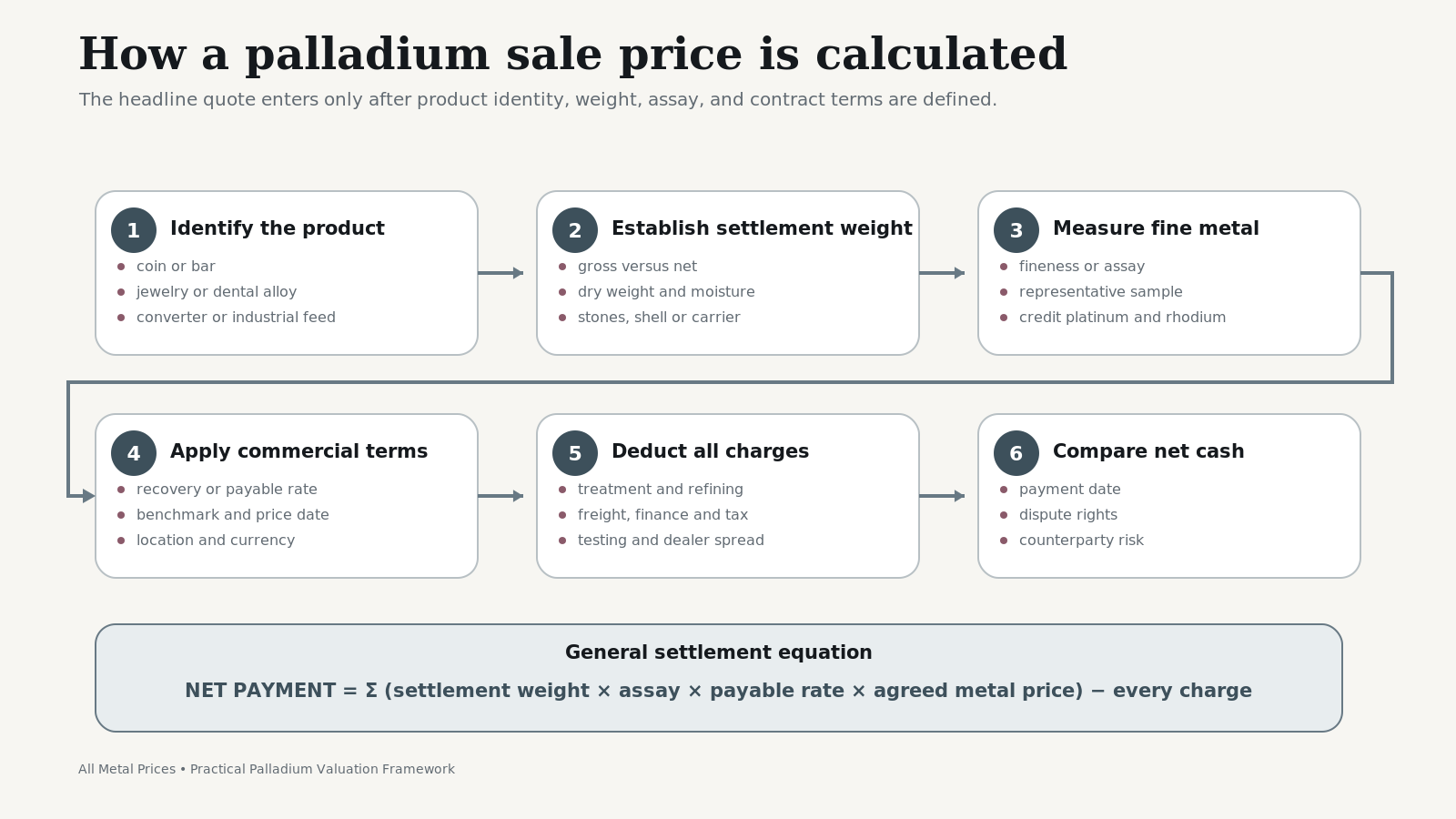
14. Responsible sourcing, sanctions, theft, and market acceptability
Palladium's route to market now includes questions that older price histories often omit: who produced it, under what conditions, whether the seller owns it, and whether counterparties may legally accept it.
Good Delivery becomes an ethical as well as technical standard
The LPPM's Good Delivery system began with technical acceptability and provenance among dealers. It now incorporates responsible sourcing. Applicants for Good Delivery or sponge accreditation must submit an audit by an approved assurance provider under the LPPM's guidance. The stated purpose is to support conflict-free and theft-free supply chains and address money laundering, terrorist financing, human rights, and other risks (LPPM 2023, 2026b).
In July 2026, the LPPM released version 5.1 of its Responsible Platinum/Palladium Guidance, with mandatory reporting under the RPG5 framework scheduled from January 2027. Refiners must map supply chains, assess risk, conduct due diligence, arrange independent assurance, and report (LPPM 2026b).
The system is not a guarantee that every upstream problem has been eliminated. Audits depend on records, risk judgment, access, and enforcement. They do create consequences: a refiner that cannot meet the standard can lose access to the most liquid wholesale network.
Russia, sanctions, and the distinction between legality and acceptability
Following Russia's invasion of Ukraine, governments imposed extensive financial and trade sanctions. Palladium was not uniformly prohibited in every jurisdiction, but payment, shipping, insurance, ownership, and counterparties became more complicated. On April 8, 2022, the LPPM suspended the Russian state-owned refiners JSC Krastsvetmet and Prioksky Plant of Non-Ferrous Metals from its Good Delivery lists (LPPM 2022).
A suspension does not make every preexisting bar chemically different. It changes market acceptability. Metal produced before a cutoff, held in another jurisdiction, or refined by a different entity may receive different treatment. Compliance depends on exact dates, parties, origin, custody, and applicable law.
This distinction matters to sellers. “Not sanctioned” does not mean every bank or dealer must accept a transaction. Firms can apply stricter risk policies. Conversely, a country-of-origin label alone may not determine legal status. Professional advice is necessary for high-value or cross-border lots.
Catalytic-converter theft
High palladium and rhodium prices increased the incentive to steal converters because they can be removed quickly and sold into fragmented scrap channels. Theft imposes costs far beyond the recovered metal: vehicle damage, lost transportation, insurance claims, emissions violations, and policing.
Governments and industry responded with seller-identification rules, payment restrictions, purchase records, serial tracking, licensing, and proof-of-ownership requirements. Requirements differ by jurisdiction and change over time. A legitimate seller should expect questions that would be unnecessary for ordinary steel scrap.
A buyer offering anonymity and immediate cash may appear convenient while exposing the seller to legal risk. Traceability protects both sides and supports higher-value refinery access.
Labor and environmental externalities
Primary palladium supply comes from operations with large physical and social footprints. Underground mines face rock falls, heat, dust, machinery hazards, and occupational disease. Smelters release sulfur dioxide and metal-bearing emissions unless controlled. Tailings and slag require long-term management. Norilsk's industrial complex has a severe pollution legacy; South African PGM mining has deep labor and community conflicts; every producing district faces water, energy, land, and closure obligations.
These costs do not always appear in the spot price. Regulation, litigation, carbon costs, labor agreements, and investor requirements can internalize part of them. Responsible sourcing is therefore not only a moral overlay; it can affect supply, capital cost, operating continuity, and brand eligibility.
Secondary supply also needs scrutiny. Recycling can reduce dependence on mining, but poorly controlled informal processing can expose workers and communities to dust, acids, fumes, and hazardous residues. A lawful chain should not merely move pollution to a less visible processor.
Provenance as market infrastructure
The historical arc is striking. Wollaston's anonymous sale created controversy because the seller and process were hidden. Modern palladium markets demand the opposite: named refiner, serial number, assay stamp, manufacture date, custody record, audited sourcing, and documented owner.
Trust moved from personal scientific demonstration to institutional traceability. The metal did not change. The acceptable story attached to it became longer.
15. The palladium market in the 2020s: record prices, reversal, and transition
The early 2020s exposed both sides of palladium's concentrated industrial market. Prices reached extraordinary nominal highs and then fell sharply as expectations changed.
Tightness and the 2020–2022 surge
Years of deficits, strong gasoline-vehicle catalyst demand, constrained mine growth, and limited immediately available stocks supported rising prices before 2020. Pandemic disruptions affected mines, recycling, vehicle production, logistics, and investor behavior. In 2021, flooding at major Nornickel mines heightened supply concern. Russia's February 2022 invasion of Ukraine then raised fears that sanctions or logistics would interrupt the world's largest national source.
Palladium briefly traded above $3,000 per ounce in 2022 in some markets. The move reflected immediate supply anxiety, not a consensus that long-run automotive demand had tripled. Once it became clear that metal continued to flow and vehicle production remained constrained by other components, prices retreated.
Battery electric vehicles alter the long-run story
A battery electric vehicle has no exhaust and therefore no conventional exhaust catalytic converter. Rapid BEV adoption reduces the future addressable market for automotive palladium. This is the central structural challenge.
The transition is not linear. Hybrid vehicles retain combustion engines and can require substantial catalyst loadings. Vehicle fleets turn over slowly. Emissions standards may tighten, increasing metal per remaining engine. Regional adoption rates differ. Internal-combustion vehicle production can remain resilient even while its global share declines.
The market therefore prices a race between falling long-run catalyst demand, near-term vehicle output, substitution with platinum, mine curtailments, and recycling supply.
Low prices can remove supply
After the 2022 peak, palladium fell below levels needed by some high-cost operations. Producers responded with mine-plan reviews, restructuring, delayed projects, and production cuts. Because mines produce metal baskets, the response depends on combined revenue. A weak palladium price can be partly offset by stronger platinum, rhodium, nickel, copper, or gold—and vice versa.
This creates a potential stabilizer. Expectations of declining demand depress price; low price forces supply cuts; cuts tighten the market before demand has fallen as far as expected. Commodity transitions rarely follow a smooth line.
The 2025 balance
Johnson Matthey estimated that palladium remained in deficit in 2025. Its May 2026 report placed 2025 primary supply at 6.589 million ounces, secondary supply at 3.135 million, and demand at 10.140 million. Automotive demand alone was estimated at 8.227 million ounces. The report projected a move toward surplus in 2026, based partly on lower automotive demand and increased recycling, while warning that investment, trade flows, and supply rationalization could alter liquidity (Johnson Matthey 2026).
These are estimates, not audited global accounts. PGM data require judgments about producer sales, inventories, recycling definitions, and regional demand. A careful reader should treat the balance as a structured model rather than a warehouse census.
New uses and the limits of diversification
Palladium remains important in chemical synthesis, electronics, hydrogen purification, medical and dental applications, and specialized alloys. Research continues into catalysts and energy technologies. These markets may grow, but replacing millions of ounces of automotive demand would require enormous scale.
Investment demand can absorb metal temporarily, especially when prices appear low relative to history. It does not create industrial consumption. ETF stocks can later return to market.
What is durable
Technologies and price leadership will change, but several market features are likely to persist:
- palladium will remain tied to a multi-metal mining basket;
- primary supply will remain geographically concentrated;
- recycling will supply a large share of the market;
- substitution will operate with engineering lags;
- acceptable provenance will matter more, not less;
- the headline price will remain a poor estimate of an unassayed scrap object's cash value.
The future may contain fewer combustion vehicles, but the stock of palladium already dispersed through vehicles, equipment, jewelry, and industrial systems will continue to generate sales for decades.
16. A practical guide to selling palladium today
This section is educational, not a live price quote or legal, tax, or investment recommendation. Laws, sanctions, and buyer terms vary by country.
Step 1: identify the product before asking for a price
Classify the material as one of the following:
- recognized bullion coin or bar;
- collectible coin or medal;
- hallmarked jewelry;
- unmarked jewelry or dental alloy;
- new industrial sponge, powder, salt, wire, foil, or catalyst;
- spent industrial catalyst or process residue;
- intact catalytic converter;
- decanned or milled converter material;
- futures, ETF shares, or another financial claim.
A buyer strong in one category may be poor in another. A coin dealer is not necessarily an assay refiner; an autocatalyst processor is not necessarily a jewelry specialist.
Step 2: preserve evidence
Do not remove packaging from a bullion product merely to prove the metal. Do not polish hallmarks. Photograph converter serial numbers before shipping. Keep purchase invoices, vehicle records, assay certificates, chain-of-custody records, and correspondence.
For industrial material, retain process descriptions, safety data, prior assays, lot weights, and sample seals. Evidence can prevent the buyer from applying the most conservative possible grade.
Step 3: establish gross and net weight
Use a calibrated scale suitable for the lot. Record units. For jewelry, weigh stones and nonmetal parts separately where practical. For powder, establish moisture procedures. For converters, distinguish whole-unit weight from decanned ceramic weight.
A bathroom scale and an online spot price are not enough for a high-value lot.
Step 4: choose the appropriate verification method
- Recognized bullion: dealer authentication plus weight and dimension checks may suffice.
- Hallmarked jewelry: hallmark review and XRF screening can support an offer; final refining may use melt assay.
- Mixed jewelry/dental: pool and assay through a specialist.
- Individual converter: obtain several catalog bids using the exact serial number.
- Bulk converter lot: request a documented sampling and assay protocol.
- Industrial catalyst: use a refiner experienced with the specific carrier and contaminants.
Ask whether testing is destructive and who owns the material if you reject the offer.
Step 5: compare net, timed offers
An offer should state:
- whether it is fixed or provisional;
- how long it remains valid;
- who pays transport and insurance;
- whether title transfers on shipment, receipt, assay, or payment;
- the benchmark and pricing date;
- every charge;
- payment timing;
- dispute procedure;
- treatment of other metals.
A fast payment can be worth accepting at a modest discount. The decision should be explicit, not hidden in an unexplained spread.
Step 6: verify the buyer
Check legal business identity, physical address, licenses where required, complaint history, insurance, and terms. For shipped material, use tamper-evident packaging and documented weights. High-value industrial lots justify site visits, financial checks, and references.
For converters, confirm that the buyer maintains ownership records and complies with local scrap laws. For bullion, confirm how funds are sent and when price locks become binding.
Step 7: understand taxes and reporting
Sales can trigger income, capital-gains, value-added, sales, withholding, customs, or business taxes. Bullion, jewelry, scrap, and securities may receive different treatment. Cross-border movement can require declarations and sanctions screening.
Keep acquisition cost and sale records. The buyer's payment statement may not contain enough information to establish tax basis later.
Red flags
- “We pay spot” without defining weight, purity, fees, or product.
- Refusal to provide a weight ticket or assay report.
- A bulk-lot sample taken only from the surface.
- A price tied to palladium while ignoring payable platinum and rhodium.
- Pressure to ship before terms are written.
- A buyer who discourages proof of ownership for converters.
- A claim that a handheld XRF reading on one point proves an entire heterogeneous lot.
- An unusually high catalog price that becomes subject to broad deductions after delivery.
- A request to misdescribe the shipment or avoid customs reporting.
A seller's minimum record
Keep one file containing photographs, weights, serials, buyer quote, price source, assay, deductions, shipment tracking, final settlement, and payment confirmation. That record is useful for disputes, taxes, insurance, and evaluating future buyers.
Frequently asked questions about selling and valuing palladium
When was palladium first sold?
Palladium was advertised for sale in London in 1803, before William Hyde Wollaston publicly acknowledged that he had isolated it. The material was offered through a Soho mineral dealer under the name palladium or “new silver.” Richard Chenevix bought and tested it, incorrectly concluding that it was an artificial platinum-mercury alloy. Wollaston disclosed his identity and method in 1805 (Chenevix 1803; Wollaston 1805; Griffith 2003).
This makes palladium unusual among elements: its commercial launch helped establish the discovery claim. The first transaction was also the first serious test of whether the product was chemically distinct.
Why is palladium called palladium?
Wollaston named the metal after Pallas, the asteroid discovered in 1802. The name linked a terrestrial discovery to a widely discussed astronomical one. The asteroid itself had been named for Pallas, a figure associated with Athena in Greek tradition. The choice was contemporary branding as well as scientific nomenclature.
Is palladium always worth more than platinum?
No. Their price relationship has reversed several times. Palladium can trade above platinum when gasoline-vehicle catalyst demand is strong and physical supply is tight. Platinum can trade above palladium when its own demand is stronger, substitution reduces palladium use, or palladium inventories become more available.
The two metals are not interchangeable by simple weight substitution. Catalyst systems require engineering, testing, certification, and supply-contract changes. Relative prices create an incentive to substitute; they do not produce an immediate one-for-one response.
Why is palladium so volatile?
Palladium combines a small physical market with concentrated mine supply, large automotive demand, slow mine development, variable recycling, and limited short-term substitution. A delay in Russian exports, a South African outage, a change in automaker purchasing, or a shift in investor inventories can therefore matter disproportionately.
Volatility can also be amplified by financing. Users may borrow metal, investors may hold exchange products, and futures positions may be liquidated without an immediate change in industrial consumption. The visible price reflects both physical conditions and the urgency of financial participants.
Does the palladium spot price tell me what my item is worth?
It provides a reference value for a defined quantity of standardized metal at a particular location and time. It does not establish the cash value of an unidentified object.
To estimate an item’s sale value, the seller still needs to know the fine-metal quantity, product form, authenticity, location, buyer’s route to market, treatment charges, recovery, settlement timing, and whether other metals are payable. A one-ounce accredited bar can trade close to wholesale metal value. A ring, dental alloy, catalyst powder, or whole converter cannot be valued by weight alone.
Why does a bullion dealer bid below spot?
The dealer must authenticate the product, finance inventory, hedge price exposure, insure it, process payment, and resell it. A retail palladium coin may also have a thinner two-way market than a common gold coin. The bid therefore reflects the dealer’s expected resale price minus costs and risk.
The relevant comparison is not the percentage of spot by itself. Compare the final cash amount, price-lock terms, shipping and insurance, payment speed, and the probability that the quoted bid will survive inspection.
How can I tell whether a palladium bar or coin is genuine?
Begin with the issuing mint or refiner, stated weight and fineness, dimensions, markings, packaging, and purchase provenance. A competent dealer may also use precision weighing, dimensional measurement, conductivity or electromagnetic testing, X-ray fluorescence, ultrasonic methods, or other instruments. No single nondestructive test is infallible in every format.
Avoid destructive testing of a collectible product before learning whether opening, scratching, drilling, or cutting it will reduce its resale value. For an unfamiliar or high-value item, use an established bullion specialist or assay office rather than relying on a photograph.
How much palladium is in a catalytic converter?
There is no universal amount. Loadings differ by vehicle model, engine, emissions standard, market, model year, catalyst design, and the relative prices of platinum-group metals when the system was engineered. Some converters contain more palladium, some rely more heavily on platinum or rhodium, and some assemblies contain multiple catalyst units.
A serial-number catalog can estimate an intact identifiable unit. Bulk material requires representative sampling and assay. Claims that “every converter contains” a fixed number of grams are not a sound basis for buying or selling.
Can an XRF analyzer determine the value of a catalytic converter?
XRF is valuable for identifying metals in many alloys and for screening certain materials. A direct handheld reading on an intact converter shell does not measure the palladium dispersed through the internal ceramic or metallic substrate. Even a reading on exposed catalyst material represents only the point or small area tested.
For a homogeneous, carefully milled lot, laboratory XRF can form part of a controlled assay program. Commercial settlement often uses validated sampling, fusion or digestion, and instrumental analysis such as ICP-OES or ICP-MS, with duplicate and umpire procedures. The sampling plan is as important as the instrument.
Should I sell a converter by serial number or by assay?
Serial-number pricing can be efficient for individual intact converters when the code is legible and the unit has not been altered. It gives the seller a known price without waiting for a refinery settlement. The buyer accepts the risk that actual recovered metal differs from the catalog estimate.
Assay-based settlement is generally more appropriate for larger, mixed, damaged, decanned, or milled lots. It can recognize the true metal content of the lot, but only if sampling is representative and deductions are transparent. Sellers should compare the guaranteed catalog total with the expected net assay settlement, including time and counterparty risk.
Is palladium jewelry easy to sell?
It is saleable, but not every jewelry store maintains an active palladium bid. A hallmarked piece can be easier to identify, particularly in markets that recognize palladium fineness standards. The strongest resale route depends on whether the object has value as branded jewelry, a designed object, a collectible, or only as recyclable alloy.
A refiner pays for recoverable metal, not retail labor or sentimental value. A specialist estate-jewelry or branded-jewelry buyer may pay more for a desirable piece. Obtain both kinds of quote before treating a well-made object as scrap.
What do palladium hallmarks mean?
A hallmark is an official or legally recognized indication that an article has been tested or certified to meet a stated fineness. In the United Kingdom, compulsory palladium hallmarking took effect in 2010 for articles above the statutory exemption weight. Common fineness marks include 500, 950, and 999, although 950 is especially familiar in jewelry (Department for Business, Innovation and Skills 2010; Hallmarking Act 1973).
A hallmark does not state the object’s exact weight, current market price, brand premium, or resale condition. It is evidence of fineness, not a complete appraisal.
Can dental palladium be sold?
Yes. Dental crowns, bridges, casting buttons, filings, and laboratory sweeps may contain palladium along with gold, silver, platinum, copper, tin, indium, gallium, cobalt, nickel, ceramic, or other materials. Visual identification is unreliable. A specialized dental refiner can pool, melt, sample, and assay the material, then credit payable metals.
For small lots, compare minimum fees and whether the buyer pays for every relevant metal. Remove biological material only in accordance with safety rules; do not burn, grind, or chemically treat dental scrap at home.
Is palladium magnetic?
Bulk palladium is weakly paramagnetic, not strongly attracted like iron. Magnet response alone cannot authenticate a product. Palladium alloys may contain other metals, plated objects can behave unpredictably, and sophisticated counterfeits can be designed to pass simple household tests.
A magnet can identify some obvious nonmatching materials, but it is a screening tool, not an assay.
Can I sell palladium through a futures contract or ETF instead of selling physical metal?
A futures contract and an exchange-traded product are financial instruments, not universal disposal routes for physical objects. Selling a futures position closes or creates a standardized exchange obligation. Selling ETF shares transfers securities through a brokerage account. Neither action automatically converts a ring, converter, powder lot, or small bar into deliverable exchange metal.
Large commercial participants may hedge physical exposure with futures while separately selling material under a refinery or supply contract. The two transactions reduce price risk only when quantities, timing, currency, and basis behavior are understood.
Is selling a catalytic converter legal?
The answer depends on jurisdiction, ownership, vehicle status, seller identity, and documentation. Many places have tightened recordkeeping, payment, licensing, and proof-of-ownership rules because converter theft became widespread. Environmental rules may also restrict removal or sale of an operating vehicle’s emissions-control equipment.
A legitimate seller should preserve the vehicle identification, title or dismantling record, seller identification, converter serial, photographs, and transaction receipt. A buyer who proposes hiding the material’s origin or bypassing required records is creating legal and payment risk.
Will electric vehicles make palladium worthless?
Battery-electric vehicles do not use combustion-engine exhaust catalysts, so a larger electric fleet reduces one major source of future palladium demand. The change is gradual rather than instantaneous. Hybrids still use catalysts; the global combustion fleet remains large; emissions standards can raise loadings; and end-of-life vehicles release previously installed palladium into recycling years after manufacture.
Lower automotive demand can also close or restructure mines, reducing supply. Palladium will retain chemical, electronic, hydrogen, medical, and other uses. The transition changes the size and composition of the market; it does not imply a mechanically predetermined price of zero.
Glossary of palladium trading and recycling terms
Allocated metal: Specific, identified metal held for an owner. The owner has title to designated plates, ingots, bars, or other units rather than only a general claim against a dealer or custodian.
Assay: A measurement of composition or fine-metal content. In commercial refining, assay usually follows a documented sampling and preparation process and may be subject to duplicate or umpire analysis.
Basis: The difference between the price of a physical transaction and a reference futures or benchmark price. Basis can reflect location, form, quality, financing, timing, and credit.
Benchmark: A published reference price produced under a defined methodology. A benchmark is an input to contracts; it is not a guaranteed bid for every object containing palladium.
Catalyst: A substance that increases the rate of a chemical reaction without being consumed in the same manner as a reactant. Palladium is used in automotive, chemical, pharmaceutical, and other catalytic applications.
Contained metal: The calculated quantity of palladium physically present in a material before applying recovery and payable terms. It is generally assay multiplied by dry or agreed settlement weight.
Decanning: Opening a catalytic-converter housing and removing its ceramic or metallic catalyst substrate for processing. Professional decanning requires dust control, ownership documentation, and safe handling.
Fine weight: The weight of pure palladium contained in an alloy or product. Gross weight multiplied by fineness gives theoretical fine weight before process loss.
Fineness: The proportion of precious metal in an alloy, usually expressed in parts per thousand. A fineness of 950 means 95.0 percent palladium by mass.
Good Delivery: A market standard covering acceptable refiner, form, weight, fineness, markings, and other requirements for wholesale plates or ingots. LPPM palladium Good Delivery metal has a minimum fineness of 99.95 percent and specified 1–6 kilogram form and markings (LPPM 2023).
Hedge: A transaction intended to offset price exposure in another position. A refiner may sell futures or forwards against metal it expects to recover, but assay, timing, and basis risks remain.
Lease rate: The cost or implied return associated with borrowing physical metal. Elevated lease rates can signal that immediately available metal is scarce relative to demand.
Loco London: Metal or a claim on metal deliverable in the London market under its conventions. Location is part of the product; palladium in another country or form may trade at a premium or discount to loco London.
Lot: A defined quantity of material treated as one commercial unit for weighing, sampling, assay, processing, and settlement.
Metal account: An account denominated in metal weight rather than currency. A refiner can credit recovered palladium ounces to a customer, who may sell, transfer, lease, or withdraw them subject to terms.
Net settlement: The final amount due after applying settlement weight, assay, recovery or payable percentage, pricing date, treatment charges, refining fees, freight, financing, taxes, and other agreed items.
Payable percentage: The share of contained or recovered metal for which the buyer pays. It may incorporate expected process loss and commercial margin. It must be interpreted together with all fees.
PGM: Platinum-group metal. The six elements are platinum, palladium, rhodium, ruthenium, iridium, and osmium. Commercial materials frequently contain more than one.
Price lock: An agreement fixing the reference price or final bid for a stated quantity and period. The trigger may be a phone confirmation, written acceptance, receipt, assay, or another event defined by the buyer.
Quotation period: The date or average of dates used to price metal under a supply or refining contract. It can occur before shipment, during processing, or after final assay.
Recovery: The proportion of palladium entering a process that is ultimately captured in a saleable or creditable product. Recovery differs from assay and from payable percentage.
Secondary supply: Palladium returned from used products, manufacturing scrap, spent catalysts, residues, and other recycled sources, as distinct from current mine production.
Sponge: A porous, high-surface-area form of refined palladium used as an industrial feedstock. It is not the same retail product as a stamped bullion bar.
Spot price: The price for prompt transaction under specified wholesale conventions. News sites often display an indicative spot quotation, while an executable bid depends on counterparty, volume, form, and location.
Substrate: The ceramic honeycomb, metallic foil, pellet, carbon, alumina, or other carrier on or in which catalytic material is dispersed.
Toll refining: Processing in which the customer retains ownership of the contained metal and pays treatment and refining charges. The refiner returns or credits recovered metal rather than buying the feed outright.
Troy ounce: The precious-metals unit equal to 31.1034768 grams. It is heavier than the 28.3495-gram avoirdupois ounce used for many ordinary goods.
Unallocated metal: A contractual claim on a provider for a quantity of metal without ownership of specific bars or plates. It is generally more convenient for trading but introduces counterparty exposure.
Umpire assay: An independent analysis used to resolve a difference between the assays of seller and buyer under agreed tolerance and settlement rules.
Washcoat: A high-surface-area layer applied to a catalyst substrate that carries catalytic components, including platinum-group metals.
XRF: X-ray fluorescence, a nondestructive elemental-analysis technique. It is useful for many alloy and screening tasks but reads only the material reached by the beam and does not solve nonrepresentative sampling.
Conclusion: palladium was made saleable, not merely discovered
Palladium's commercial history begins with a paradox. The metal was present in ores and alloys long before chemists isolated it, yet its first recognized value appeared only after a refiner transformed an troublesome residue into a named, testable product. Wollaston's anonymous 1803 sale did more than introduce a new element. It revealed the steps by which matter becomes a commodity: separation, naming, verification, standardization, distribution, and acceptance.
Those steps repeated at larger scales. Nineteenth-century refiners turned tiny fractions of platinum ore into specialist chemicals and alloys. Integrated mines converted nickel-copper and PGM deposits into accountable metal baskets. Automakers translated emissions law into multi-million-ounce demand. London dealers defined acceptable wholesale plates and ingots. Futures exchanges standardized financial exposure. Mints and trusts gave private investors recognizable claims. Hallmarking offices made jewelry fineness legible. Recyclers built sampling and metallurgical systems capable of finding valuable grams dispersed through tons of end-of-life material.
Each system solved a different problem, and none erased the others. A palladium benchmark solves price reference for standardized wholesale metal. It does not identify an alloy, authenticate a coin, grade a converter, establish title, or recover metal from ceramic. An XRF reading can help identify a ring but cannot represent an unsampled bulk lot. A hallmark supports a fineness claim but does not preserve retail workmanship in a scrap bid. A futures hedge manages one price exposure while leaving assay, recovery, timing, and basis risks intact.
This is why “What is palladium worth?” is incomplete. The commercially useful question is: What exactly is being sold, how will its palladium be proved, and where can the buyer resell or use it? The answer determines whether value is realized through a collector premium, a dealer spread, a hallmark, a Good Delivery chain, an industrial specification, a serial catalog, a laboratory assay, a refinery metal account, or a securities market.
The modern palladium market also shows how regulation can create and reshape a commodity. Vehicle-emissions rules generated the demand system that made palladium strategically important. Anti-theft laws changed the documentation required to sell converters. Responsible-sourcing rules expanded the meaning of acceptable refined metal. Sanctions and corporate policies separated legal origin from market acceptability. The transition toward battery-electric vehicles is now altering the largest demand category, while recycling returns metal installed in earlier decades.
No single trend decides the outcome. Palladium is a co-product of multi-metal mines, so supply does not follow its own price neatly. Substitution responds to relative prices but requires engineering time. Recycling grows with collection economics and the age of the vehicle fleet, not simply with today's spot quote. Investors can withdraw metal from industrial circulation and later release it. Geographic concentration can turn administrative delay into physical scarcity.
For sellers, the enduring lesson is modest but valuable. Preserve identity. Preserve provenance. Measure weight correctly. Match the assay to the material. Ask how the price date is chosen. Compare the final net settlement rather than a promotional percentage. Credit every payable metal. Put sampling and dispute rules in writing. The history of palladium is, in large part, the history of institutions built to replace uncertainty with evidence. A seller receives the best defensible price when the evidence travels with the metal.
Research method and editorial standards
This paper was written as a transaction-centered history rather than a general chronology of the element. Research began with the 1803–1805 discovery dispute and followed the institutions that allowed palladium to be identified, transferred, priced, financed, fabricated, hallmarked, and recovered. Priority was given to primary scientific papers, government publications, market-rule documents, securities filings, mint records, scholarly books and journals, and technical reviews.
Historical statements were checked against more than one source where the literature contains differing emphases. Modern market data were treated as estimates rather than exact global inventories. Industry balance reports combine company disclosures, trade data, surveys, modeling, and judgment; they can be revised. The paper therefore gives the date and source of time-sensitive figures and avoids presenting a forecast as a permanent fact.
Commercial examples are illustrative. They demonstrate formulas and deductions but are not current bids. No hypothetical spot price, assay, recovery, or fee should be used to value a real lot without replacement by documented transaction terms. Legal, tax, sanctions, hallmarking, and converter-ownership requirements vary by jurisdiction and can change.
The article distinguishes confirmed facts from inference. Where a source documents an event but not a participant's private motive—for example, Wollaston's decision to sell anonymously—the text presents plausible interpretations as interpretations. It also separates benchmark metal from consumer objects and financial claims, because collapsing these categories produces misleading valuations.
All Metal Prices should review the market-balance section, benchmark administration, Good Delivery and responsible-sourcing rules, sanctions references, mint programs, and legal guidance at least annually. Substantive revisions should carry a visible “last reviewed” date. Corrections should identify what changed and why.
References
abrdn Palladium ETF Trust. 2026. Annual Report and Form 10-K for the Fiscal Year Ended December 31, 2025. U.S. Securities and Exchange Commission. https://www.sec.gov/edgar/browse/?CIK=1459862
Bezuidenhout, Andries, and Sakhela Buhlungu. 2011. “From Compounded to Fragmented Labour: Mineworkers and the Demise of Compounds in South Africa.” Antipode 43 (2): 237–263. https://doi.org/10.1111/j.1467-8330.2010.00758.x
British Hallmarking Council. 2012. Annual Report and Accounts 2011. London: British Hallmarking Council. https://www.gov.uk/government/organisations/british-hallmarking-council
Butler, Jonathan. 2006. “Pass-the-Parcel—Russian Style.” The Alchemist, no. 42. London Bullion Market Association. https://www.lbma.org.uk/alchemist/issue-42/pass-the-parcel-russian-style
Canadian Encyclopedia. 2006. “Sudbury.” Last edited March 4, 2015. https://www.thecanadianencyclopedia.ca/en/article/sudbury
Capps, Gavin. 2012. “A Bourgeois Reform with Social Justice? The Contradictions of the Minerals Development Bill and Black Economic Empowerment in the South African Platinum Mining Industry.” Review of African Political Economy 39 (132): 315–333. https://doi.org/10.1080/03056244.2012.688803
Cawthorn, R. Grant. 2010. “The Platinum Group Element Deposits of the Bushveld Complex in South Africa.” Platinum Metals Review 54 (4): 205–215. https://doi.org/10.1595/147106710X520222
Chenevix, Richard. 1803. “Enquiries Concerning the Nature of a Metallic Substance Lately Sold in London, as a New Metal, under the Title of Palladium.” Philosophical Transactions of the Royal Society of London 93: 290–320. https://doi.org/10.1098/rstl.1803.0012
CME Group. 2026a. “Palladium Futures and Options.” Accessed August 24, 2026. https://www.cmegroup.com/markets/metals/precious/palladium.html
CME Group. 2026b. “Palladium Futures Contract Specifications.” Accessed August 24, 2026. https://www.cmegroup.com/markets/metals/precious/palladium.contractSpecs.html
Department for Business, Innovation and Skills. 2010. Palladium Hallmarking: Guidance on the Hallmarking Act 1973 (Application to Palladium) Order 2009. London: UK Government. https://www.gov.uk/guidance/hallmarking-in-the-uk-consumer-protection
European Commission. 2000. Directive 2000/53/EC of the European Parliament and of the Council on End-of-Life Vehicles. Official Journal of the European Communities L 269. https://eur-lex.europa.eu/legal-content/EN/TXT/?uri=CELEX:32000L0053
ETFS Palladium Trust. 2010. Registration Statement and Prospectus. U.S. Securities and Exchange Commission. https://www.sec.gov/Archives/edgar/data/1459862/000119312510000771/ds1a.htm
Fogg, Bruce J., and John E. Molinari. 1976. “Dental Uses of Palladium.” Platinum Metals Review 20 (1): 15–20. https://technology.matthey.com/
Garside, Melissa. 2026. “Palladium Mine Production Worldwide by Country.” Statista. Accessed August 24, 2026. https://www.statista.com/statistics/273647/global-mine-production-of-palladium/
Gemological Institute of America. 2019. “Palladium: An Increasingly Popular Jewelry Metal.” GIA Research & News. https://www.gia.edu/
Gregory, Paul R., and Valery Lazarev, eds. 2003. The Economics of Forced Labor: The Soviet Gulag. Stanford, CA: Hoover Institution Press. https://www.hoover.org/research/economics-forced-labor-soviet-gulag
Griffith, W. P. 2003. “The First Advertisement for Palladium.” Platinum Metals Review 47 (4): 175–183. https://doi.org/10.1595/003214003X474175183
Hagelüken, Christian. 2012. “Recycling the Platinum Group Metals: A European Perspective.” Platinum Metals Review 56 (1): 29–35. https://doi.org/10.1595/147106712X611733
Hallmarking Act 1973. 1973 c. 43. United Kingdom. https://www.legislation.gov.uk/ukpga/1973/43/contents
International Platinum Group Metals Association. 2026. “Applications of Platinum Group Metals.” Accessed August 24, 2026. https://ipa-news.com/
Johnson Matthey. 2009. Platinum 2009. Royston, UK: Johnson Matthey. https://matthey.com/products-and-markets/pgms-and-circularity/pgm-market-reports
Johnson Matthey. 2026. PGM Market Report, May 2026. London: Johnson Matthey. https://matthey.com/products-and-markets/pgms-and-circularity/pgm-market-reports
Karim, S., Y. Ting, and coauthors. 2021. “Recycling Pathways for Platinum Group Metals from Spent Automotive Catalyst: A Review.” Journal of Cleaner Production 327: 129523. https://doi.org/10.1016/j.jclepro.2021.129523
Kim, Chang-Ha, Seung-In Woo, and Seung-Hyun Jeon. 2000. “Recovery of Platinum-Group Metals from Recycled Automotive Catalytic Converters by Carbochlorination.” Industrial & Engineering Chemistry Research 39 (5): 1185–1192. https://doi.org/10.1021/ie9905355
London Platinum and Palladium Market. 2014. “New Platinum and Palladium Price Benchmarks Launched.” https://www.lppm.com/
London Platinum and Palladium Market. 2022. Responsible Platinum/Palladium Guidance, Version 4. London: LPPM. https://www.lppm.com/responsible-sourcing/guidance
London Platinum and Palladium Market. 2023. Good Delivery Rules for Platinum and Palladium Plates and Ingots. London: LPPM. https://www.lppm.com/good-delivery/good-delivery-rules
London Platinum and Palladium Market. 2026a. “A Brief History of the LPPM.” Accessed August 24, 2026. https://www.lppm.com/a-brief-history-of-the-lppm
London Platinum and Palladium Market. 2026b. “LBMA Platinum and Palladium Price Administration and Responsible Sourcing Updates.” Accessed August 24, 2026. https://www.lppm.com/
Maier, Wolfgang D., Sarah-Jane Barnes, and David I. Groves. 2013. “The Bushveld Complex, South Africa: Formation of Platinum-Palladium, Chrome- and Vanadium-Rich Layers via Hydrodynamic Sorting of a Mobilized Cumulus Mush.” Mineralium Deposita 48: 395–411. https://doi.org/10.1007/s00126-012-0436-1
McDonald, Donald, and Leslie B. Hunt. 1982. A History of Platinum and Its Allied Metals. London: Johnson Matthey. https://technology.matthey.com/books/a-history-of-platinum-and-its-allied-metals
Nassar, Nedal T., T. E. Graedel, and E. M. Harper. 2015. “By-Product Metals Are Technologically Essential but Have Problematic Supply.” Science Advances 1 (3): e1400180. https://doi.org/10.1126/sciadv.1400180
National Institute of Standards and Technology. 2024. “SI Units: Mass—The Troy Ounce.” https://www.nist.gov/pml/owm/si-units-mass
Nobel Prize. 2010. “The Nobel Prize in Chemistry 2010: Palladium-Catalyzed Cross Couplings in Organic Synthesis.” https://www.nobelprize.org/prizes/chemistry/2010/summary/
Nornickel. 2023. “History of the Norilsk Industrial District.” https://www.nornickel.com/company/history/
Nornickel. 2025. Annual Report 2024. Moscow: MMC Norilsk Nickel. https://ar2024.nornickel.com/
Organisation for Economic Co-operation and Development. 2016. OECD Due Diligence Guidance for Responsible Supply Chains of Minerals from Conflict-Affected and High-Risk Areas. 3rd ed. Paris: OECD Publishing. https://doi.org/10.1787/9789264252479-en
Royal Canadian Mint. 2006. Annual Report 2005. Ottawa: Royal Canadian Mint. https://www.mint.ca/en/company/reports
Royal Society of Chemistry. n.d. “Palladium: Element Information, Properties and Uses.” Accessed August 24, 2026. https://www.rsc.org/periodic-table/element/46/palladium
Sibanye-Stillwater. 2026a. “Stillwater and East Boulder Operations.” Accessed August 24, 2026. https://www.sibanyestillwater.com/business/americas/pgm-operations-americas/stillwater-east-boulder/
Sibanye-Stillwater. 2026b. Integrated Report 2025. https://www.sibanyestillwater.com/news-investors/reports/annual/
Sprott Asset Management. 2026. “Sprott Physical Platinum and Palladium Trust.” Accessed August 24, 2026. https://sprott.com/investment-strategies/physical-bullion-trusts/platinum-and-palladium/
U.S. Environmental Protection Agency. 1974. Consultant Report of the Committee on Motor Vehicle Emissions: Evaluation of Catalytic Converters. Washington, DC: EPA. https://nepis.epa.gov/
U.S. Environmental Protection Agency. 1986. Aftermarket Catalytic Converters: Guide to Their Purchase, Installation, and Use. Washington, DC: EPA. https://nepis.epa.gov/Exe/ZyPURL.cgi?Dockey=9101NNNC.TXT
U.S. Environmental Protection Agency. 1991. What You Should Know About Using, Installing, or Buying Aftermarket Catalytic Converters. Washington, DC: EPA. https://nepis.epa.gov/
U.S. Geological Survey. 2003. “Platinum-Group Metals.” In Minerals Yearbook 2002. Reston, VA: U.S. Geological Survey. https://pubs.usgs.gov/myb/vol1/2002/plati.pdf
U.S. Geological Survey. 2026a. “Platinum-Group Metals Statistics and Information.” https://www.usgs.gov/centers/national-minerals-information-center/platinum-group-metals-statistics-and-information
U.S. Geological Survey. 2026b. Mineral Commodity Summaries 2026. Reston, VA: U.S. Geological Survey. https://doi.org/10.3133/mcs2026
United States Mint. 2026. “American Eagle Palladium Bullion Coins.” Accessed August 24, 2026. https://www.usmint.gov/coins/coin-medal-programs/american-eagle/palladium-bullion
Usselman, Melvyn C. 2015. Pure Intelligence: The Life of William Hyde Wollaston. Chicago: University of Chicago Press. https://press.uchicago.edu/ucp/books/book/chicago/P/bo19780069.html
Vale. 2023. “Sudbury Operations and Nickel-Copper-PGM Processing.” https://www.vale.com/canada
White, Gregory L. 2002. “A Mismanaged Palladium Stockpile Was Catalyst for Ford's Write-Off.” Wall Street Journal, February 6, 2002. https://www.wsj.com/articles/SB1012945367101516160
Wollaston, William Hyde. 1805. “On the Discovery of Palladium; with Observations on Other Substances Found with Platina.” Philosophical Transactions of the Royal Society of London 95: 316–330. https://doi.org/10.1098/rstl.1805.0024
World Platinum Investment Council. 2026. “Platinum and Palladium Market Data and Substitution Research.” Accessed August 24, 2026. https://platinuminvestment.com/
Related guides and calculators
Apply the history to a current question
This history explains how the market developed. To value an item, use a current reference price, verified weight and purity, and comparable buyer terms.